
Guest Post by Janet Daniels

I met Amy Cherrix at Simmons University in 2008, when we began our master’s programs through the Center for the Study of Children’s Literature. After completing a Master’s degree in Children’s Literature, Amy worked as an editor at Houghton Mifflin Books for Young Readers. Later, she served as the children’s book buyer at Malaprop’s Bookstore in Asheville, NC (Yay, Indie Bookstores!).
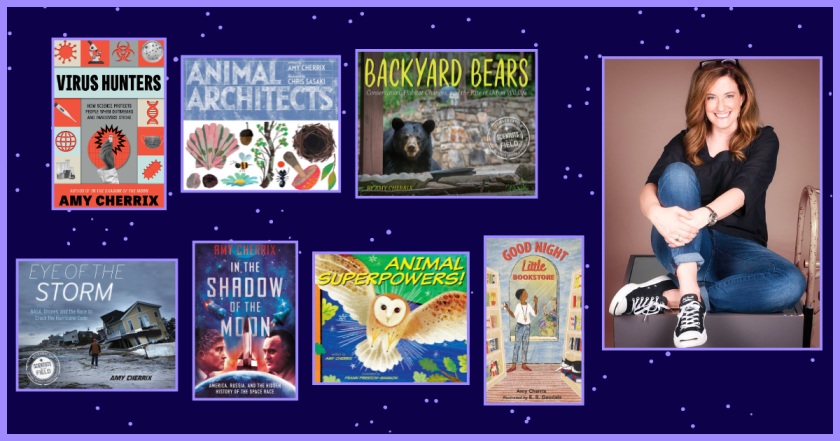
Then Amy began writing for young readers. To date, she has written seven books:
- Two for the Scientists in the Field series:
- Two works of middle grade nonfiction:
- Two nonfiction picture books about amazing animals:
- And a delightful picture book ode to independent bookstores: Good Night, Little Bookstore
Janet: Amy, welcome to the Writers’ Rumpus blog! What inspired you to write for children and young adults?
Amy: I decided to change careers in my mid-30s while living in Los Angeles and working in the film and television business. I felt disenchanted with my job and my career path. I woke up on my 36th birthday at the exact minute I was born and vowed to myself that before the sun set that day, I would take action to change my life.
I asked myself what I would do if I could do anything?
The answer was writing. I’d been happiest when I was writing–as the high school newspaper editor or on English or geography assignments. Writing was fun and felt natural to me. (Why I didn’t consider it as a career path at the time, I have no idea.)
Also, around this time, my grandmother’s house flooded. We lost every piece of our family’s memorabilia, including my collection of children’s books. I grieved those books and was fascinated by how much their loss impacted me. I wanted to understand that connection. So after a lot of soul-searching on that fateful birthday, I decided to find the answers by going back to school and earning a master’s degree in children’s literature from Simmons University.
Janet: So, how did you start writing for children?
Amy: I was working in-house at Houghton Mifflin and pitched the idea for Eye of the Storm because there were no books about meteorology in their Scientists in the Field series. I had to jump through a lot of hoops to reassure the acquisition committee that I could do it. Ultimately, they agreed.
A few years later, I’d moved back to my hometown of Asheville, North Carolina and learned that the city had a booming urban and suburban black bear population. My neighbors and I were having to figure out how to safely share space with a lot of black bears.
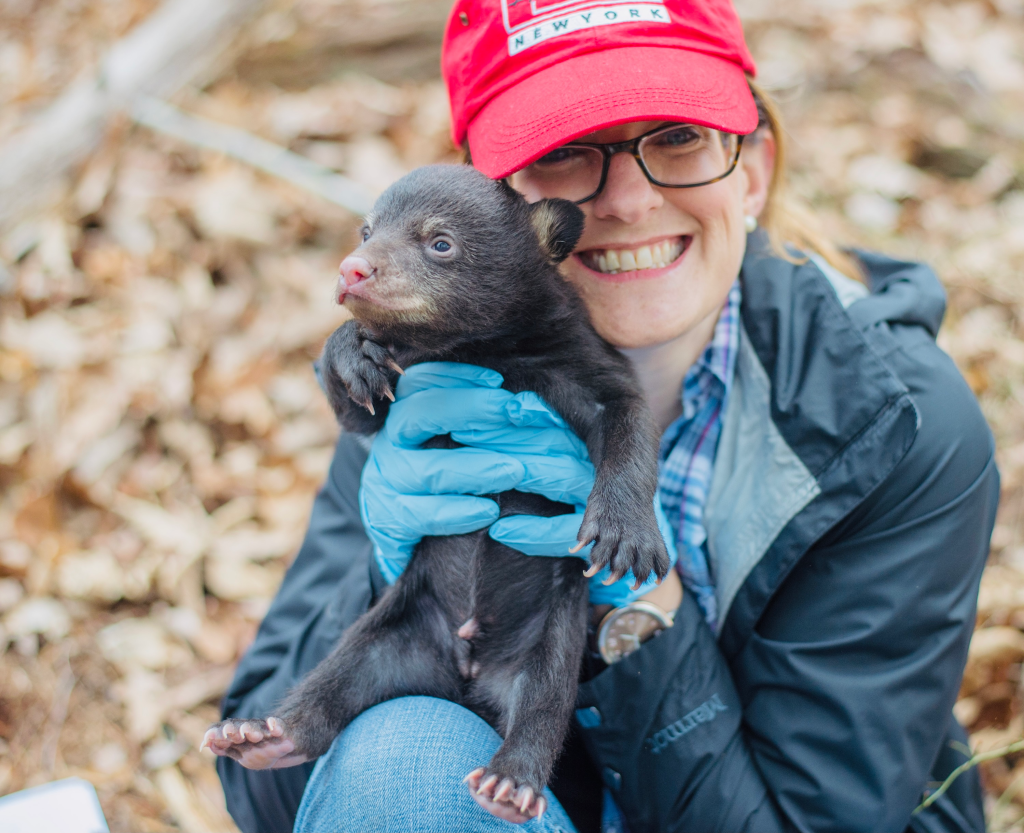
Fascinated, I wrote Backyard Bears, to tell the story of the scientists and citizen scientists working together to find a solution. I was invited to help with the bear study, and on one occasion was allowed to hold a tiny wild bear cub. It was one of the best moments of my life.
Janet: Could you tell me about your two other long-form nonfiction books?
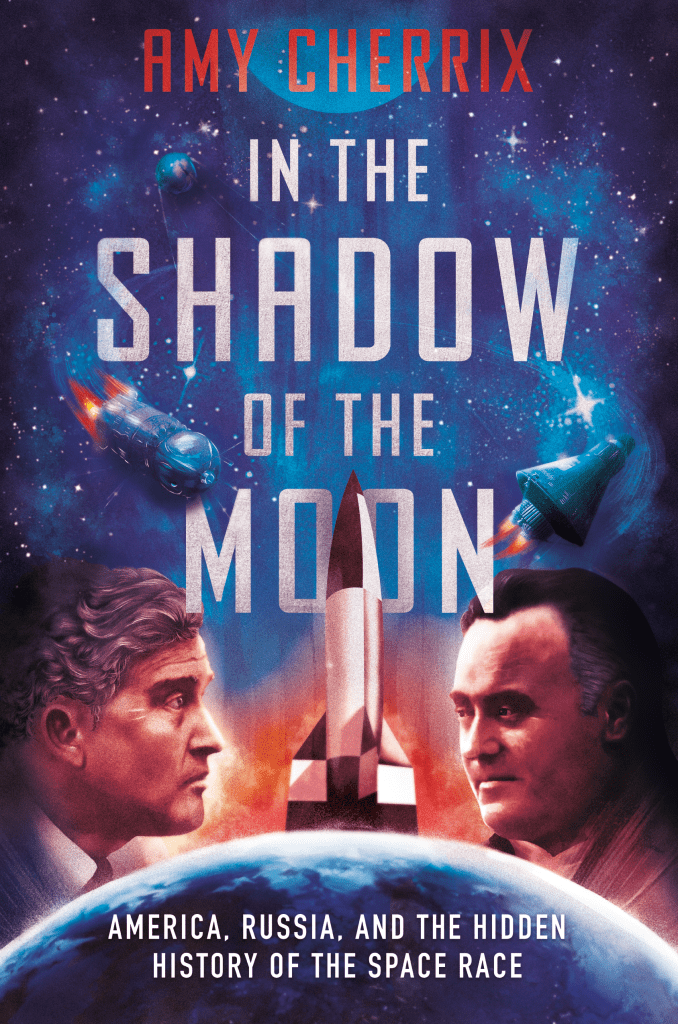
Amy: The idea for In the Shadow of the Moon arrived one night as I was falling asleep watching PBS. I thought I heard the narrator say something like, “The mastermind of the Apollo Program was a former Nazi.” The next day, I woke up and had to know if I’d heard correctly. A basic Google search confirmed it was true.
Dr. Werner von Braun, the engineer responsible for the Apollo moon program, was a former Nazi Party member, a former member of Hitler’s SS. What’s more, the United States knew these facts when they brought him to the US illegally, after World War II, in order to keep his scientific knowledge and missile designs out of the hands of the Russian government.
I knew I had to write the story for young readers.
Von Braun’s story soon led me to Sergei Korolev, the mastermind behind the Soviet space program during the space race. Korolev’s life was even more compelling because he had been falsely imprisoned by Joseph Stalin during the Purges and almost died after years of abuse in the gulag labor camp system. But once the US government had procured von Braun to build its missiles, the Soviets suddenly decided to spring Korolev out of jail. They needed someone to compete with Von Braun. The story is so epic, it’s Shakespearean.
Janet: How long did it take you to research and write this fascinating story?
Amy: It took me about two years to write this book. The research was intense. I interviewed Cold War historians, spaceflight experts, and traveled to Germany for 10 days. The trip was both inspiring and harrowing because the birth of the American space program is tied to the missiles von Braun designed and had built in a Nazi concentration camp by forced labor during World War II. I visited the camp and will never forget what it was like to tour the tunnels where the missiles were built, and how so many suffered and died in their creation.

Amy visited the US Space and Rocket Center in Huntsville, AL, while researching In the Shadow of the Moon.
Janet: What was the hardest part of writing the book?
Amy: Making peace with the past. The research led me to some very dark places, and forced me to wrestle with the fact that the golden age of space travel is rooted in one of the darkest, most horrific times in human history. I believe that if we are going to celebrate the space program, and celebrate America’s achievement as the first country to reach the moon, we must also acknowledge that it came at an impossibly high cost. I wanted to show readers the evidence and let them draw their own conclusions.
Janet: And what came next?
Amy: After In the Shadow of the Moon, I didn’t know what I was going to write, but in March of 2020, a new book idea found me.

As the COVID-19 pandemic started, I was trying to make sense of what was happening and read every book I could get my hands on about the history of pandemics. Time and time again, I saw how science had prevailed during some of the worst outbreaks ever to strike humankind.
So I wrote Virus Hunters to parachute young readers into some of those outbreaks. I wanted to show how public health professionals, whose names readers have probably never heard, have changed the course of history and saved countless lives.
Janet: Were you able to go to the CDC?
Amy: Yes! I visited the Centers for Disease Control and Prevention (CDC) in Atlanta and interviewed virologists, microbiologists, and officers in the Epidemic Intelligence Service. The EIS is the agency’s elite squad of epidemiologists who conduct surveillance on outbreaks and pandemics around the world, to figure out how to stop them in order to save lives.
At the CDC, I met so many extraordinary people! When you ask them why they do this work, overwhelmingly, the majority of scientists will tell you it’s because they have always wanted to be a part of something larger than themselves. They do not seek the spotlight. I wanted young readers to know that even if we can’t see the important work these people do, they are quietly working behind the scenes for the betterment of humankind. And I hope the book strikes a chord for young people who might consider a career in public health.
Janet: Let’s talk about your other books. You’ve also written picture books about animals. How did those come about?
Amy: A book idea usually starts because I’m very curious or passionate about something. One of my biggest influences is the natural world.
Let me be honest, I am not a naturally outdoorsy person. As much as I wax poetic about my love of nature, you’re not going to find me hiking the Appalachian Trail, scaling a rock face, or pitching a tent by the river for a weekend. It’s just not my vibe, but I’m fascinated by the nature and its creatures.
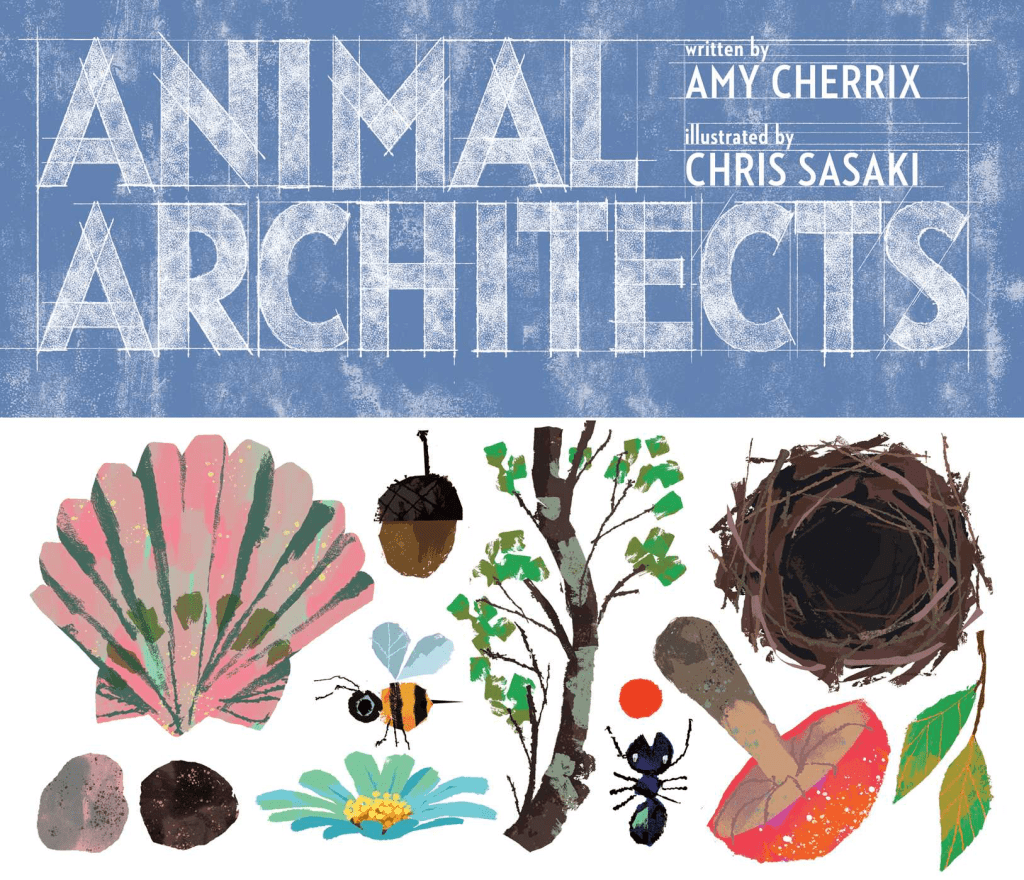
When I was writing my picture book, Animal Architects, I wanted to celebrate some of the incredible things animals build in nature like the Great Barrier Reef and prairie dog towns that span many miles. I’ve always loved David Attenborough’s nature documentaries. I admire his distinctive whispered delivery. It makes you feel so close to the subject, and so I knew I wanted to create that intimacy between the text, its illustrations, and the reader.
Janet: What do you want to show children with that book?
Amy: I wanted to inspire a sense of wonder in the natural world. I think that’s how we save it. We have to be honest about the impacts of global warming and climate change, but we can’t raise a generation of eco-warriors who are hopeless. I want children to be inspired by the natural world. I want them to be hopeful about the possibilities, and show them, yes, things are bad, but look over here. This is what we’re trying to save!
I think by informing and entertaining kids within an immersive reading experience, they can better identify with these creatures.
Janet: And then you wrote a second nonfiction picture book about animals!
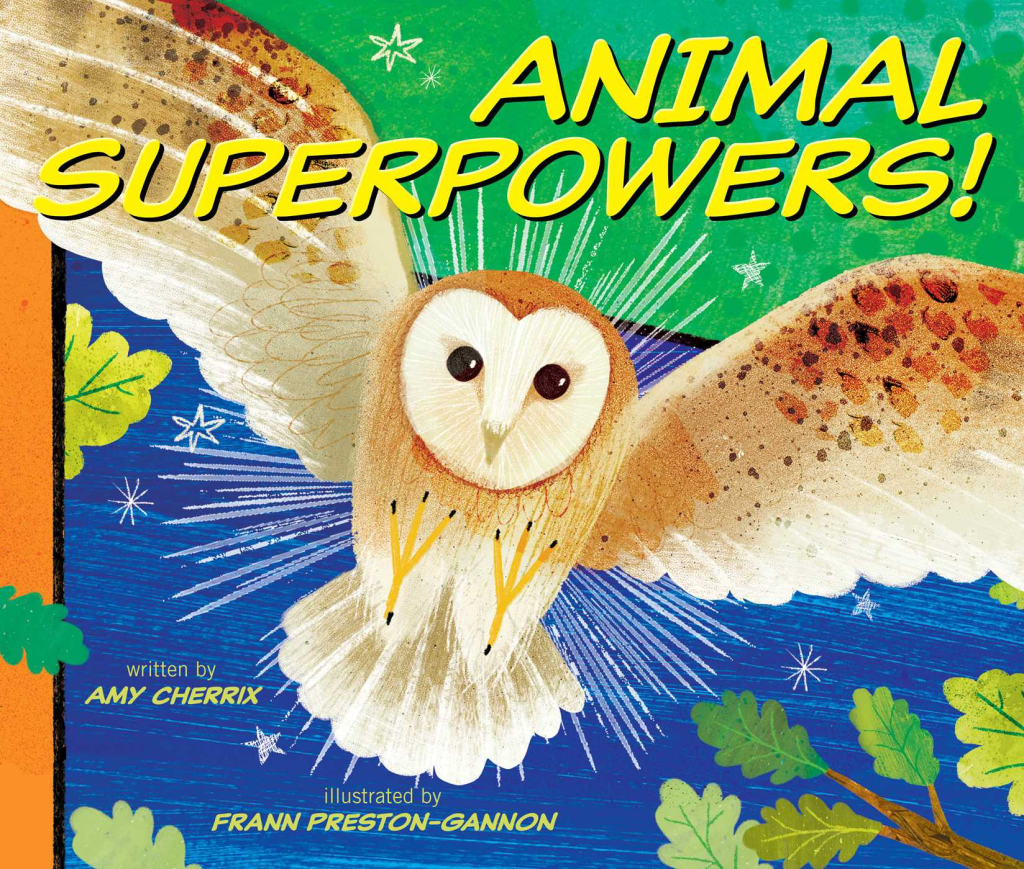
Amy: Yes, my second book about animals is Animal Superpowers! I wanted to celebrate just how extraordinary animals are by showing their various adaptations as “superpowers.” For example, there’s a snapping shrimp that uses its plus-sized claw to fire a deadly bubble at its prey.
Janet: That’s the whole reason it has a huge claw?
Amy: Yeah, it’s a basically deadly bubble blower! How cool is that?
Janet: So cool! What is next for you?
Amy: My next picture book is The United States of Dinosaurs and Other Prehistoric Animals: 50 of America’s Wildest and Weirdest Bygone Beasts (Odd Dot/Macmillan, 2027). It’s a time-traveling tour of prehistoric USA that introduces the dinosaurs and other prehistoric animals that once roamed the land we call home. We’ll visit famous (or surprising) places where fossils have been found. And some of them could be closer to you than you think . . . maybe in your own backyard.
Janet: Bonus question – Where can people find you?
Amy: People can find me online at the following sites:
- Website: amycherrix.com
- Instagram: @AmyCherrix
- YouTube: @AmyCherrix
Janet’s note: Amy’s books have been awarded many stars from various reviewers. See her accolades here: https://www.amycherrix.com/press-kit.
NOW FOR INFORMATION ABOUT THE TRIPLE GIVEAWAY! Amy is graciously offering to give away one copy each of Virus Hunters, Animal Superpowers, and Backyard Bears. To enter the giveaway, comment on this post. If you share this post, let us know and you’ll receive a second entry.
Winners will be chosen at random among those who leave comments up to 10/21. Good luck!
 WRITERS' RUMPUS
Nonfiction rocks and so do you! All of your books are amazing! So pleased you wrote about the Apollo program. I love the Moon landing, but yes, there are dark realities that need to be captured. Also, brave astronauts launched on a V-rocket…named after a bomb. Blasting off into space was just that. Linda Plevak
LikeLike
LikeLike
What an immense pleasure to read a Amy/Janet collaboration! Any, I saw Calder picking up Eye Of the Storm this week, and it made my mom/scholar heart burst with joy. Your books have resonated with my kids 💓
LikeLike
Oh my goodness, I’d love to win one of Amy’s fabulous books! Sharing this on my socials, too 🙂
LikeLike
Great interview, Janet! Loved learning more about Amy and her wonderful books. I can definitely see why holding that adorable bear cub would be a ‘best moment.’ Congratulations on all your success, Amy!
I hadn’t been on X in a long time, and I’m surprised to see how many writers are still on there. I shared this post and will do so on BlueSky, too. 🙂
LikeLike
Janet and Amy: Welcome to Writers’ Rumpus! This is a fantastic interview, and I’m so excited to learn about Amy and her amazing books. A black bear recently moved under my mother-in-law’s porch, so I’d love to read BACKYARD BEARS! I’m eager to check out the rest of your books as well, and I thank you for dedicating your investigative skills to kidlit!
LikeLike
So fun to read about the author behind a couple of the picture books I admire! Thanks for sharing. Congrats, and keep ’em coming!
LikeLike
Wow! How fun to connect the author of BACKYARD BEARS to the children’s PBs. I used this book when researching my own PB bear manuscript (currently on submission). I’m delighted to “meet” Amy here and see the far reach of her gifts as an author. Thank you for spotlighting her work.
LikeLike
Great interview and fabulous giveaway! Congratulations, Amy, on all your books! I have to check them out!
LikeLike
What a fascinating interview. Can’t wait to check out all of Amy’s books!
LikeLike
Great interview!! Big fan of Amy’s books & it’s always fun to hear the ir backstories about their creation!
LikeLike
Thanks for sharing these delightful books. The Animal Superpowers is on my TBR list and I am looking forward to the latest. Congratulations to Amy and the fabulous illustrators of her books.
LikeLike
Hi! Congrats! You are one of the free book winners. Could you email me your address so I can pass it on to Amy to send a book your way? I’m janetcdaniels@gmail.com. Best, Janet
LikeLike