
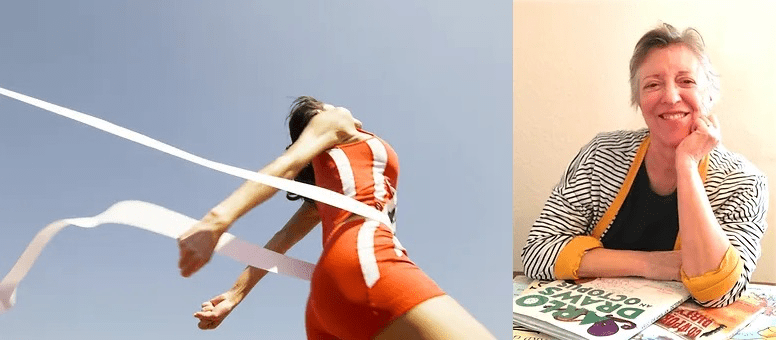
Guest Post by Lori Mortensen
I love writing picture books. I especially love writing picture book endings. They’re the icing on the cake. The cherry on top. The glorious culmination of all everything that’s gone on before. But beware. Endings can be tricky. If you’re like many writers, you may be so eager to cross the manuscript finish line; you convince yourself that the first ending that popped into your head was meant to be. Whew! You did it!
The end.
BUT DON’T DO IT.
Finding the right ending takes time, patience, and plenty of mulling.
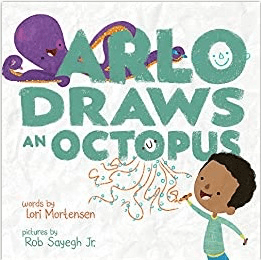
For example, when I began writing my latest picture book release, ARLO DRAWS AN OCTOPUS, I knew Arlo would try to draw and octopus and fail miserably. It was a premise that was close to my heart because I remembered drawing at the kitchen table with my older sister who always seemed to draw better than me. As I wrote my picture book, it was fun to capture Arlo’s very relatable frustration.
But as he drew, much to his surprise,
the head did not look like a head.
It looked more like a hill. A tall, silly hill.
This was not supposed to happen.

Eventually, however, I came to that pivotal moment—Now what? If I jumped to the obvious solution, Arlo would struggle to draw, then come up with an octopus masterpiece. Hooray! But this ending felt too easy. Too expected. Too boring. There had to be something better.

Pull the Bus to the Curb and Brainstorm
When I’m not sure where I’m going, I pull my metaphorical writing bus to the curb and brainstorm. “No worries, folks! We’ll reach our destination. We just need stop and look around awhile.” Hmmm . . . What else could happen? Maybe his drawing could come to life. Maybe his sister would come along and rip it up. Maybe his crayons could go on strike. (Oh-oh! Someone came up with that terrific idea already!) The possibilities were endless.
Say Ahhh
Then, I found it.
The perfect ending that gave me that Ahhh feeling as well as an unexpected, yet delightful surprise.
What was it?
After Arlo crumples up and throws away his “disaster-piece,” he goes back and gets it because he was always taught not to litter. However, when he grabs the crumpled paper and smooths it out, he discovers that it’s not his drawing. Whaat? (I loved it!) At the same time, an octopus has come along, opens his crumpled drawing, and sees that it’s not his drawing either. They look up and say, “Hey, this isn’t mine. Did you draw this?” Then, they both exclaim— “I like it!”
To my surprise, it became a story about artistic and personal redemption. The reader (and Arlo) would instantly understand that not only was Arlo’s picture “very much okay after all,” –so was he! (My younger self would have loved it!)
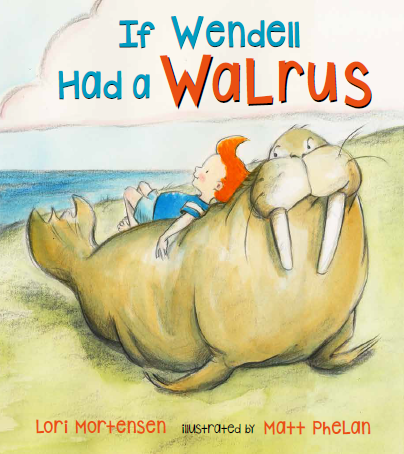
If Wendell Had a Walrus
I hit the same pivotal moment when I was writing IF WENDELL HAD A WALRUS. I knew my character, Wendell, would look at a walrus-shaped cloud and want a real one of his own. As the story progressed, he imagined all the fun he would have if he had a walrus and makes several failed attempts to get one. Then, there it was. Now what?
The quick answer was Wendell wanted a walrus, so he’d get a walrus, right? But this predictable ending felt flat. Once again, I pulled my writing bus to the curb and began to brainstorm. Maybe the walrus would find him! Maybe a walrus would simply show up on his doorstep. All fun ideas. However, when the perfect solution popped into my head, I knew it. It evoked that familiar Ahhh feeling and included an unexpected, yet delightful surprise.
What was my perfect ending?
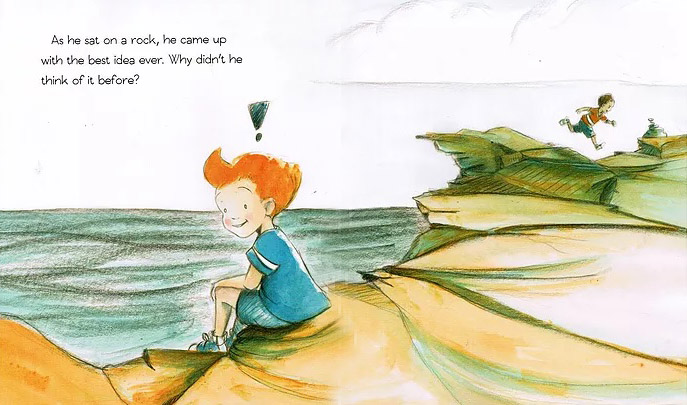
While Wendell goes about trying to find a walrus, the illustrations show another boy in the background. Eventually, the boys meet at the shore, each having tossed a bottle with a message into the ocean.
“Walrus?” says Wendell.
“Whale” says the boy.
All at once, the reader understands that both boys share a similar longing. However, as they wait for their respective creatures to respond to their messages, they do many of the things Wendell imagined he would do with his walrus. At the end, the text reads: “When would Wendell get a walrus? There was no rush.” On the last page, we see a walrus and a whale with a bottle. “You got one, too?” the walrus asks.
Wendell wouldn’t get a walrus. Whaat? He got something better. A friend. That was my solution—and I loved it!
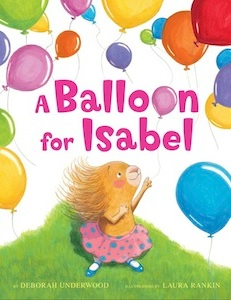
A Balloon for Isabel
One of my favorite picture book endings is in A BALLOON FOR ISABEL by Deborah Underwood. In this story, Isabel, a porcupine, desperately wanted a balloon for graduation. All the other animals were getting one. Yet, because she was a porcupine, her porcupine teacher, Ms. Quill, said absolutely not. A balloon was too dangerous. As the story progressed, Isabel and her friend, Walter, came up with all kinds of ways to remove the balloon-popping danger that failed miserably. Finally, Isabel came up with a great idea—covering her pokey quills with colorful gumdrops. It was fun and creative and other stories might have stopped right there.
But not this story.
At the end of this story, we see Isabel and her classmates all happily holding balloons. The text reads, “No porcupine at graduation was happier than Isabel.” Then, on the very last page, we see, “Except maybe one” with a picture of Ms. Quill happily holding a balloon.
It was a brilliant ending. As a reader, I’d been so focused on Isabel and her quest, that I overlooked an underlying thread that someone else might have been missing balloons as well—and much longer than Isabel. In the end, Isabel not only solved her balloon problem, she’d brought a long-awaited joy to her teacher as well. The ending had it all. That familiar Ahhh feeling and an unexpected, yet delightful surprise.
Of course, the Ahhh feeling doesn’t necessarily mean sweet. Endings can evoke a variety of feelings depending on the story—hope, gratitude, love, loss, or just a laugh. But the story makes the reader feel something.
The next time you reach that pivotal moment and ask—Now what? —pull the bus to the curb and brainstorm. When you find the right ending, you’ll lean back and say, Ahhh . . .
Perfect.
AUTHOR BIO:

Lori Mortensen is an award-winning children’s author of more than 100 books. Her books, which reviewers have praised as “stellar” “as good as it gets” and “begs to be read aloud,” have been published by such notable publishers as HarperCollins, Henry Holt, Abrams, Bloomsbury, and Peachtree. Popular releases include ARLO DRAWS AN OCTOPUS, illustrated by NYT bestselling author/illustrator Rob Sayegh, Jr., IF WENDELL HAD A WALRUS, illustrated by NYT bestselling author/illustrator Matt Phelan, COWPOKE CLYDE RIDES THE RANGE, a Bill Martin Jr. Picture Book Award Nominee and the sequel to Amazon bestseller COWPOKE CLYDE AND DIRTY DAWG, and picture book biographies NONSENSE! THE CURIOUS STORY OF EDWARD GOREY and AWAY WITH WORDS, THE DARING TRUE STORY OF EXPLORER ISABELLA BIRD.
When she’s not greeting geese at the lake, or putting her nose in a mystery, she’s tapping away at her keyboard, conjuring, coaxing, and prodding her latest stories to life. Today, she lives in the foothills of Northern California with her family and all birds that flock to her feeder—including a daredevil squirrel. To find out more about upcoming releases, teacher activities, news, and more, visit her website at www.lorimortensen.com.
 WRITERS' RUMPUS
Thanks for a great post! Finding the perfect ending is so exciting and satisfying–and difficult. I’m going to pull over to the curb for a while now…
LikeLiked by 1 person
You’re welcome! 🙂
LikeLike
I always find endings hard, so these suggestions are definitely worth a try! Thanks, Lori!
LikeLiked by 1 person
You’re welcome Marty!
LikeLike
Thanks Lori! Great info and I have to say that endings are the hardest part for me. When I finally get to one I panic. I’m grateful to my wonderful critique partners who help me brainstorm when I have more than one possible ending.
LikeLiked by 1 person
You’re welcome! Endings are hard, yet so wonderful when you find the right one. Critique partners are priceless!
LikeLike
I needed this. While reading how you solved your ending, I recognized the story I’m working on doesn’t fall into that ah ha moment. I am now rewriting it, again. Thank you.
LikeLiked by 1 person
Thanks, Charlet! Good luck with your rewrite.
LikeLike
Ah, pull the bus to the curb sounds a whole lot more fun than being stuck! Thanks for the reframe.
LikeLiked by 1 person
Yes! “Cause we’ll be on our way any minute!
LikeLike
You’ve given me much to think about Lori, thank you! There’s fun in the journey after all!
LikeLiked by 1 person
You’re welcome! There is fun in the journey. 🙂
LikeLiked by 1 person
Loved this, Lori! And what creative, heart-tugging stories! You’ve inspired me to rethink and rework some of my endings.
LikeLike
Thanks, Hilary! Good luck with your endings. 🙂
LikeLike
Thanks for sharing your process, Lori! I love to learn how to improve my writing. Best wishes, Amy
LikeLike
You’re welcome, Amy! Wishing you many happy endings. 🙂
LikeLike
Thanks for the back story, and the lovely metaphor for an often awkward part of the writing process. I need more parking spots for all my curbed buses!
LikeLike
You’re welcome Ilona! I’m all for more parking spots! 🙂
LikeLike
Thanks! I’ve been struggling with then ending of my latest pb manuscript, and you’ve inspired me to try taking it a little further with some brainstorming.
LikeLike
You’re welcome Andrea! Good luck with your brainstorming. 🙂
LikeLike