
Guest Post by Terry Farish
I was invited to present with kidlit writer and media specialist Sara Lesley Warner on the topic, Welcoming Kids to Diverse Libraries at the NH School Library Media Association. Librarians are often the link between their schools and bringing in visiting authors. The theme of the March 2024 conference was Better Together. In this spirit of better together, I spoke about how visiting authors can nurture young readers – supporting the similar goals of librarians – and contribute to a welcoming library. I talked to many authors who visit schools to ask them what they do if they’re presenting at schools with English learners. I learned a number of strategies from these authors, and other authors I talked to were interested in ideas for things they could do. This post is for you and everyone.
There are steps we can take to be inclusive with EL’s. These aren’t necessarily new. You may have been doing them all along. In the EL world, teachers say, “What’s good for EL’s is good for all students.”
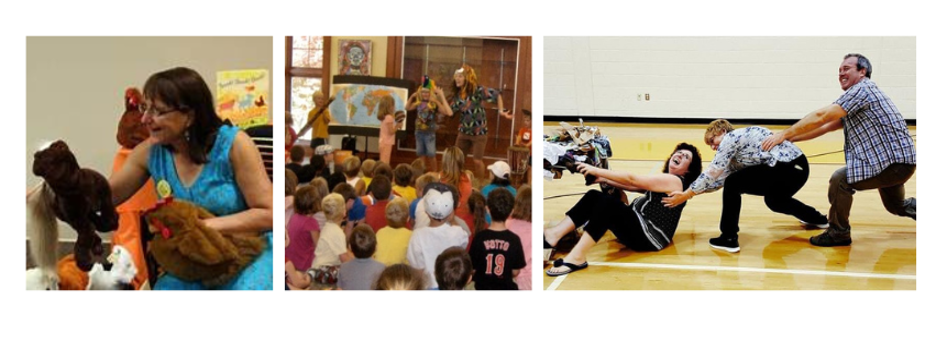
Authors Deb Bruss, Lindsay Bonilla, and Marty Kelley
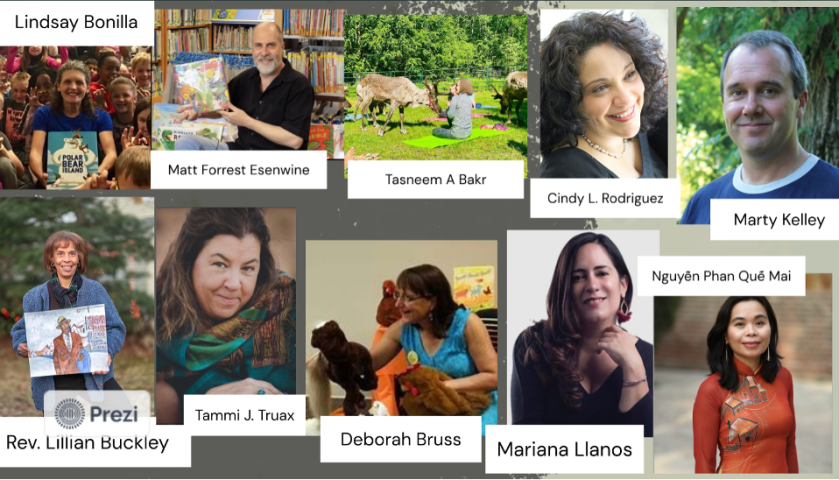
- Invite children to show what they know. Deb Bruss, author of Book, Book, Book, told me how she invites children to show what they know. She brings puppets representing each character in Book, Book, Book. A child might not speak the word for the character in English so Deb might ask a child, Show me the cow. Show me the chicken. And the child can point. Then she says the names as she hands the puppets out, and children help tell the story with their puppet. With older students, authors can give background information on the topic of their book, show props, and invite students to tell or draw what they know about a subject. This gives students a chance to share their knowledge about a topic. For example, if the book had a character that is a guinea pig, the author could ask if students have seen a guinea pig and what people think about guinea pigs in their home culture. A lot of interesting stories about cultural perspectives can arise, even about guinea pigs!
- Show visuals – props, objects kids can touch or experience with the senses, puppets, animals, large pictures – and introduce key words as a pre-reading warm up. These items will help children understand the English word you are connecting with the visual. You can also show maps if you’re presenting about a place in the world. Tangible objects can also be used to give students background knowledge about a topic they might not have been exposed to and offer more context for your story. Some writers make signs with key words so that ELs have the English word three ways: 1) the written word spelled out in the English alphabet, 2) visually – pictures or props such as a stuffed animal or puppets, and 3) orally, so kids can hear the sound and put the sound together with the written word and the visual. This gives kids lots of support in building comprehension. This might be workable in any size group if it’s a smooth fit for your program.
These are some of the books written by authors I interviewed:
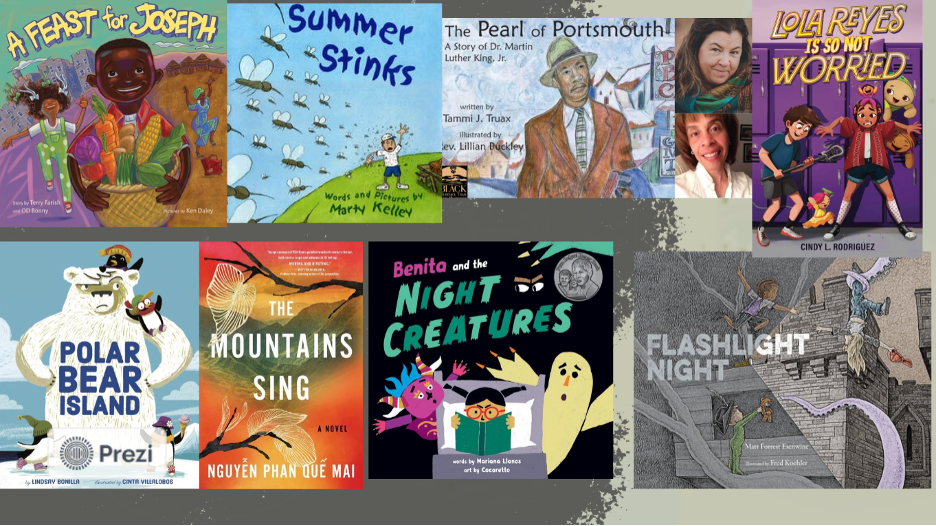
- Offer Interactive elements. A lot of authors talked about kinesthetic elements in their programs. Lindsay Bonilla described how she presents her book, Polar Bear Island. She brings lots of props, and children play the roles of the characters in the book. They show the story with their movements and sound effects while she tells the story.
- Create humorous situations that put kids at ease. Writer-illustrator Marty Kelley, creator of many picture books including Summer Stinks, offers humor that all children enjoy. His humor offers a sense of play and ease in which kids can relax and have fun with stories.
- Cindy Rodriguez writes middle-grade adventure novels including her newest, Lola Reyes Is So Not Worried. She said she puts the captions on if she’s showing a video. “This not only helps students with hearing issues, but English learners benefit from hearing and seeing English that they can read at the same time as they listen to the video.”
- Mariana Llanos, Pura Belpré Honor award-winning writer, was born in Peru, and now lives in the U.S. She reminds us about the power of representation and said the important thing is to invite authors who are from culturally diverse backgrounds into schools and libraries.
- Tasneem A. Bakr is an EL teacher and book creator. She tries to speak some words in the home language of students in the group, but she’s careful. “It’s a small gesture,” she said. “Simple words like Thank you. I try to do it with grace and humility. I always apologize before hand in case I mispronounce something, even when I know the language well.”
Bilingual authors, sometimes ELs themselves as children, share their knowledge about presenting to English learners. One example is the article below by librarian and children’s book writer Jacqueline Jules: “10 Ways to Support ELLs in Your School Library”. It’s in ¡Colorín colarado! a bilingual site for educators and families with many excellent resources for visiting authors working with English learners in their programs.
Here is a bit about me!
Terry Farish is the author of the YA novels Go Home (Groundwood Books) and The Good Braider, a novel in verse. She teaches adult English learners in New Hampshire.
 WRITERS' RUMPUS
As a former special education teacher and speech therapist, i have had many ESL students during my career. I found your article inspiring with many useful ideas especially for the newbie teacher.
LikeLiked by 1 person
Thank you. My instructor in a class on EL Curriculum said often that what’s good for ELs is good for all students. Scaffolding seems to help so many. Thanks for writing.
LikeLike
These are wonderful ideas, Terry. I will be sure to remember them for the future. Thank you for sharing all of this!
LikeLike
Thanks, Hilary, I’m glad they’ll be useful to you. I work with little kids sometimes and they are so fun to watch them laugh see their pictures in response to a story. You have so much to share in your stories.
LikeLike
A thougthful post Terry. Thank you for sharing these ideas, and supporting inclusionary practices within school libraries and elsewhere. Glad to hear you published another book. I’ll get my hands on that one. Best from NEST! Kate
LikeLike
Thank you, Kate. Hope all goes well with NEST. I wonder what you’re working on.
LikeLike
Very informative post, Terry! Thank you for collecting all these useful tips and sharing them with others to improve school visits for all. I’m looking forward to reading your latest book, Go Home.
LikeLike
Thanks, Marcia. I learned a lot this last year working in the school and then talking to all the writers. I use these same ideas with adult English learners. They helped me communicate better. Thank you.
LikeLike