
Here are two picture books by different author-illustrators from Spain that encourage individuality and whose characters are insects and other arthropods. Coincidentally, among the protagonists of both are ball bugs.
Wandering through the Casa del Libro (House of Books) store in Madrid while searching for a picture book to review for you, I stumbled upon a section of easy readers in which the text was set in solid capital letters throughout. This style of type handling is intended to simplify reading since the child holding the book would only need to know the shapes of one style of the alphabet rather than the letterforms of both capital and lowercase letters. This paradigm was not previously familiar to me. The narratives were all didactic, so I continued on to the picture book section.
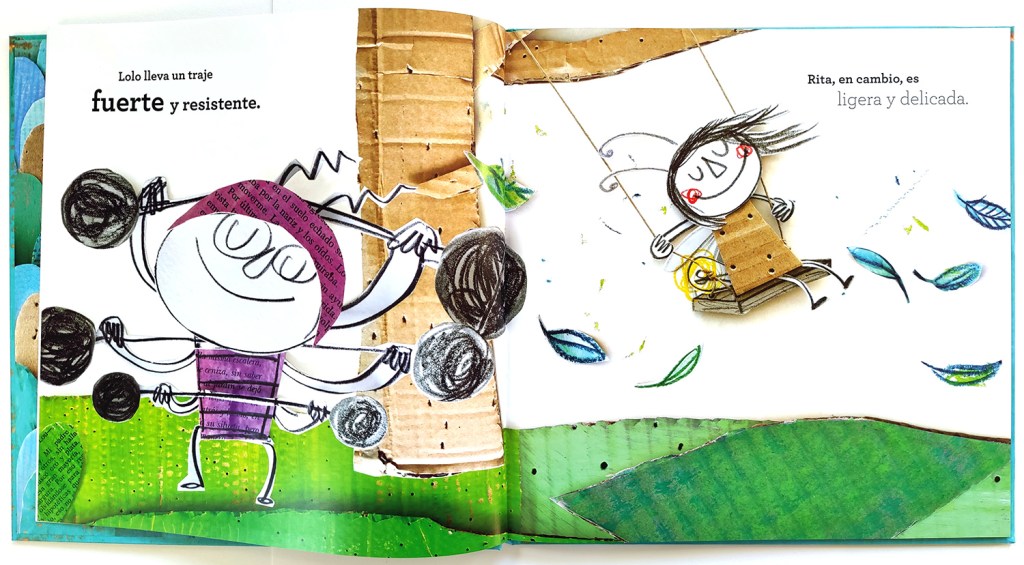
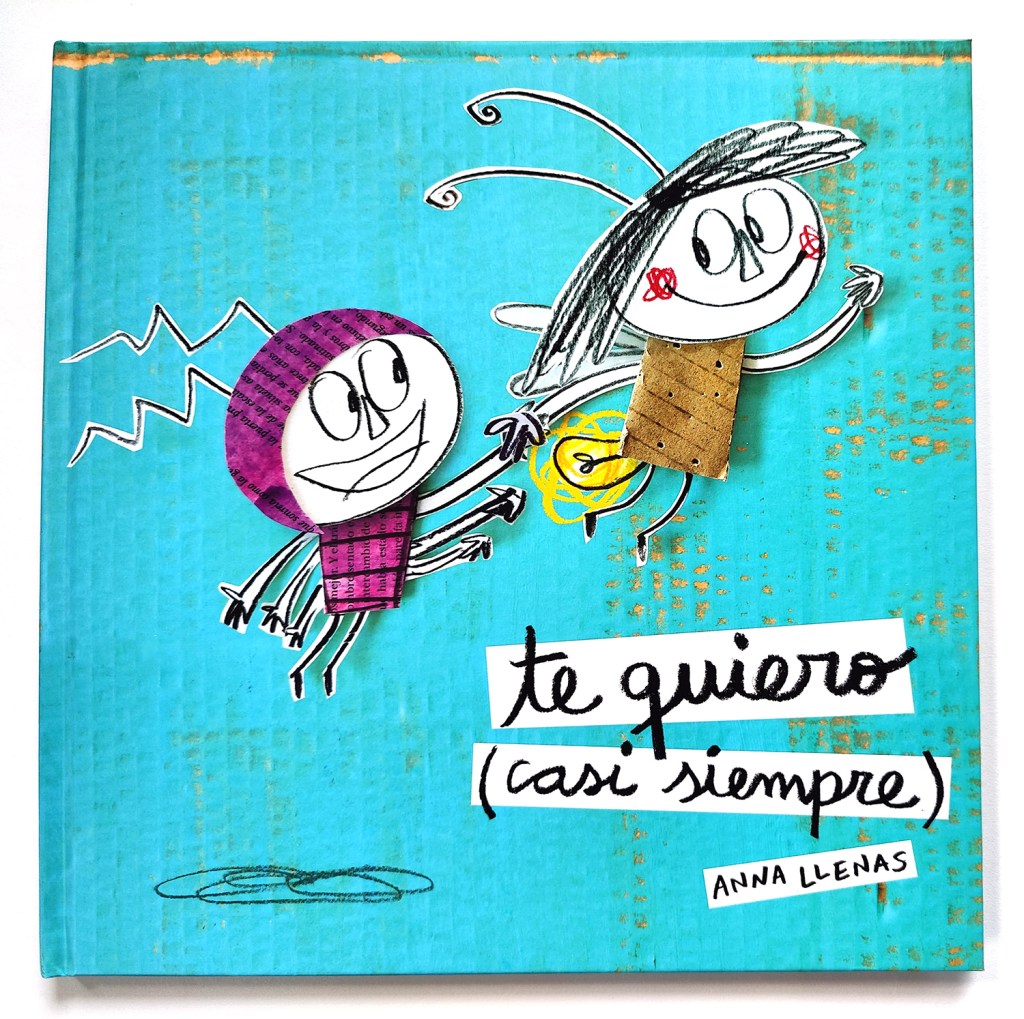
Te quiero (casi siempre) / I love you (almost always) by Anna Llenas begins by showing how different Lolo and Rita are. He is a bicho bola, a ball bug (also called pill bug or wood louse) with a hard shell, and Rita is a light and delicate luciérnaga, a firefly. He is practical, with his feet on the ground, while she is imaginative and flies above. The contrasts continue, but really, it is their differences that make Lolo and Rita like each other.
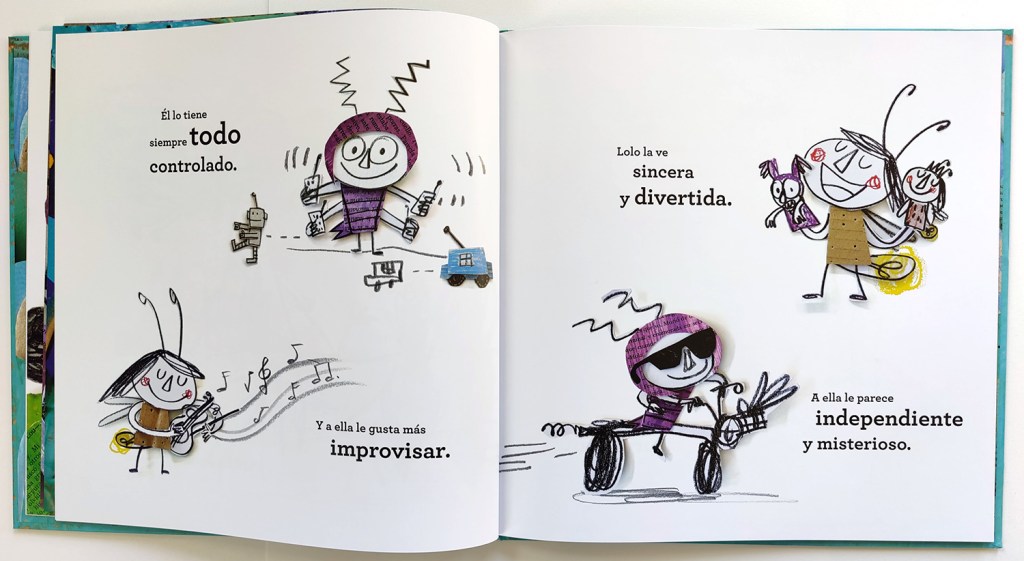
Then comes a day when they each find annoyances in the other. She thinks his shell is too hard, while he decides she shines too brightly. Maybe she’s too sincere, and he is too independent. She is too spontaneous, and he is too mysterious. Lolo and Rita are very different, which can be upsetting.
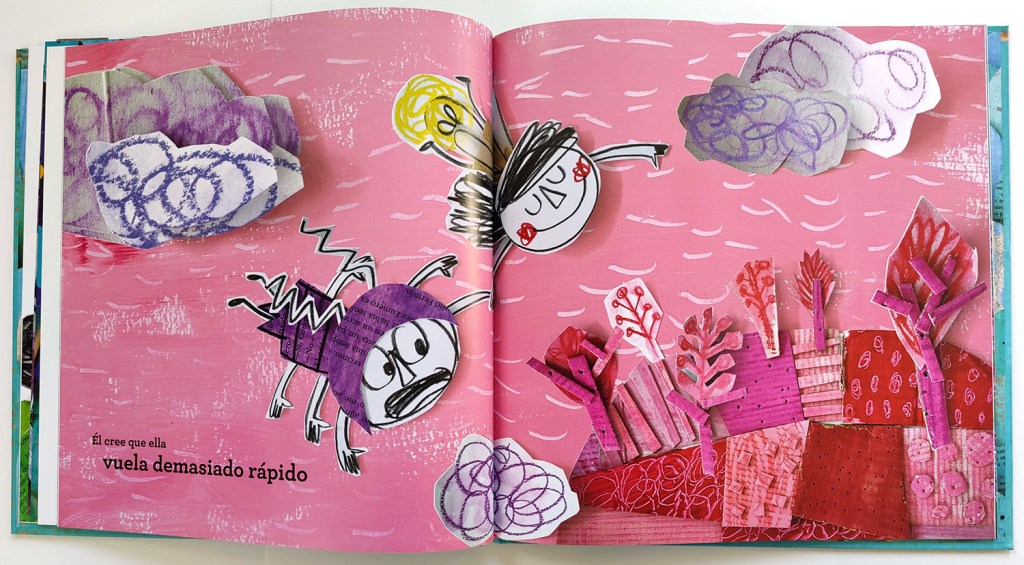
Suddenly, Lolo tries to soften his armor a bit. Rita strives not always to shine the brightest. He goes with the flow more, and she tries to slow down her flight speed, and so on.
Lolo and Rita realize that though they are very different, they love each other.
This is a story with a simple structure yet advanced vocabulary words like “respect,” “sincere,” “independence,” “spontaneous, ” and so on—seemingly mature concepts for children of picture book age. It is about emotional intelligence conveyed to young readers with joy.
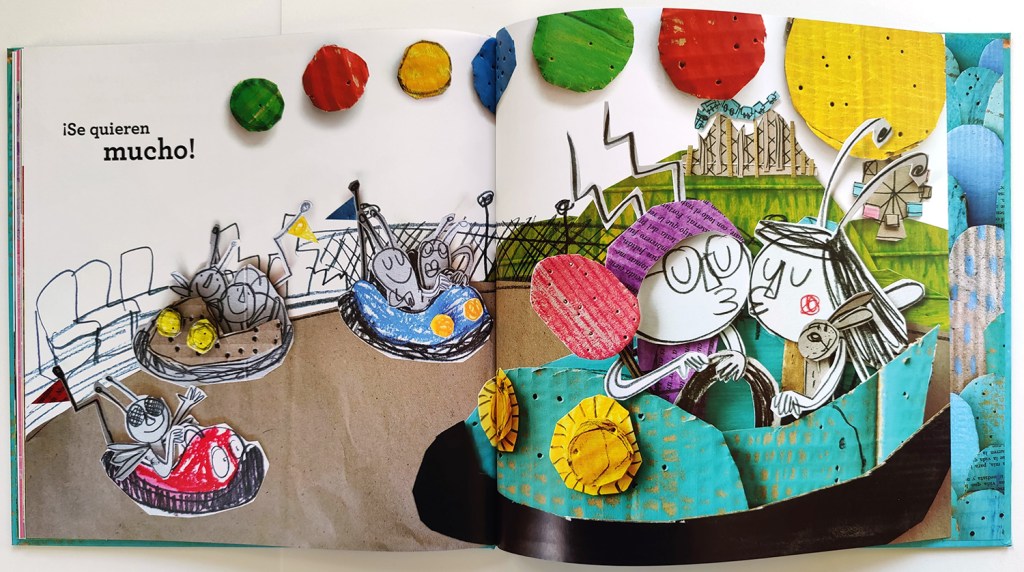
The lively illustrations are photographed paper and cardboard collages of cutout drawings and textures. The resultant shadows add subtle depth to the simple art. The endpaper image shows many tongue-shaped cardboard cutouts of various colors with their shapes poked with a sharp tool to add texture. These crowd together like people. Some double-page interior spreads are full of color, while others have white backgrounds, creating a rhythm appropriate to the narrative.
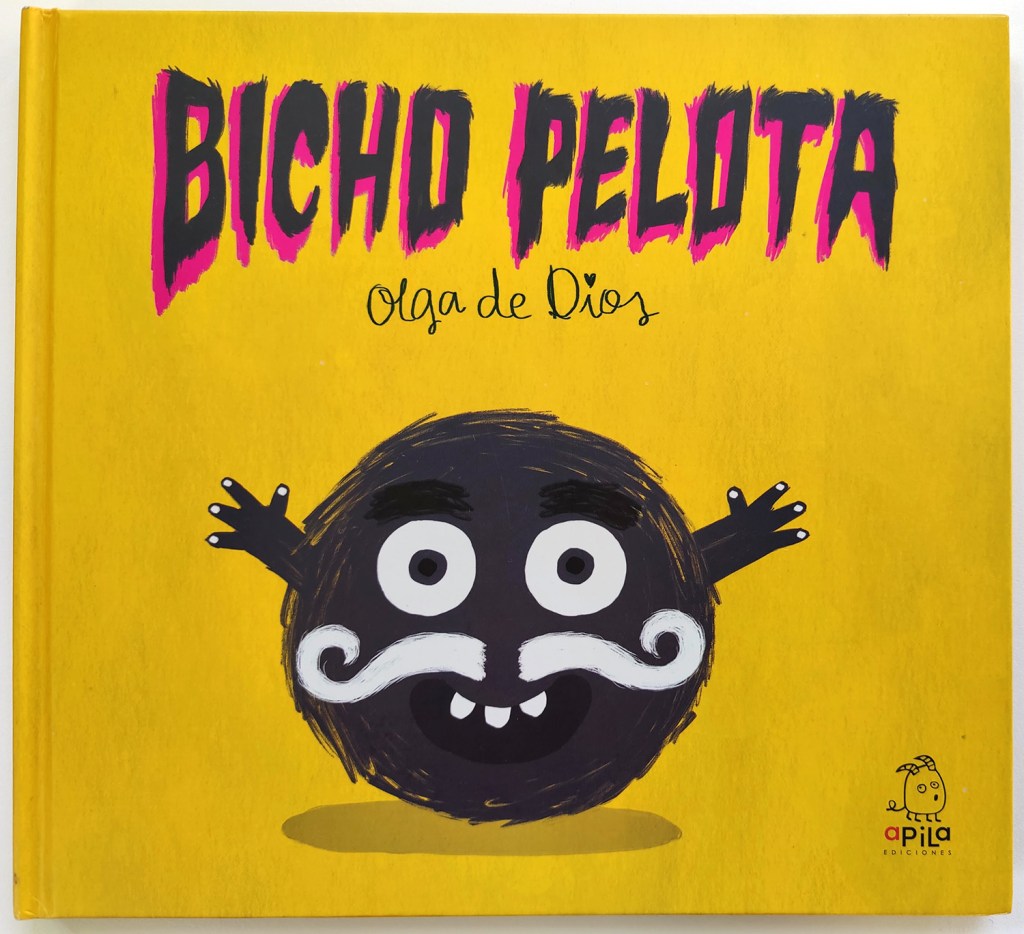
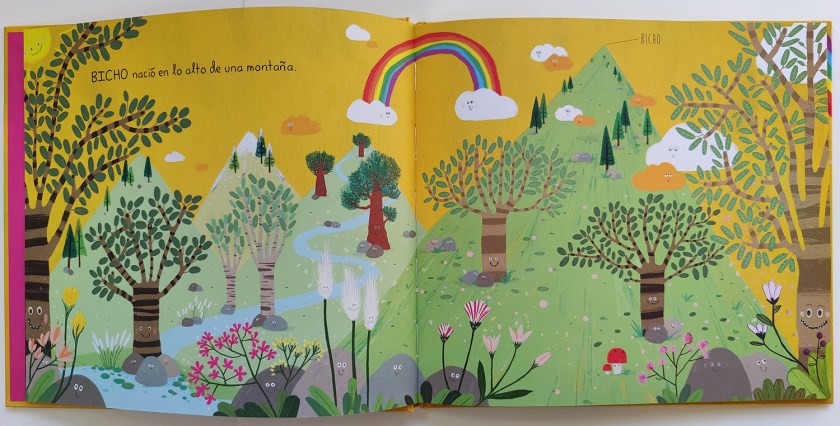
On the front endpapers for Bicho Pelota / Ball Bug by Olga de Dios is its dedication “to all the people who decide how they want to be named.” Upon seeing the first spread of the story, how could anyone not be enchanted with Bicho’s world? He lives somewhere up on that distant mountaintop, but look at the smiley faces of the trees, flowers, rocks, clouds, and mushrooms. They are his community, his friends who clearly will try to help him. Every reader will wish to live there, please.


Interestingly, Lolo is a bicho bola, which translates as a pill bug like the ones in our gardens, while the pelota of Bicho’s name means ball, as in pelota de fútbol – a soccer or other sports ball. This is a play on words reinforced by two spreads at the end of the story. The first teaches the names of various insects in the story, while the second spread shows many different types of sports balls. This makes the point that Bicho is both and neither.
Meanwhile, Bicho, stuck up on the mountain’s pinnacle, is surrounded by other bichos (what my French Canadian grandmother would call “bibbits”), which are insects and other creepy-crawlies. They are eager to give him life advice. Bicho is shown as slender and googly-eyed. Una oruga, a caterpillar, suggests that if he eats and eats, he will turn into a mariposa or butterfly. So he eats and eats. But he does not become a butterfly; rather, he is a fat, round Bicho.
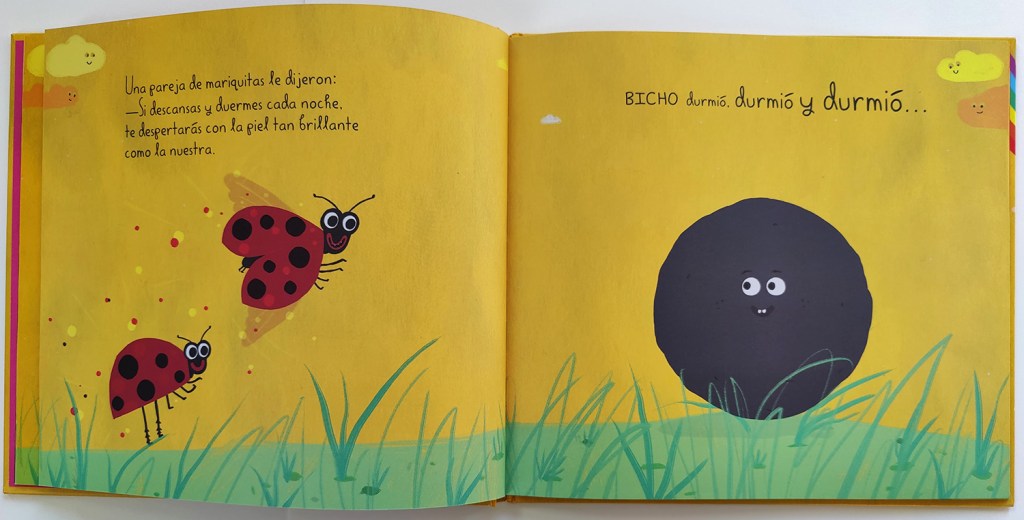
A pareja – a ladybug – suggests he will grow a shiny shell if he sleeps a lot; when he does, he wakes up hairy. The hormigas – ants – advise him, but that does not turn out as intended either. Finally, a banda de piojos – a band of lice, come singing and dancing.
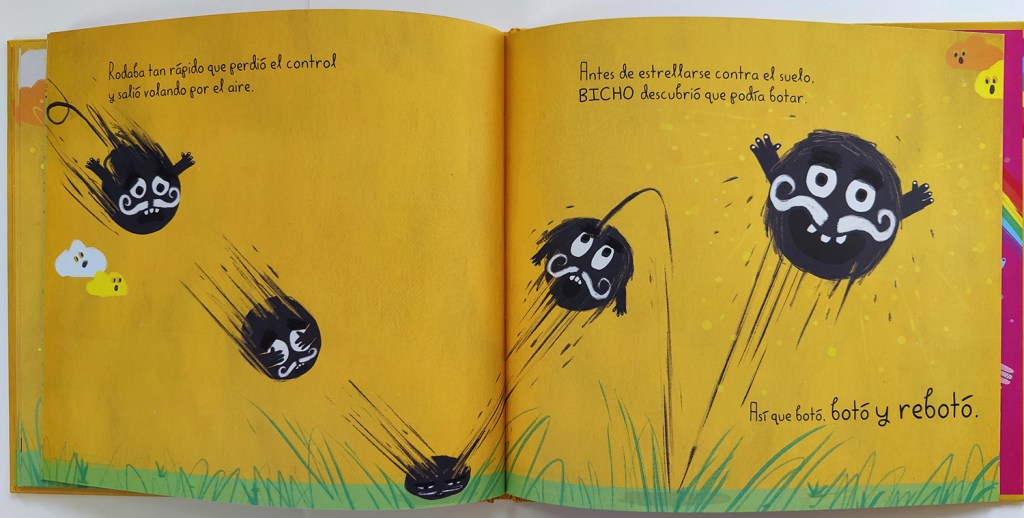
After a while, Bicho becomes itchy all over, loses his balance, rolls down the mountain, loses control, and flies through the air. He bounces and bounces and bounces. He loves to roll and bounce and is unlike any other bug we know. Neither was he like any other ball we know. Despite this, he declares that he will be called a ball bug.
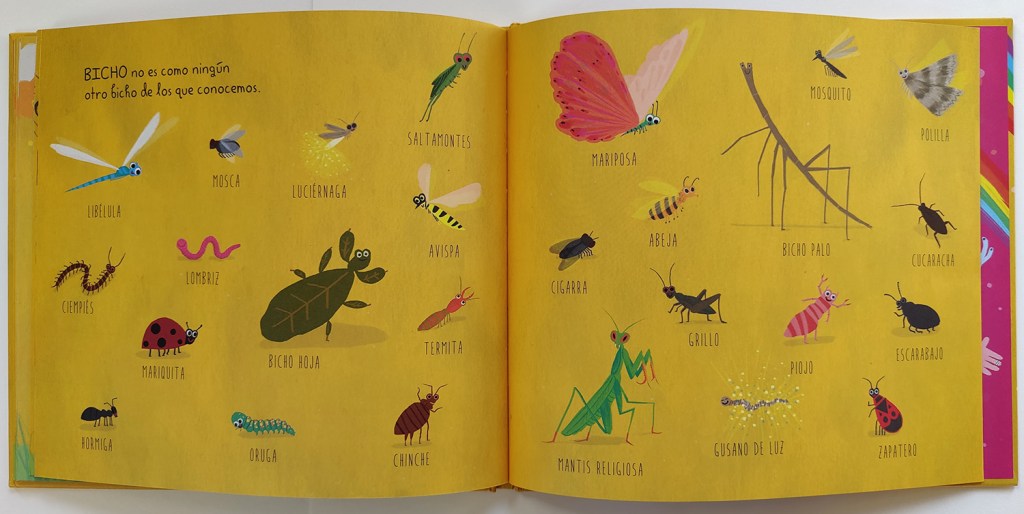
A note on the copyright page says that Olga de Dios created the art digitally and that Bicho Pelota is the fifth book in the Monstruo Rosa series. Many of the grass patterns in the foreground repeat on other spreads, simplifying the artist’s process. All pages have saturated yellow backgrounds, but it is the googly-eyed insects and active, brightly colored compositions that enliven this art. Throughout, charming little cloud characters react to the dramatic elements in the plot.
One small difference in the design of these two books compared to those published in the USA is that the text on the spine is in the opposite orientation. When shelved, the titles would read up rather than down.
These two tales about understanding identity are attractive and fun. Young readers will love them and discover insights about themselves and their friends.
Te quiero (casi siempre) / I love you (almost always) by Anna Llenas, 48 pages, Espasa Libros, Barcelona, España ISBN: 978-84-670-4370-9 www.planetadelibrosinfantilyjuvenil.com
Bicho Pelota / Ball Bug by Olga de Dios, 36 pages, Apila Ediciones, Zaragoza, España ISBN: 978-84-170-2877-0 www.apilaediciones.com
 WRITERS' RUMPUS
This is fascinating; both of these books are such fun to see. The illustrations are vibrant–unique yet similar. Thank you for introducing them to us!
LikeLike
Joyce, this is wonderful. I love to see international books, see the cultural distinctions in story and illustration. Thank you!
LikeLiked by 1 person
The way you highlight and explain the nuances of the media used to illustrate these stories is enlightening. Thank you,
LikeLike
Thank you for your enthusiasm, Terry! I’ve always felt that creators benefit from seeing what our world of peers invent. We all grow by sharing understanding.
LikeLike
Hi Marti! A picture book is a neat package that includes story, art, and book design. Also the scale and texture of each book. These are both fairly large formats and Bicho Pelota has a matte finish cover while Te quiero (casi siempre)‘s cover is mostly matte with shiny varnish over the two characters and the title. All aspects of a book, even the subtle ones, work together.
LikeLike