
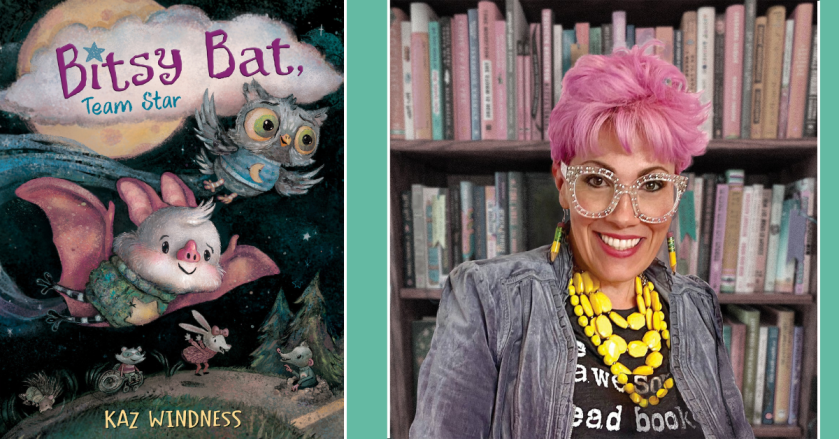
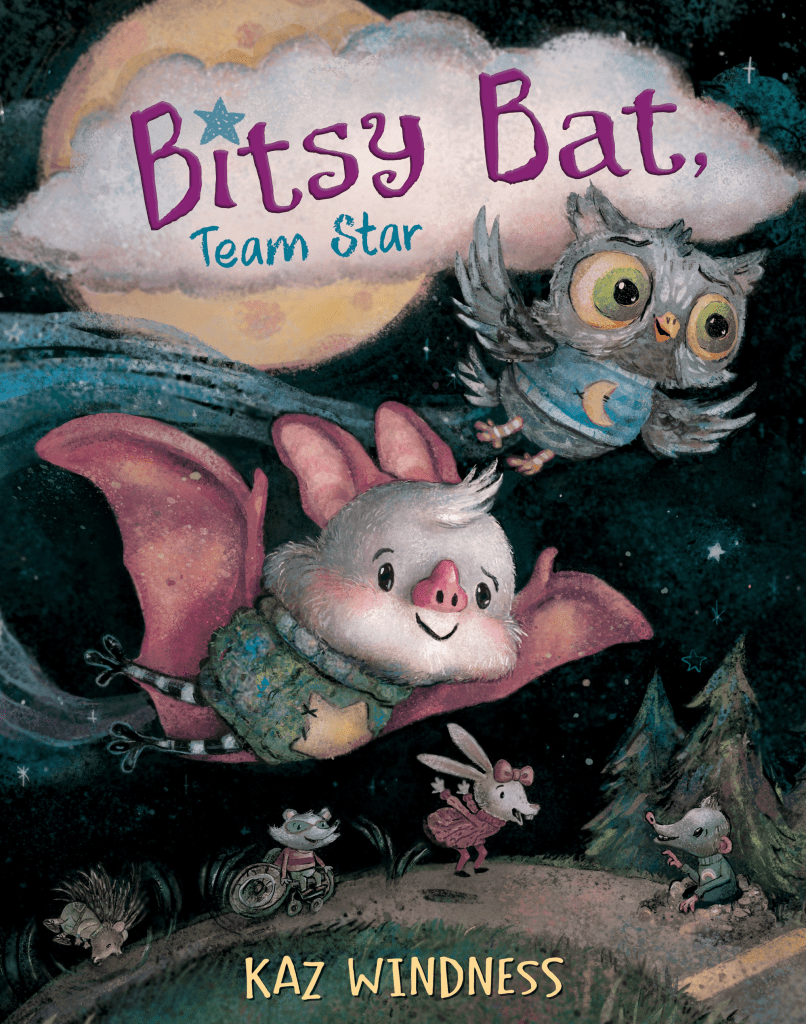
Hello, readers! I am a new writer to Writer’s Rumpus and will be bringing you interviews, reviews, and more every other month. I am excited to share my first interview with you starring the amazing Kaz Windness as we celebrate Bitsy Bat, Team Star. This latest installment in the Bitsy Bat series landed on bookshelves February 4th.
Kaz Windness is the Geisel award-winning, genre-crossing illustrator and author of funny and heart-warming books for young readers. Proudly neurodivergent (ASD/ADHD), Kaz specializes in character-driven books celebrating inclusivity, grit, and kindness. Her many books include Swim, Jim!, Worm and Caterpillar are Friends, When You Love a Book, and the Bitsy Bat series. She is a professor of illustration at the Rocky Mountain College of Art + Design and founder of The Cuddlefish Academy, where she inspires students to tell stories with pictures. Kaz lives in Colorado with her English teacher husband, two teen children, and a bunny-obsessed Boston Terrier named Remy. Kaz loves making deep-dish pizza from scratch and sketching animals at the zoo.
I am a huge fan of Bitsy Bat, School Star so I was excited to see a sequel! In this sequel, Bitsy Bat, Team Star, we are introduced to Enzo, a new classmate. What was the inspiration for Enzo?
Hi Monica! Thank you so much for having me and for the kind words about Bitsy Bat, School Star! Since the first book’s publication, I’ve had the immense honor of meeting lots of autistic students, some of whom don’t use their voices to communicate. They’ve taught me that just because they don’t use their voices doesn’t mean they don’t have something to say. It’s important to presume competence and provide accessibility tools like the AAC (Augmentative and Alternative Communication) device you see Enzo using. I knew from the start that I wanted to introduce a flying character. Although how Enzo communicates is not central to the story, it’s an added layer of showing an inclusive and diverse classroom.
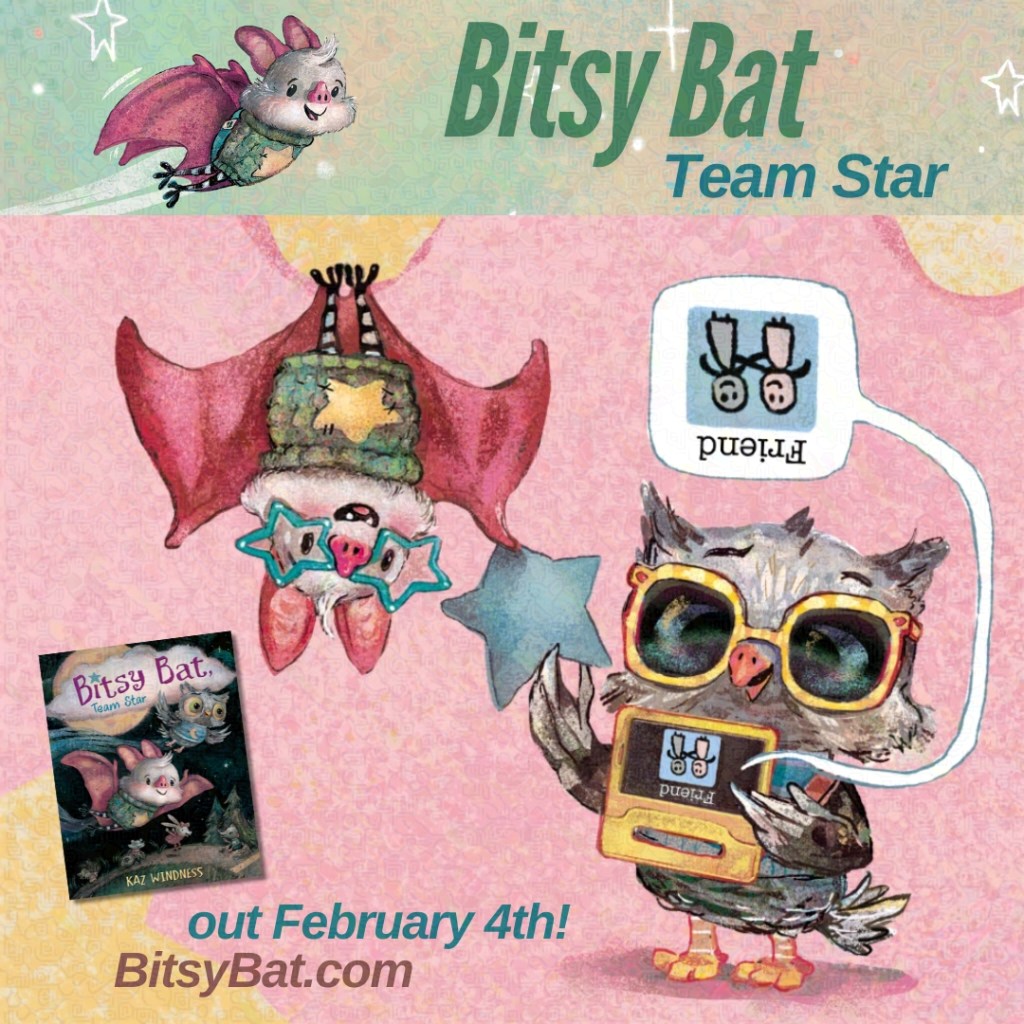
You masterfully weave in representation of differently abled characters. Enzo uses a communication device, or what some of the students in my school refer to as a talker. I’ve never seen this in a picture book before, and am delighted that students may see themselves reflected in Enzo. The speech bubbles with the communicator icons are perfection. What was the process for developing Enzo’s voice?
That was probably the trickiest visual element in the book. The speech bubble aspect came from my experience as a graphic novelist (see Worm and Caterpillar are Friends), and I spent a lot of time researching common communication board symbols. I wanted the art in the book to be an honest representation of the real-world usage, but also believable in Bitsy’s animal-centric world. I also wanted to demonstrate full sentences. Non-speaking kids should have full access to vocabulary and ways of forming full sentences, because this gives them greater access to the world. I often struggled to find a good symbol to communicate what Enzo wanted to say. This gave me a much greater understanding and sympathy for non-speakers. I’m glad the AAC technology exists and is improving. We can do more to give non-speaking people a voice and a platform to share their needs, feelings, and wisdom.
Ok, as much as I love Enzo, let’s give Bitsy some time to shine, too. Bitsy ends up a star, but makes mistakes along the way. Led by a touch of jealousy and a determination to win, perhaps at all costs, Bitsy’s flaws make the character even more real. Were there any challenges in creating a likable character who makes not so likable choices?
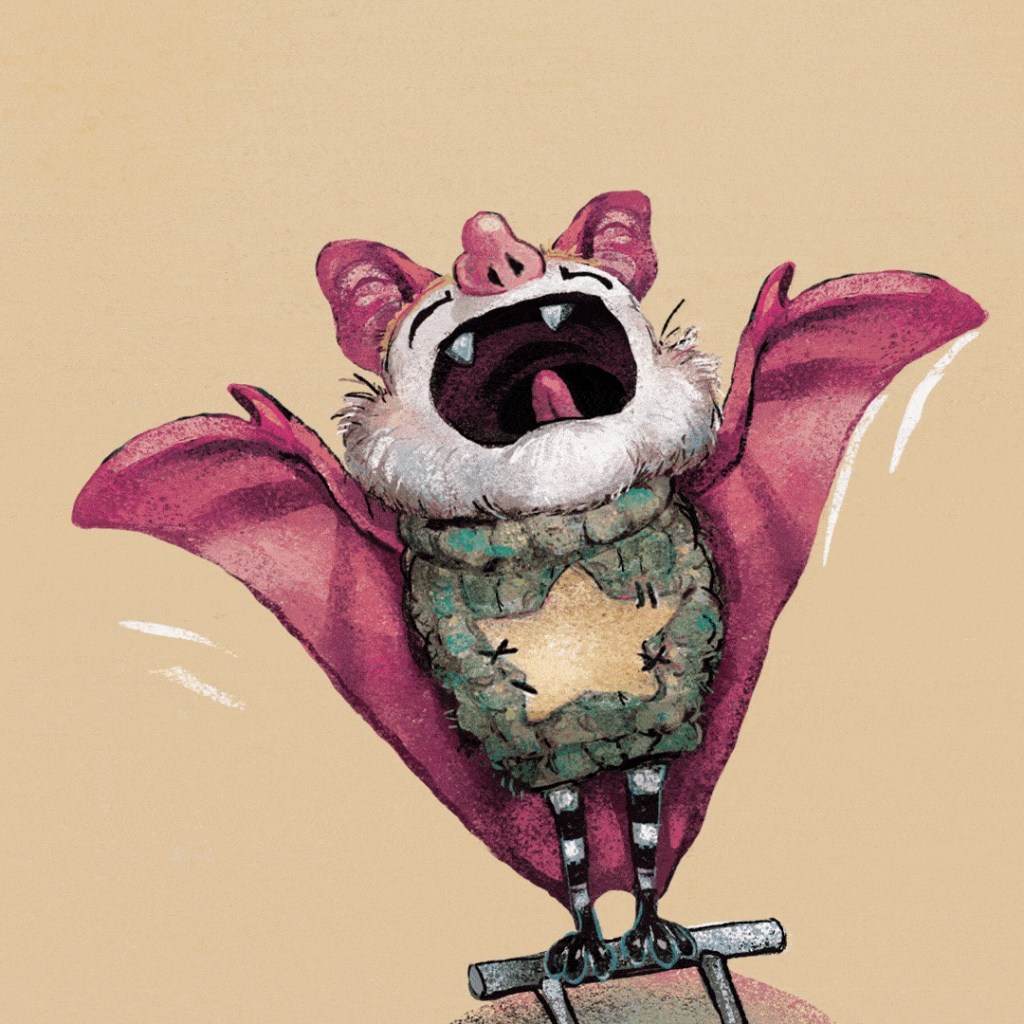
Beautifully said: “A likable character who makes not-so likable choices.” Don’t we all want to be loved for ourselves, despite making mistakes sometimes? While I was developing the story with my editors, there was some push to make Bitsy more likeable. They thought she should apologize when she didn’t help set up the Crittercrawl races. They thought she shouldn’t be so reactive with Enzo. Bitsy is a real kid to me, and a character who is a lot like I was as a child. I love that Bitsy has friends like Benjamin Berry who question her when she’s been hurtful while still loving her unconditionally. I have those friends. I also pushed back on Bitsy apologizing, because hyperfocus is part of being neurodivergent. Why should Bitsy have to derail her need to practice flying to do what the other characters thought was a more appropriate activity? I knew that Bitsy’s friends were asking her to help as a “bid” to reconnect, but why should Bitsy have to stop what she’s doing to perform a neurotypical social expectation? I’m grateful that my editors were on board for these types of conversations. It’s the type of conversation I hope readers have, too.
There are so many hooks in this story – teamwork, friendship, the communication device, school, emotions, an autistic perspective – just to name a few, yet the language of the text is simple and concise. Short of wizardry, do you have any tips you can share for how you create a balanced, layered text for children?
Oh my gosh, get good help! I couldn’t have made this story work without exceptional editors Catherine Laudone and Danielle Collins and brilliant art director Laurent Linn. When we first talked about the second book, Catherine asked me what I wanted to say that hadn’t been covered in the first book. I knew I wanted to introduce Enzo, include a different way of communicating, and explore my experience of struggling with friendships, especially when they go through a change. It’s a common theme for me (see Worm and Caterpillar are Friends) but very much related to my experience as an autistic. More than anything, I’ve wanted friends, but simultaneously, friendship has been my biggest struggle. Catherine and I came up with a lot of different scenarios for how Bitsy might encounter these challenges. We at last settled on a field day where we could show lots of skills in a fun and active way, but also set up challenging friendship dynamics. It also helps that these books are 48 pages. The standard picture book is 32, and we couldn’t have fit this full story and several “More on Autism” informational pages in a shorter book.
I’m always fascinated by everyone’s writing process and how there is no one recipe for success. As an author-illustrator, what comes first to you, the illustrations or the text?
I recently learned that Maurice Sendak advised author-illustrators to always write first. He said once you had the words, the pictures would appear like a Polaroid in your head. It doesn’t quite work like that for me. Usually, the character comes first, and they appear in my sketchbook while I’m doodling. Some of those characters start talking to me. Some of those characters have stories to tell. Sometimes all I have to do is write down what they say (see Worm and Caterpillar are Friends). Sometimes I can’t hear them very well, and I have to do more drawings to get a clearer phone connection. Sometimes I have to use formulas like the three-act story structure and write a logline. (I teach a class on that, Hook! Plot! Pitch! on CuddlefishAcademy.com.) I don’t think there’s a right or wrong way to develop a picture book, but it is helpful to have a work flow that generally works for you, plus tools to get you unstuck. I’m always curious about what others do, too! I’m constantly borrowing and adding tools to my author-illustrator repertoire.
Lastly, what do you hope readers will take away from reading Bitsy Bat, Team Star?
As always, I hope Bitsy’s readers feel seen, celebrated, and loved for exactly who they are. I hope the new story helps foster inclusion and recognition of differences, such as non-speaking communication. I also hope they enjoy the action and excitement of the Crittercrawl races. I’ve loved creating this book and thank you so much for the opportunity to talk with you about it.
There are complimentary curriculum-based educator lesson plans and other fun activities like how to draw Bitsy at BitsyBat.com.
Author:
Monica Acker is an author and educator located in Massachusetts. She is the author of Brave Like Mom (illustrated by Paran Kim) and The Legend of Leo the Dandelion (2026, illustrated by Mikel Valverde). When not writing, Monica spends her time as the mom taxi to her three children and dreaming up vacations with her husband.

 WRITERS' RUMPUS
Great interview! Thank you both.
LikeLike
Nice interview, Monica! Welcome!
LikeLike
Wonderful interview. I’ll be checking out these books. I love that you included the communication device. That had to be challenging in the illustrations but so needed in today’s world.
LikeLiked by 1 person
Love this maiden voyage Writers’ Rumpus interview, Monica! And Kaz, what amazing characters and storylines you create! I loved hearing your insights and can’t wait to pick these Bitzy Bat books up to read. Thank you both.
LikeLiked by 1 person
Great Interview! I love hearing about the process and how each writer and illustrator is so different. I love your books Kaz. I can hardly wait to read this new one with Bitsy.
LikeLiked by 1 person
Nice interview, Monica! Very interesting to learn about Kaz and her creative process. Just with this wee peek, Bitsy’s personality already jumps off the page. Congratulations to Kaz on all counts!
p.s. I love her pencil earrings and how she is color-coordinated to match her adorable, bright book covers. 🙂
LikeLiked by 1 person