

When Debra wrote to our blog about a potential interview regarding her nonfiction picture book, A Family for Zoya: The True Story of an Endangered Cub, I took one look at the book cover and signed up immediately. Yes, I’m an animal lover, but even so, when I proposed July 29th as a date for our post, I didn’t realize that today is WORLD TIGER DAY. How cool is that!?! (For more information, check out this WWF link.) Even cooler: Debra is donating 100% of her profits from book sales to the Tiger Conservation Campaign!!
LC: Debra, welcome to Writers’ Rumpus! A Family for Zoya is such a compelling story about an Amur tiger cub who was abandoned by her mother at the Philadelphia Zoo and “adopted” by a Sumatran tiger mama 1,300 miles away who had just given birth.
Can you share your inspiration for writing this story about Zoya’s life-altering experience?
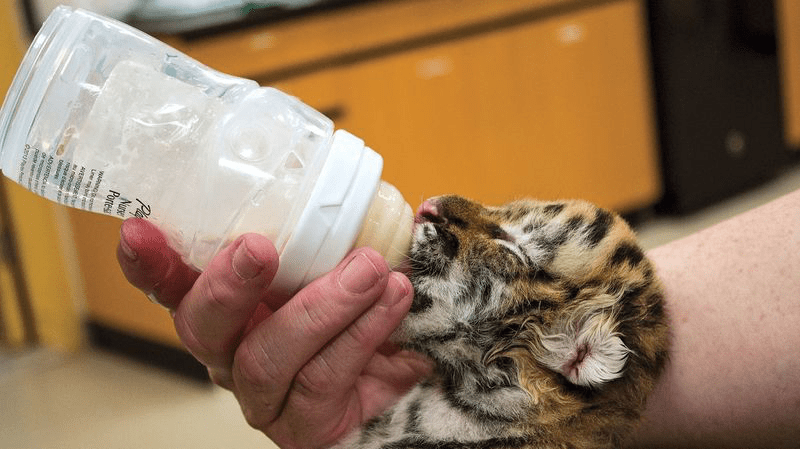
Little Zoya being bottle fed
DKW: Thank you for the opportunity to share my story and journey with your readers, Laura. I fell into writing this story through my previous job running the Philadelphia Environmental Film Festival. The Philadelphia Zoo was one of the film festival’s sponsors, and one day while I was waiting at the zoo for a meeting, I went to see the Big Cat Falls exhibit. I hadn’t been at the zoo since my kids were small. An animal caretaker was telling visitors the inspiring tale of little Zoya, a critically endangered tiger cub who had been rejected by her mother. I was intrigued and went home and researched her full story and learned that Zoya was the first cub to ever be “adopted” by another tiger subspecies. And the photos I saw of Zoya and her new tiger family were adorable. After that I was hooked. Then, of course, I had to figure out how to write and publish a children’s book, which I had never considered before!
LC: The kidlit community welcomes you with open arms! The “Did you know?” footnotes after each page really caught my eye. My favorite footnote is one I know kids will enjoy: “Tigers smell like buttered popcorn.” How did these footnotes evolve, and who came up with the idea to add them?
DKW: I learned so much about wild tigers and wildlife conservation as I researched the book. Part of the appeal of this story for me was presenting the science of why Zoya was genetically valuable. When the publisher, Platypus Media, asked me to rewrite the story from Zoya’s point of view and for a younger audience, we worked together to move most of the scientific information into sidebars and back matter. I think these interesting sidebars, which can be read by older children or adults, complement the main story about Zoya’s race for adoption really nicely.
The chance to dig deeply into interesting new topics is one of my favorite things about writing nonfiction for kids. It’s similar to teaching adults about technical legal topics, which I’ve done as a land conservation lawyer—you have to really understand the subject matter to be able to distill and present it in a clear and entertaining way.
LC: I love the connection between your work as a land conservation lawyer and your success as a nonfiction picture book author. What deeper message do you hope readers will gain from this charming and true story?
DKW: It’s fashionable in some circles to view zoos in a negative way, but modern, accredited zoos are important contributors to research about wildlife conservation. Animal caretakers and scientists at those institutions focus on the wellbeing of both their own animals as well as ones living in the wild. Zoos also are the first point of contact most people have with species that aren’t pets or pests. So zoos can help us to care about the fate of animals around the world.
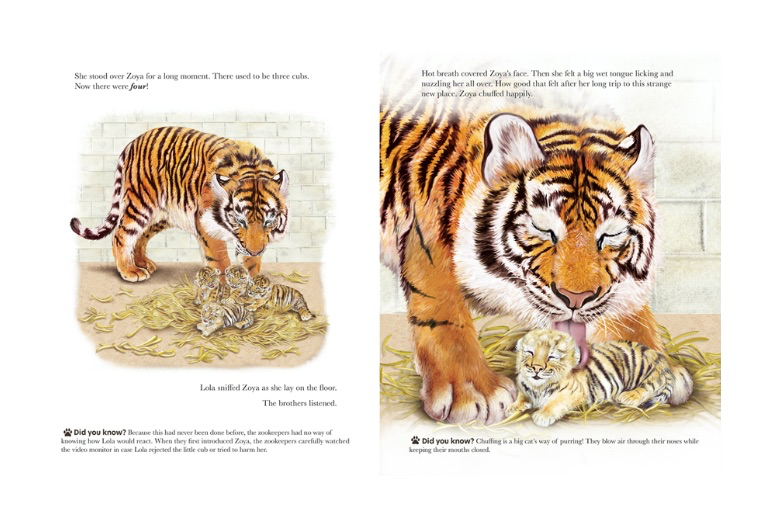
The other underlying theme I hope readers take away from the book is that if animals can be accepting of differences, maybe people should too! Zoya is an Amur tiger. That subspecies used to be called “Siberian,” but tigers became so rare in Siberia due to poaching and habitat destruction that they were renamed “Amurs” for the small Amur River Valley where the remaining wild tigers live. Amurs like Zoya are the biggest type of tiger, with brown stripes and thick, fluffy fur suited for their snowy climate. The zookeepers attempted to introduce baby Zoya into a family of Sumatran tigers in a zoo a thousand miles away. Sumatrans are the smallest tiger subspecies, with dark fur and black stripes to help camouflage them in the jungle. Tigers rarely if ever care for cubs that are not their own. And cross-fostering between two different tiger subspecies had never even been tried before! Luckily, after a few anxious hours, Lola, the Sumatran tiger mother, welcomed Zoya into her litter. Lola even taught the new baby how to nurse, because Zoya had only been bottle-fed up to that point.
LC: It’s remarkable that cross-fostering among different tiger subspecies had never before been attempted — and incredibly exciting that it worked for Zoya. 1,000 times YES: these tigers can teach us humans a thing or two about compassion and acceptance.
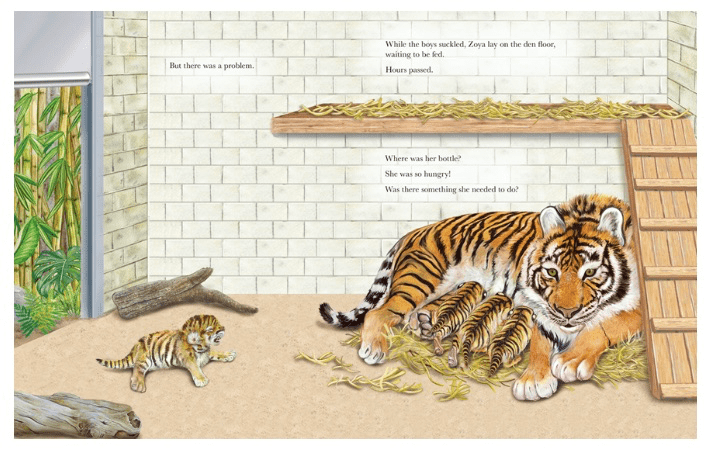
The illustrations like the one above are incredibly lifelike. I wanted to reach through the pages and cuddle Zoya and her adopted brothers. Did you have influence in choosing the illustrators? What was the process of integrating the pictures with the story?
I originally envisioned this story illustrated with photographs, because I’d located good photos of Zoya and her family and the photographers had generously offered to donate them for the book. But the publisher wanted to go in a different direction and found the two incredible illustrators—sisters Annalisa and Marina Durante. They are medical illustrators in Italy, and they imbued the story with accuracy, charm, and warmth. And the publisher ended up including several very cute photos of Zoya and her family to the back matter and back cover.
Coincidentally, I’m an Italophile and have struck up a correspondence with the talented Durante sisters–in my halting Italian–and hope to go visit them in Milan one day!
LC: I hope you get to meet up! Do you mind sharing what happens after grown up Zoya meets Viktor, a male Amur (Siberian) tiger at the Roosevelt Park Zoo in North Dakota?
DKW: Viktor was chosen to mate with Zoya because of the purity of both of their genetic lines. I learned that top zoos follow the breeding recommendations in Species Survival Plans developed for each endangered species. Luckily, the two tigers liked each other enough to mate, and Zoya had a successful litter of three healthy cubs. It was only because she was adopted by Lola, who was a wonderful mother to her, that Zoya learned how to be a good mother herself.
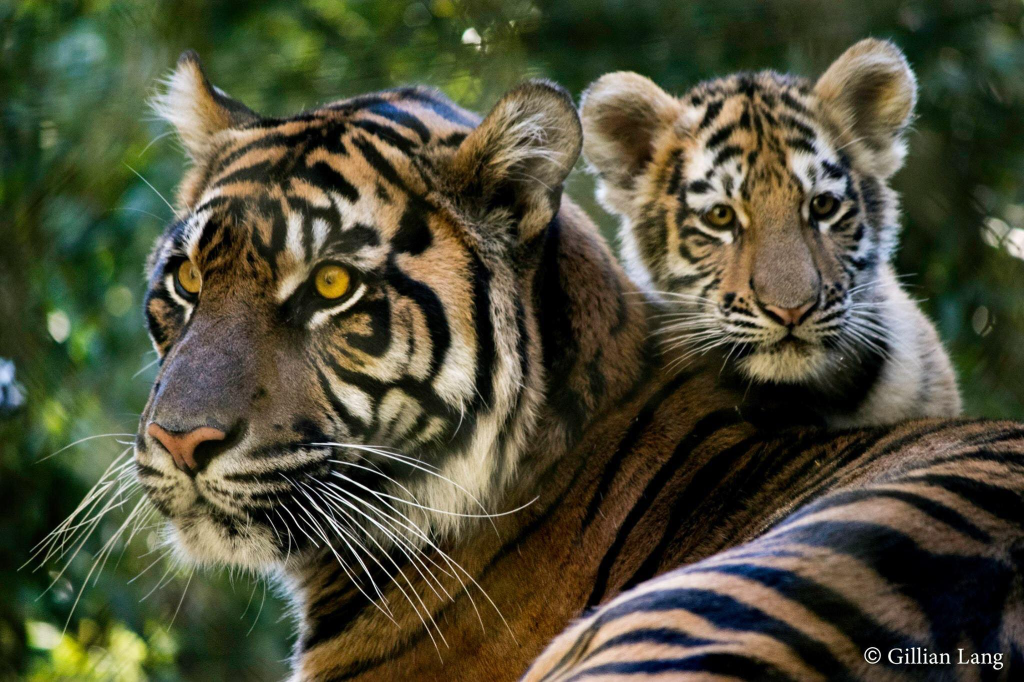
Does this photo melt your heart? Zoya with one of her cubs.
LC: Your bio is impressive beyond words, especially your “Woman of Lifetime Achievement in Conservation” award from PennFuture. Please share details about your involvement with One Little Earth.
DKW: I grew up near the Appalachian Mountains and developed a real love of the outdoors and wild places. I’ve been lucky to turn my passion for nature into a career, first working as a land conservation lawyer for several decades, then founding an environmental film festival, and later, expanding the film festival into a nonprofit that supports youth programs and children’s books that inspire a love of nature. This summer, my nonprofit, One Little Earth, is sponsoring underserved kids to attend outdoor summer camp and is underwriting the publication of new children’s books through its alliance with indie publisher The Little Press. We’re donating hundreds of copies of each book to youth literacy organizations throughout the region. (You can learn more at www.OneLittleEarth.org.)

The hardest thing is to carve out time to write my own stories. I have another nonfiction picture book coming out next year and have half a dozen more underway. Not surprisingly, they all have nature themes!
LC: I can’t wait! Your dedication, passion, and generosity are incredibly awe inspiring. How can readers and nature lovers reach you?
I’d love to hear from everyone via my author website: www.DebraKimWolf.com
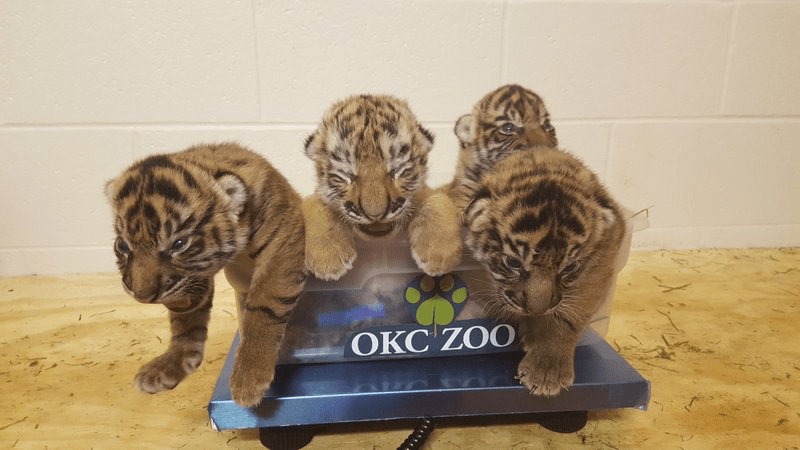
Zoya and her adoptive brothers being weighed
LC: Debra, thank you for this wonderful interview. For inspiring children to appreciate and protect nature, you are an inspiration to us all!
And there’s more: Debra is generously offering a free book to one of our lucky readers. Leaving a comment below will earn you a chance to win. If you repost this interview, you’ll double your chances of winning A Family for Zoya for your enjoyment or for donation to the group, school, or library of your choice. On behalf of tigers everywhere, we thank you! The raffle will end in one week.
 WRITERS' RUMPUS
“It was only because she was adopted by Lola, who was a wonderful mother to her, that Zoya learned how to be a good mother herself.”
Awww, all the feels! What amazing work you do, Debra. All of it!
Sharing on my social media channels!
LikeLiked by 2 people