
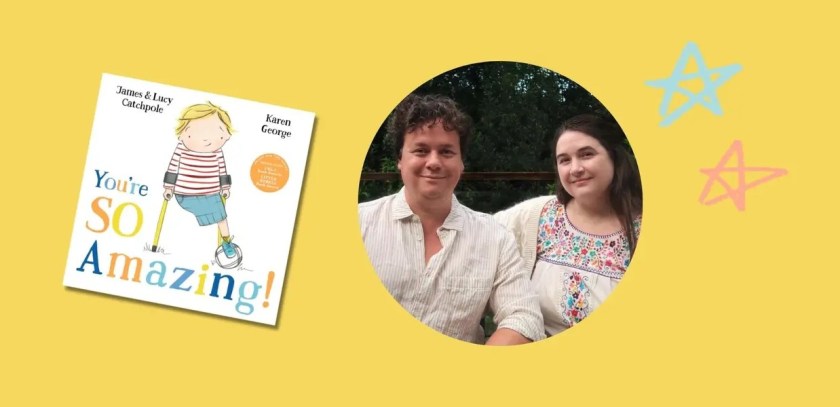
By Danna Zeiger (and her kids)
We just missed Disability Pride Month (July!) but I would love to extend the festivities with James and Lucy’s important picture books: YOU’RE SO AMAZING! and WHAT HAPPENED TO YOU? The truth is, there is an abysmal dearth of representation in children’s literature. According to The Cooperative Children’s Book Center, only 7% of the children’s books it received in 2023 “featured a primary or significant secondary character/human subject with a disability” (Dickinson). Needless to say: we need more representation! I will gladly be adding to the collection on September 9, when my own book is published (REWRITING THE RULES) but James and Lucy have already written two beautiful books based on their own experiences.
This is a special interview! I read James and Lucy’s books with my kids, as usual. And my kids had *so many questions* for them both! Luckily, I am in touch with their wonderful publicist at Little, Brown and everyone was delighted by the idea of an interview. This one is a little different–I let my kids ask some of the questions! And my own are below :-). [ I will note that my five-year-old’s immediate question was wanting to know what happened, and I gently re-read their excellent author’s note about being polite and that even if one is curious, we don’t actually need to know every detail of someone’s life :-). Author’s notes are important, too!]
DZ’s Kids: Are these stories based off of real experiences you had as a kid?
J&L: Yes, for sure. I was Joe and Joe is me. But they’re also based on more recent experiences. When I started writing What Happened to You? my first child had just started nursery school. Dropping her off there each morning, and then hanging around the playground afterwards, reminded me of how it was when I was four and five, because the same thing happened: all the kids came over to ask me about my leg! I’ll tell you something cool, though. I made a decision: I wouldn’t tell the kids what happened to my leg, but I wouldn’t make up my usual crazy stories about pirates and sharks, either. Instead, I’d ask them what they thought had happened. And some of those kids, and the thoughts they had, went straight into the book. Ibrahim and the thousand lions? He’s a real kid from my neighbourhood! Except he’s about twelve now, and far too cool for any of that. 
DZ’s Kids: What was your experience like in school, in classrooms, with a disability? Were you (James and/or Lucy) included? In friendships? In groups?
J&L: Lucy wasn’t disabled as a child, like I was. My experience of primary school was…ok, from what I remember. I made friends, and I was mostly able to join in with everyone else. I couldn’t play football (soccer) on my false leg, so I remember being referee once or twice, including the time I got knocked over by the scrum of kids chasing the ball, hit my head on the goalpost, and the teacher cried and Freddie Kingham wet himself. That’s pretty funny, looking back. I don’t remember being teased or bullied, which is the main thing – I was lucky, that way.
DZ’s Kids: What accommodations are you provided with, and which accommodations do you wish you were provided? Where do you feel is society still most ableist? And, how can we (both adults and children) make change happen?
J&L: Looking back, the main problem I had was actually with the doctors and prosthetists (who make the artificial legs). Obviously, they meant well and wanted what was best for me, but they all had this idea that I should wear a false leg all the time, when I could move around much more easily on crutches without one. As I got older, dragging that false leg around started to really hold me back. It wasn’t until I was thirteen or so that I found the courage to ditch the false leg, and go to school on crutches, as myself. All those years I could have been playing football, instead of pretending to be the referee… I recently wrote about that in our anthology Owning It – our disabled childhoods in our own words, which is coming out in North America in August. Society is more accepting of difference now than it was in the 1980s, I think. Hopefully, there’s less pressure on disabled kids these days to conform, and to try to be like everyone else.
DZ’s Kids: Why did you choose to write a picture book about this, as opposed to, say, a novel for older kids? What ages are most important to educate, or which do you think are the least aware?
J&L: It’s a lot, to expect four and five-year-olds to grasp this idea of personal questions and boundaries (they always still want to know what happened!). But it’s still a good idea to plant the seed with them, just as we do with teaching them all sorts of complicated things, like good manners. That’s one reason to write a picture book. But here’s another one. When you write a picture book, you get two readers for the price of one: a child and a parent. Grown-ups are a funny bunch. They often want to know what they should do, when their child yells at a disabled person in public – I know this, because they often come up to me and say: I’m so sorry – what should I do?! But they also don’t like being told how to do things differently, if they already think they know something. So I thought, the best way to reach them (and their kids) might be to write a book that speaks to their children, but which they have to read out, too. Sneaky, huh?
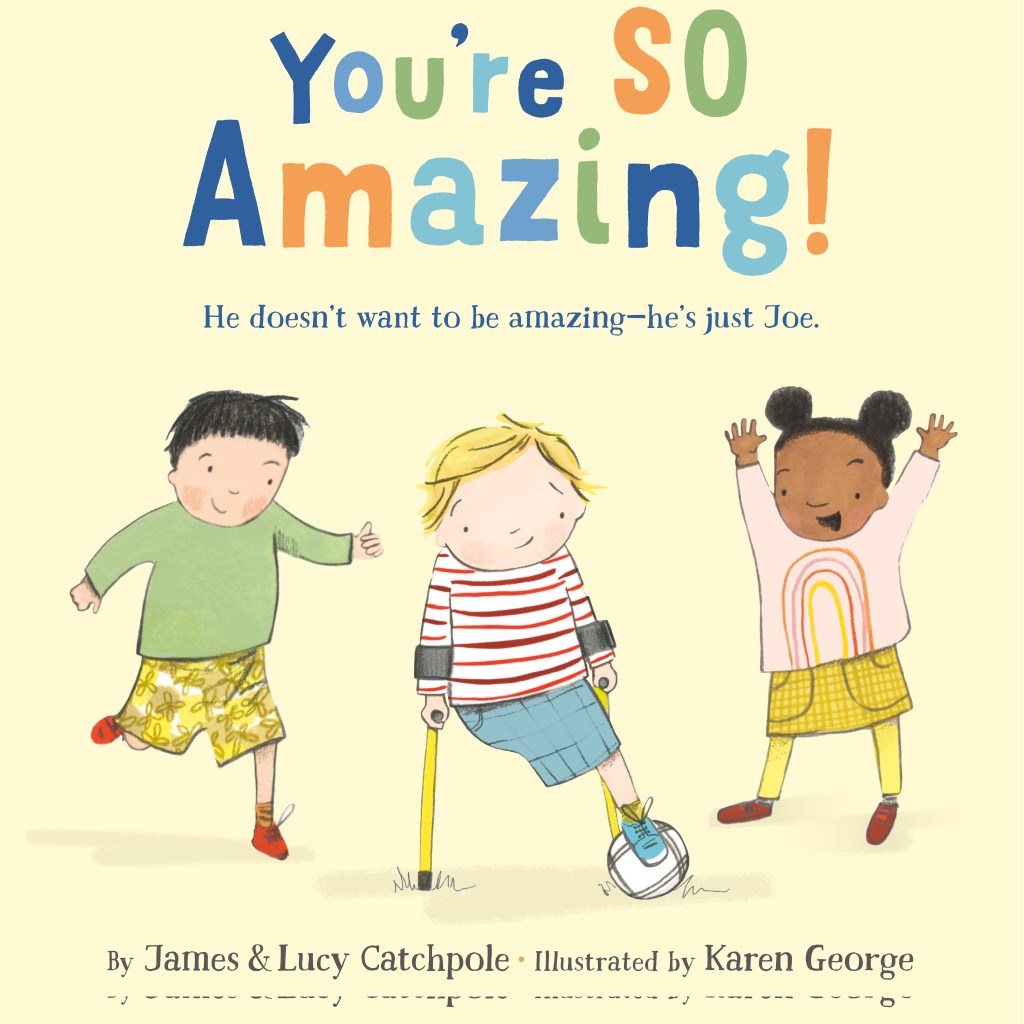
DZ’s Kids: What was it like to co-write YOU’RE SO AMAZING?
J&L: Ah, it was brilliant. Lucy was the one who kickstarted that book, with the core line: ‘Joe was amazing. He knew he was amazing, because everyone kept telling him he was amazing.’ Lucy and I are both disabled, but in very different ways. She has to spend almost all her time in bed, while I get to run around in the world. So she’s had almost twenty years of seeing people tell me I’m amazing for being disabled…but no one ever says that to her! (Well, they did when our daughters were babies and she had a baby on her lap, in her wheelchair. But then they got too big to sit there, as babies do…) The different ways the world responds to us is something we’ve always found fascinating, right from our first date. It’s a conversation we’ve been having for all these years, so it was enormously satisfying to be able to put it into a book together.
DZ’s Kids: What were your biggest challenges as a kid?
J&L: Like a lot of visibly disabled people – people who look very different from the norm – the biggest challenges for me have always been in the ways people respond to me, both as a kid and as an adult. Often those responses are seemingly positive ‘you’re so amazing!’ – which is nice in one way, though they have nothing really to do with me and who I am, which always feels strange. But often, the response of children and even adults – people who’ve never met me before, I mean – is to ask very personal, intrusive questions. That’s to be expected, from young kids. But as they grow older, they’re supposed to learn to respect other people. And asking those questions as an older kid or as an adult is not respectful. People hardly ever realise they’re being disrespectful…but all you have to do is to say: that’s private… and then they know it, and they feel silly for not realizing it before.
DZ’s Kids: How have kids reacted to your books?
J&L: Mostly with joy and laughter, which has been a delight! Who knew that Senor Sharkface would live so vividly in their imaginations? And there are certain jokes that reliably make the whole class fall about, when I give readings. I couldn’t have predicted how effective the wordless spread in What Happened to You? would be, either, in changing the mood from laughter to reflection. But the best responses have to be when the parents of disabled kids get in touch with us online, to say how much their kids have enjoyed the books, and how they’ve felt emboldened to change the way they deal with the daily barrage of questions. That’s exactly why I wrote the first book – with that aim in mind.
And, some questions from me, Danna Zeiger 🙂.
DZ: What is it like to write children’s books while also running your own agency? How do you make time for both, as well as for honing your craft?
J&L: How is it? Intense! It’s a whole other thing on top, along with the agency and raising the children. There aren’t somehow more hours in the day, so it’s mainly for evenings – and sometimes nights… But there never would have been one without the other. I was an agent for years before I was an author, and editing picture book stories by my authors is how I learned the craft of writing them myself. As an editor, I suggest the odd line here and there, and try to do so in my clients’ voices. When it came to finding my own voice, it seemed to be there, waiting for me – but I know there are traces of all our authors’ voices in it. Indeed, I sent out an early draft of the first book to a couple of them, so they could tell me where I was going wrong – and they contributed a few lines, themselves.
DZ: What were each of your journeys into writing? Have you always written? What led you to write picture books?
J&L: Lucy’s the one who actually read English at university, and had aspirations to write. She was writing poetry and a novel, when we met – though ill health and disability got in the way. I read music and was going to sing…until, well, see above re: ill health and disability. But my mother had started her own literary agency in the nineties, and I’d edited on and off since I was a teenager. Perhaps it was inevitable the agency would claim me, eventually! And now, it has claimed both of us. So you could say that neither of us started off with intentions to write picture books. But disability changed the course of both our lives, and picture books became our livelihood…and then we realized we both had something to say, about disability, that had never been said before in picture-book form.
DZ: If there’s anything else you would like to share about upcoming projects or announcements, feel free!
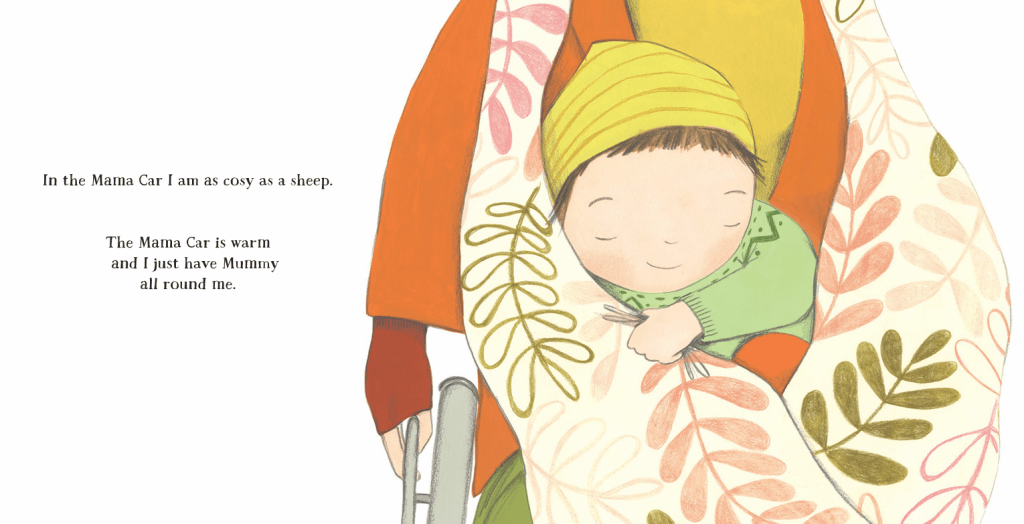
J&L: Why thank you, don’t mind if I do! As I mentioned, the anthology Owning It comes out with Faber in August – that’s for 9-14. But also, Lucy’s picture book Mama Car comes out with Little, Brown in November. It’s not a direct sequel to the Joe books – though there’s a grown-up version of Joe, as the daddy lurking in the background. It’s a story told by a very young girl – aged just two or three – about her and her tricycle, and her mummy and her mummy’s wheelchair. It’s hard to exaggerate the gulf between the way that the world – grown-ups, in particular – see wheelchairs, and the way that very young children see them. It’s the difference between an emblem of weakness and decrepitude and all the stigma that implies, and: Oh! Wow! A chair with wheels! A little car that can go in the house! And for the child of a wheelchair-using mother, it’s just part of mummy: a climbing frame, a mobile lap, the safest place in the world… I’m so grateful that Lucy has managed to capture a little glimpse of that brief, magical time when our girls were small enough for her to be their taxi. This core image from the wonderful Karen George sums it all up – we have the original framed on our bedroom wall:
*GIVEAWAY*
James and Lucy are generously offering either a critique or an AMA (ASK ME ANYTHING) with this interview!
TO ENTER: please comment on this blog post. If you share on Instagram, Bluesky, or Facebook, you get another entry–just add to your comment to share both your handle (e.g. @SOMEAUTHOR) and where you’ve shared it. Please state which prize you would like.
We will select winners at random. Giveaway closes in one week.
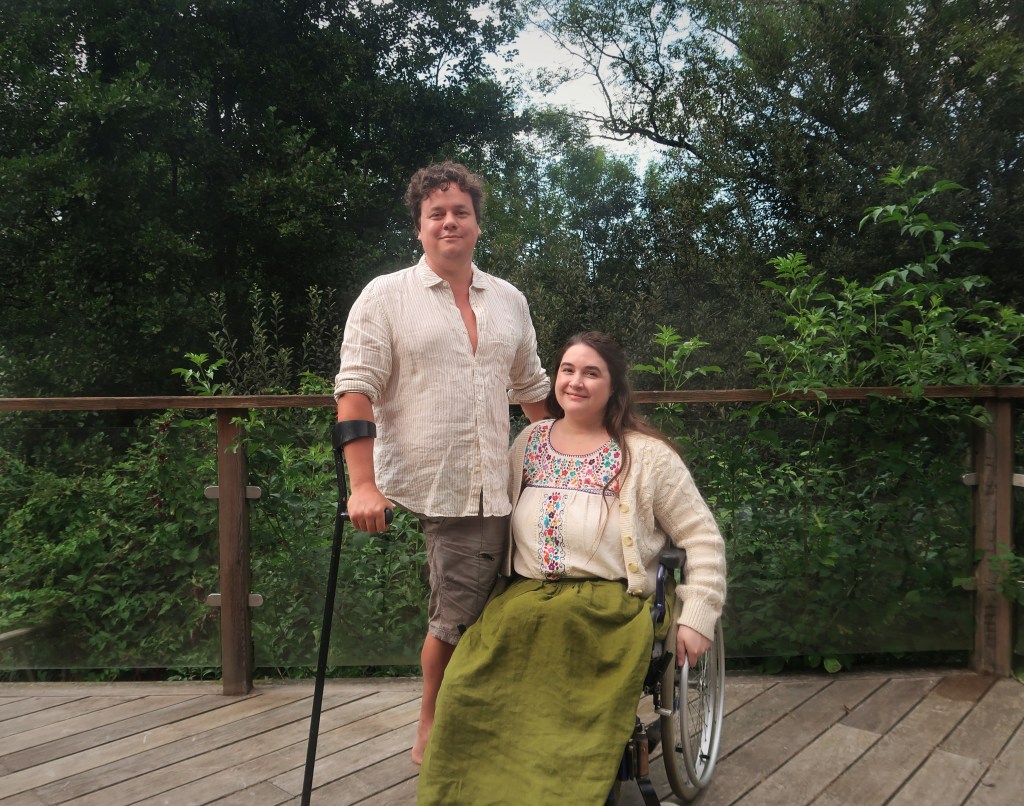
James Catchpole, the author of What Happened to You?, runs the Catchpole Agency with his wife, Lucy Catchopole, with whom he co-authored You’re So Amazing. Lucy writes about disability, family, and children’s books and has written for the BBC and the Guardian. The Catchpoles live in the United Kingdom with their two young daughters and invite you to visit them online at thecatchpoles.net or whathappenedtoyou.co.uk, and on Instagram @thecatchpoles.
 WRITERS' RUMPUS
Such a beautiful and uplifting interview. Thank you Danna, Lucy and James.
LikeLiked by 1 person
So heartened to read this interview as both emotionally and intellectually rich. Having worked for (what seems like) endless years on a picture book for my disabled grandson, I immediately went to the library for your books. Though my grandson, now years beyond selecting picture books as his first choice, has insightfully read and offered feedback for my picture book.
Should I be selected, I would love a critique. Having read variations of this story in schools, I have seen children connect with the main character’s quest.
LikeLiked by 1 person
Great interview! Your kids have a future in journalism. I’d love a critique.
LikeLiked by 1 person
This was such an interesting discussion, thank you all!
LikeLiked by 1 person
Great interview! These are such fantastic books to share with my students, but I have yet to read Mama Car. The Catchpoles are such lovely people to follow on IG!I’d love a critique if I win!
LikeLiked by 1 person
Thanks so much!!
LikeLike