

Hello readers! The dog days of summer are winding down. It’s in the 60’s in New England as I write this! I love summer sunshine, but I love the change of seasons even more. I’m ready to trade in my flip-flops for a cozy scarf and swap reading on the beach with reading by the fire. Preparing for fall is also the perfect time to share Finding Forgiveness by Rebecca Gardyn Levington, illustrated by Diana Mayo, available now from your favorite bookseller.

Rebecca Gardyn Levington is a children’s book author, poet, and journalist who I imagine dreams in couplets as so much of her work is in beautiful rhyme. Her books and poems have garnered recognition and awards. And not only do we share the same fabulous agent (Kaitlyn Sanchez at Bradford Literary Agency) but a love of chocolate peanut butter ice cream.
Rebecca, thanks for talking about writing and Finding Forgiveness. In this lovely story you intertwined sisterhood, forgiveness, and the Jewish Holiday of Rosh Hashanah all while rhyming in excellent meter. One, do you dream in couplets? Two, what was the challenge like of writing a cohesive narrative story with the restriction of maintaining your rhyme and meter?
Hi Monica! Thank you so much for having me and for your kind words about FINDING FORGIVENESS. I’m so excited to share it with everyone.
I love your first question! I wouldn’t say I dream in couplets (although I think that would elicit some REALLY cool dreams) but I can say that I definitely have a much easier time (not that it is at ALL easy!) writing in rhyme than I do in prose.
In fact, while FINDING FORGIVENESS started as a rhyming poem (as most of my picture books do), I was actually told by a couple of fellow writers (folks who are very well regarded and have many more published books than I) that I should consider taking this one OUT of rhyme. They felt like maybe the subject matter was a little too heavy for a rhyming story, and I honestly could see their point (particularly in the draft they saw).
So, I tried. I REALLY tried to change it into prose. But, I love writing in rhyme and ultimately, I realized that it actually wasn’t the rhyme that was the problem, but rather that the meter wasn’t matching the tone I was going for. It was too upbeat for such an introspective story.
Figuring out how to tell the story I wanted to tell with the right tone AND the right meter to match was definitely a challenge, one which also involved changing the opening scene and other plot points, and paying close attention to my pacing throughout. Indeed, this story underwent 31 drafts (both in rhyme and in prose) over the course of about 5 months, so this manuscript definitely didn’t come to me fully formed (not that any of them really do)!
Finding Forgiveness is set during Rosh Hashanah, the Jewish New Year. What role does this setting play in the telling of the story?
For those who don’t know, Rosh Hashanah (which literally means “head of the year” in Hebrew), is the Jewish new year and one of the holiest Jewish holidays. It is also known as the Day of Judgment, because it is the start of a ten-day period (culminating in the holiday of Yom Kippur) during which Jewish people reflect upon their actions from the past year and make amends.
On the afternoon of the first day of Rosh Hashanah, many Jewish people participate in a special ceremony called Tashlich (“Tash-leek”), which typically takes place near a body of flowing water – often in a park with a creek running through it, on a beach or at a riverbank. During Tashlich, which means “cast away” in Hebrew, we whisper our apologies as we throw bits of bread, or sometimes pebbles, into the water to symbolize casting away regrets we’ve been holding on to. Afterward, we reach out to the people we’ve hurt and personally ask them for forgiveness.
Since making amends is such a huge part of both Rosh Hashanah and Yom Kippur, I thought it would be a beautiful backdrop for my story. I specifically chose to feature Tashlich because it is a ritual that isn’t as widely known and there are very few picture books about it. Tashlich is a separate religious service that takes place after everyone has already been in temple all morning, and it is often at a separate location, so not everyone attends. In fact, as a kid growing up, my family never participated in it. It was only when I had my own family that I learned about it and began going with my children each year.

Forgiveness is such an important topic. It is easy to give a quick “sorry” but in Finding Forgiveness the older sister is not quick, she is reflective and it makes the apology much more meaningful. How did you go about giving that character the space on the page to literally find forgiveness by gathering the courage to give a heartfelt apology?
What an interesting question. The short answer is: I have NO idea how I did it! (I don’t think it was conscious, to be honest).
But now that I’m thinking about it more, I guess the longer answer is that I gave the character space by putting myself in her shoes. I used the Tashlich ceremony as the scaffolding to help shape the story in terms of what the older sister was doing, but then I interwove what I believe she would be thinking and feeling as she participated in the various parts of this Rosh Hashanah ritual.
I know first-hand (don’t we all?) how difficult it is to recognize and admit when we have caused someone else pain. We don’t always know how to approach the person we’ve hurt. We are embarrassed by our actions and are afraid of the other person’s anger toward us. We worry: will they ever forgive us? Can I ever forgive myself?
In this story, I really tried to slow things down and show the sister’s thought process and feelings as she grappled with the consequences of her actions. And then I tried to show specifically how the Tashlich ritual helps her find a way forward.

I love learning about how the story is rooted in the Tashlich ritual. Is there a moment that sprouted the seed for this story?
This story actually started with a call for poems by Ladybug magazine in the summer of 2021. They were looking for poems about “traditions and rituals” and since I love a good writing prompt, I started brainstorming about various Jewish traditions and rituals that I find meaningful. The original poem was 5 stanzas long and had a little sidebar about the ceremony. I actually remember being happy when Babybug decided not to publish the poem because I was excited about the idea of playing with it more and maybe turning it into a picture book. I’m so glad I decided to go with my gut!
The illustrations by Diana Mayo are so soft and gentle. They match the tone of the story perfectly. When you write, do you have images in your mind? Were there any pleasant surprises in the illustrations?
I couldn’t agree more. Diana’s illustrations are absolute perfection.
I’m not really a very visual person so I don’t always have images in mind for my stories, but for this one I absolutely did. In fact, I was the one who initially recommended Diana to our editor after seeing her work on SNOW GHOST, written by Tony Mitton. I thought: “THAT is the feeling I want for FINDING FORGIVENESS: gentle and intimate and lyrical and classic.”
I remember being SO over the moon that she said “YES!” (And we’re actually working on a second book together about Shabbat that will be coming out in 2027! I’ve already seen sketches and they are just as magical as this one. I can’t wait to share it with you all!)
One surprise in the illustrations was Diana’s inclusion of a pair of chipmunks who skitter along playfully throughout the spreads of the book. I assume she got the initial idea to include the chipmunks from the stanza that accompanies the scene where all the congregants are leaving the temple, walking to the park for Tashlich: “We step into the sunshine/ ‘Shanah tovah’ we say. /Chipmunks scurry, hurry past. /At last, we’re on our way.” But Diana chose to run with this and include the little creatures in the majority of the spreads throughout the book. I think their cuteness adds a wonderful layer of levity to the story and I think kids will enjoy searching for them in each of the spreads.
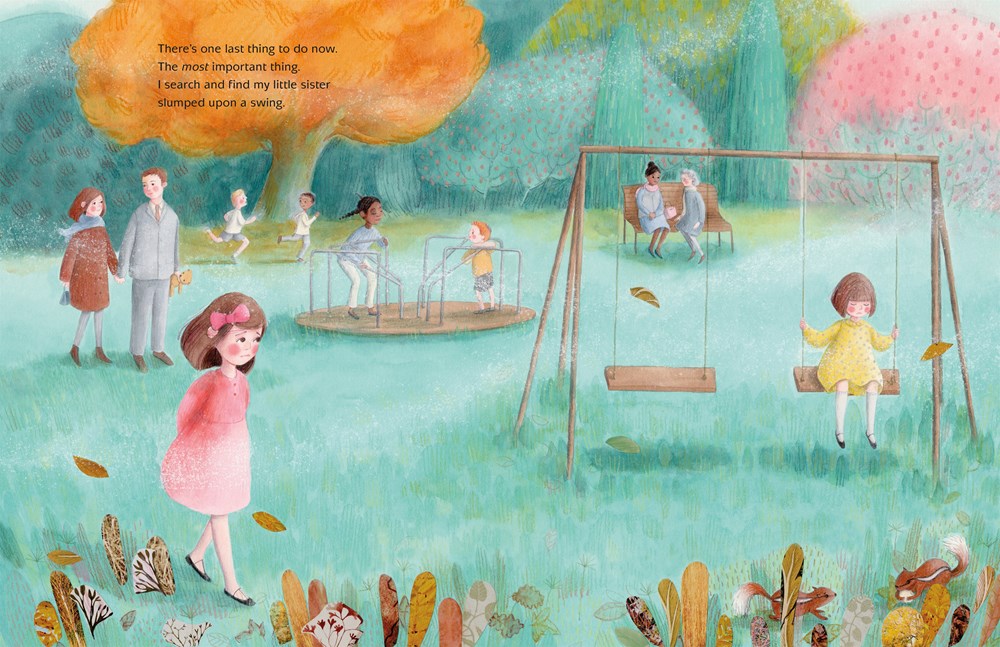
Did you spot the chipmunk?
We have already established that chocolate peanut butter ice cream is the best, but what are your favorite snacks while writing? What fuels those seemingly-but-not-really effortless rhymes?
Ha! Fun question! Honestly, I don’t usually eat when I’m writing, but (at least this summer) you’ll always find me with a tall tumbler of iced coffee by my side!
Rebecca Gardyn Levington can be found on Instagram (@RebeccaGardynLevington) and writes one of my favorite newsletters. Be sure to sign up on her website (https://rebeccagardynlevington.com/) for monthly wisdom delivered to your inbox and…
***Giveaway Alert***
when you sign-up for Rebecca’s newsletter, comment below letting us know and you’ll have a chance to win a signed copy of Finding Forgiveness.
Rebecca’s Bio:
Rebecca Gardyn Levington is a children’s book author, poet, and journalist with a particular penchant for penning both playful and poignant picture books and poems – primarily in rhyme. She is the author of WHATEVER COMES TOMORROW (which has been translated into nine languages and is the winner of a Crystal Kite Honor and a Northern Lights Book Award), AFIKOMAN WHERE’D YOU GO? and FINDING FORGIVENESS (both PJ Library Selections), as well as BRAINSTORM!, LITTLE DREIDEL LEARNS TO SPIN, WRITE HERE WRITE NOW, SOME DAYS I’M THE WIND, DINOSAUR SURPRISE and I WILL ALWAYS BE… with more books forthcoming. Rebecca writes reviews and conducts author interviews monthly for the Picture Book Builders blog. Her award-winning poems and articles have appeared in numerous anthologies, newspapers, and magazines. She lives with her family in Summit, NJ, where she enjoys bouncing on a mini-trampoline, playing Mah Jongg, and eating chocolate-peanut butter ice cream (although not usually at the same time!). Find out more and sign up for Rebecca’s monthly newsletter at www.RebeccaGardynLevington.com.
 WRITERS' RUMPUS
I’ve just signed up for Rebecca’s newsletter! What a fantastic, meaningful sounding book – love that it’s in rhyme!
LikeLike
Such a great interview. I look forward to buying this book!
LikeLiked by 1 person
I’m a big Rebecca Gardyn Levington fan! I’m signing up for her newsletter. Nice interview, Monica!
LikeLiked by 1 person
What a tender subject, Rebecca and you layered a ritual, a celebration onto it. Congratulations.
LikeLike
Between the lovely poetic language and the beautiful soft-pastel colors of the illustrations, this looks like the sweetest book ever. Congratulations to Rebecca on all her success. I’m looking forward to receiving her newsletter and seeing what’s next! 🙂
LikeLiked by 1 person
Marcia, You are the winner of the giveaway! Please connect with me at monica.acker@gmail.com to arrange your prize.
LikeLiked by 1 person
Oh, how exciting, thank you so much! I will send you an email ASAP.
LikeLike
What a beautiful book and heartfelt way to maneuver through such a challenge in our lives…saying a meaningful sorry and forgiving. And doing this through Tashlich is brilliant. It’s not as well known of a ritual, so I appreciate your choice. Thank you.
LikeLiked by 1 person
Thanks for the thoughtful interview. This is a lovely book, which I’m proud to own.
LikeLiked by 1 person