
LIFE AS WE KNOW IT NEEDS
Water
Chemicals
Energy. . .
Remember that.
Thus begins CASSINI’S MISSION: A Spacecraft, a Tiny Moon, and the Search for Life Beyond Earth by Katie Venit, illustrated by Julia Blattman. This outstanding STEM picture book about a piece of machinery—the Cassini space probe—ultimately tells a very human story of exploration, teamwork, and discovery. It has enough heart, soul, and wonder to appeal to readers with a wide range of interests, across multiple age bands.
After its launch in 1997, the Cassini-Huygens mission explored Saturn, its rings, and many of its moons for thirteen years (2004 – 2017). Fittingly for a picture book, CASSINI’S MISSION focuses on one part of this highly successful endeavor—the exploration of Saturn’s moon Enceladus. This “tiny, shiny moon” turns out to be filled with multiple surprises. Each new surprise raises questions that send the Cassini probe in a new direction, seeking data that scientists analyze before sending Cassini on its next quest.
As a prose picture book, language is clear and compelling, with spare, strategic use of rhyme (shiny, tiny moon) and alliteration (tools tasting, hull heating) heightening the dramatic moments. A repeated refrain asks questions that carry readers through page turns.
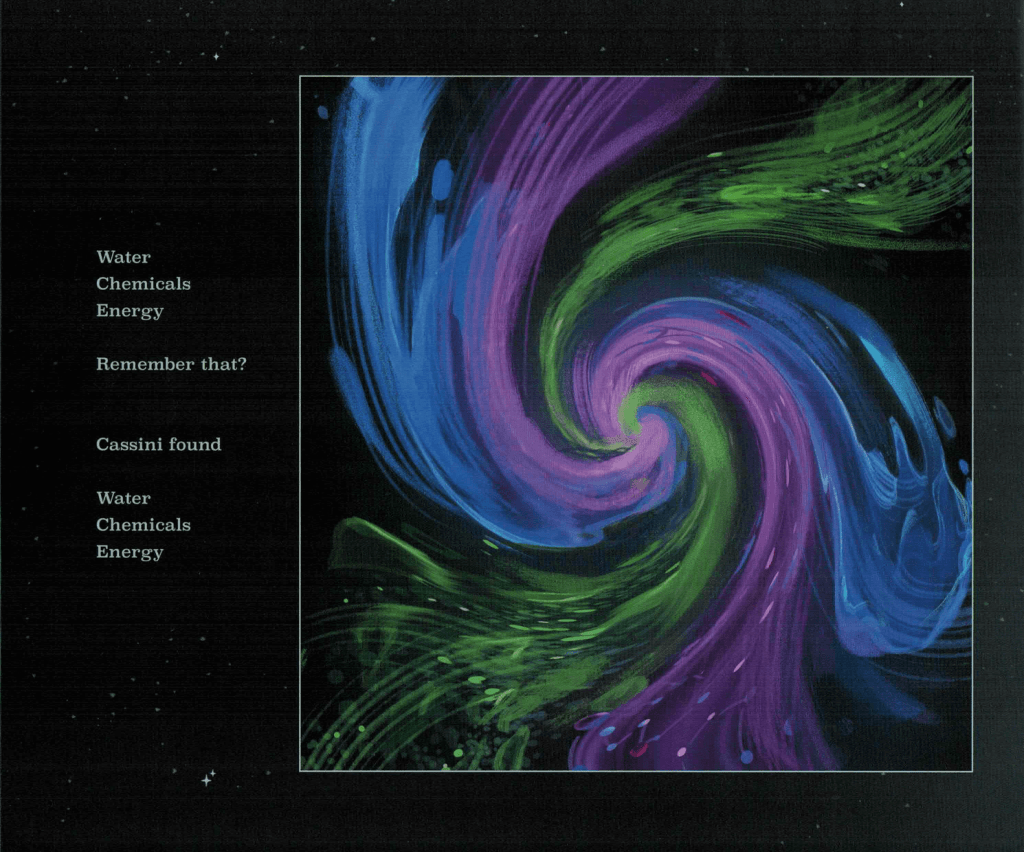
And the artwork! Clear, sharp views of Cassini and the planet and moons she visits are punctuated with the warm, inquisitive faces of scientists lit by the glow of screens in mission control. Particularly impressive are the illustrations of a somewhat abstract concept. The requirements of life, water, chemicals, and energy (remember that?) are first presented as three separate strands in three distinct colors. Later in the story, when Cassini discovers all three on Enceladus, the strands swirl together as the text describes the swirling implications of this discovery—is there life on Enceladus? Turn the page, and the same colors stretch out in tidy, parallel stripes: Saturn’s rings, with a tiny Cassini traveling through the gap. Is there life there? We don’t know. For all her marvels, Cassini can’t tell.

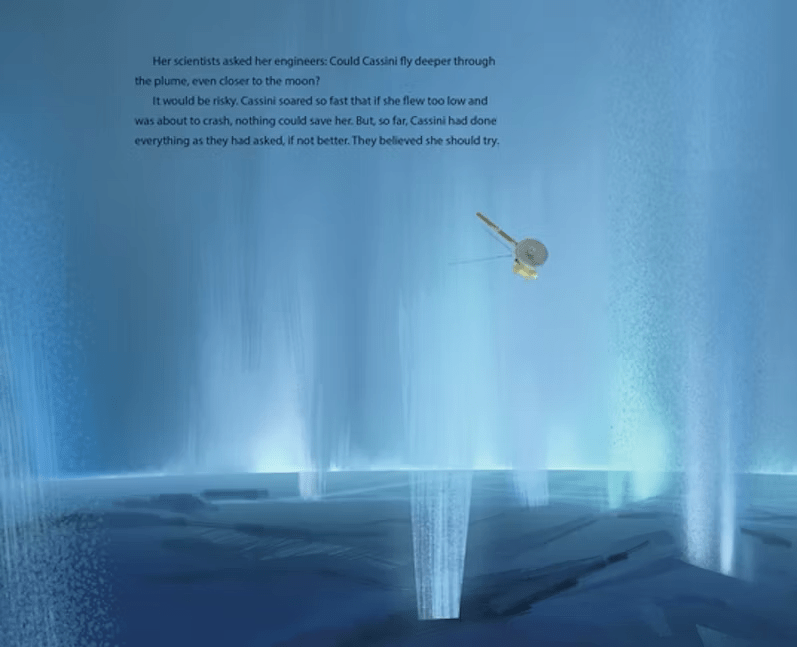
An aspect of the story that I particularly like is the way it shows how scientists and engineers work together as a team in space exploration. The scientists aren’t sure what they’ll find, so the engineers pack the probe with tools. When the probe first explores Enceladus, the scientists are surprised that this icy orb has a warm spot. The scientists ask, can the probe get a closer look? The engineers make it happen. Surprise—the warm spot has plumes of water vapor! The scientists ask the engineers, could Cassini fly through a plume? The engineers say yes. Throughout the story, scientists and engineers collaborate to carry out each twist and turn in the mission of discovery. (See footnote below.)
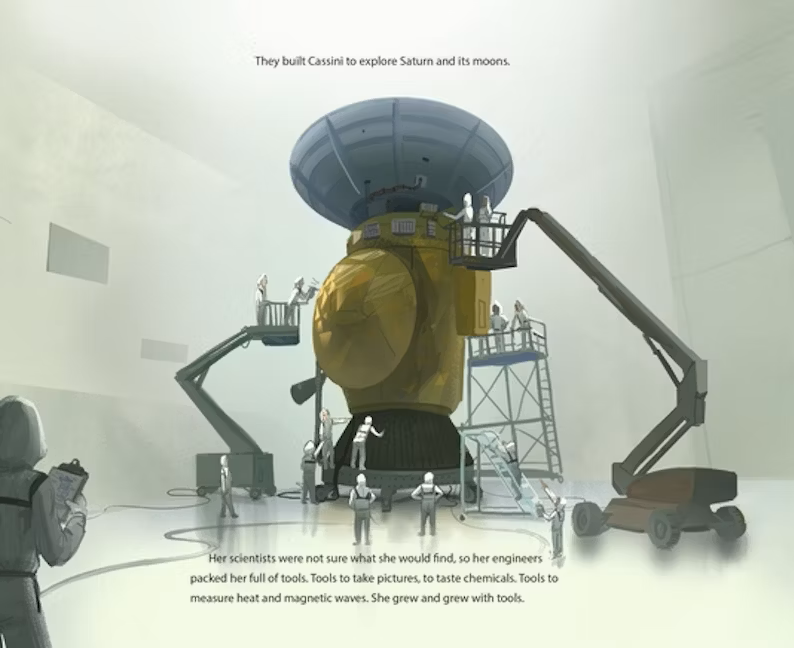
Cassini is lightly personified—she grows up, leaves home, tastes chemicals—but the text and illustrations stay firmly in the realm of nonfiction. Cassini is called “she” throughout because (as explained in the back matter) many members of the Cassini team used this pronoun for the probe. And although engineers send the instructions, the story gives Cassini agency as she carries out each maneuver and collects new data. Cassini—a space probe, a collection of tools, instruments, and a power source—becomes, in the author’s telling, a brave and noble adventurer. And when her discoveries raise a question that her tools are not equipped to explore, and she must be sacrificed to protect the very moon whose mysteries she uncovered—well, I was blinking away tears, along with some of her team members.
Highly recommended, this book should find a home in elementary classrooms from kindergarten through grade 5. Or even in middle school. In fact, I wouldn’t hesitate to hand it to an adult, as a succinct, heartfelt, and beautifully illustrated tale of science, engineering, and discovery.
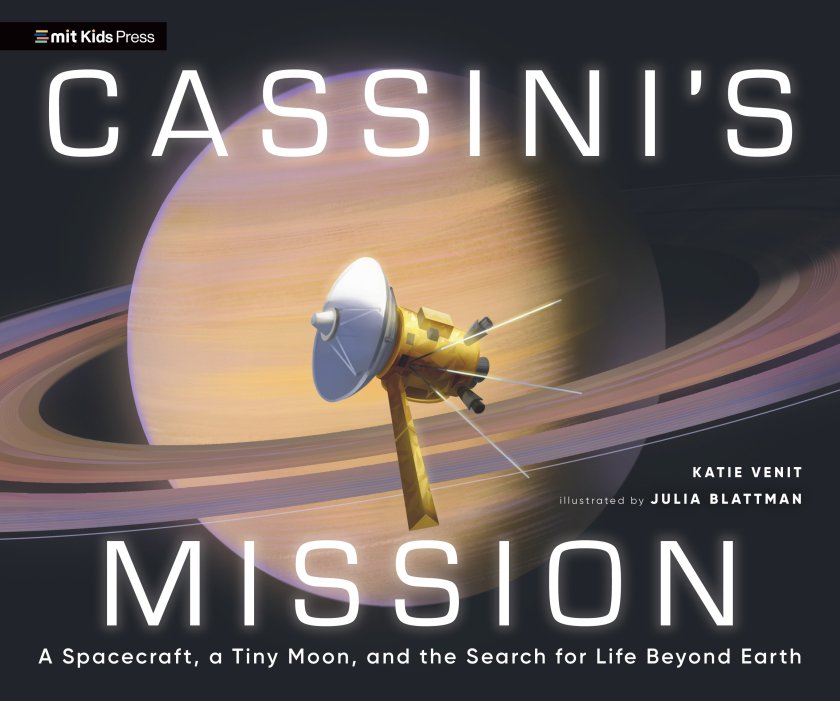
Cassinis’s Mission: A Spacecraft, a Tiny Moon, and the Search for Life Beyond Earth
By Katie Venit
Illustrated by Julia Blattman
MIT Kids Press / Candlewick
Publication date : August 12, 2025
Note from Marianne – the past few years, I have had the honor of working with scientists, engineers, and educators on a NASA-funded STEM curriculum project, PLANETS. The three units, now available as free downloads, invite learners to experience both the science and engineering aspects of space exploration through activity-based, team-based learning. I came away from this project with a new appreciation of the spirit of teamwork involved in making discoveries—and recognized this spirit in CASSINI’S MISSION.
 WRITERS' RUMPUS
Talk about the perfect book for you to review, Marianne! Our 5th-grade curriculum includes a unit about Mars! I will share this post, the free downloads, and touch base with our librarian to hopefully order copies for our school’s libraries!
LikeLike
Brilliant ! This will be a fascinating book for both young and old ! Thank you for sharing.
LikeLiked by 1 person
Wow, this sounds amazing! There is so much to learn, and picture books do it right! Thanks for sharing this!
LikeLike