
Liesl in the Sound of Music; Beth in Little Women; Helena Landless in The Mystery of Edwin Drood. This seemingly random string of characters are some of the roles I had the privilege to bring to life on stage as a theater kid.
My love of theater extends well beyond reciting lines in front of an audience. I served as theater foreperson in college, hanging curtains, focusing lights, and painting sets. All of this to say that my love of theater runs deep, which has me over the moon…
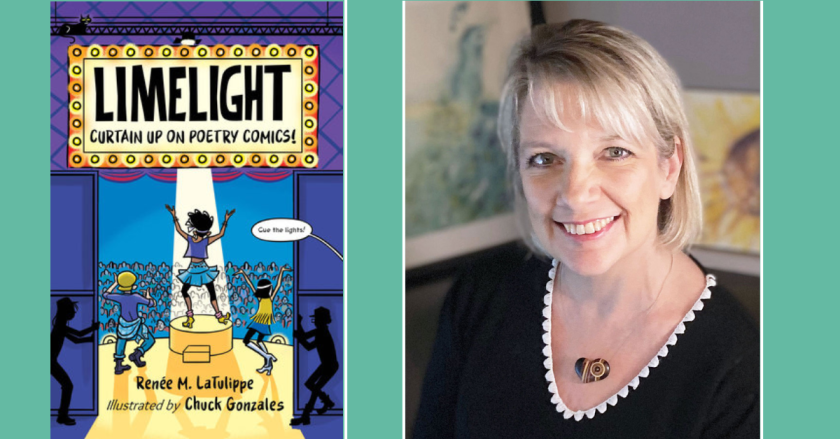
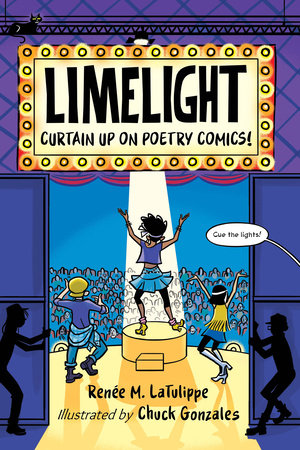
… to share Limelight by Renée M. LaTulippe, illustrated by Chuck Gonzales. In this collection of poems for ages 9-12 (and beyond), the reader experiences everything that makes up the theater. Limelight is available to add to your book collection on October 28th!
Thank you so much for sharing Limelight! Before we dive into talking about this amazing book, can you share a bit about yourself?
Thanks for having me, Monica! Let’s see, what tidbits can I share? I wrote my first poem when I was seven, but later veered from creative writing to theater before swerving back again. My favorite color is purple and my favorite flower is the humble daisy. I don’t own a pair of jeans. I realized too late that I got the wrong graduate degree. My other creative outlets are watercolor painting and playing clarinet. I greatly admire ballet dancers. I’m a homebody but love a good road trip. I feel that I have fulfilled my purpose as a parent every time my kids use sarcasm to amusing effect. I’ve lived in Italy for 25 years and rarely eat pasta. I think that covers it! 😀
Poetry paired with theater elements in a graphic novel format is so unique. I am super curious how you unlocked the way this book needed to be put together. What was the journey like from first poem to finished product?
The credit for that goes to my visionary editor, Yolanda Scott. And you put it very well when you say “unlocked the way this book needed to be put together,” because when I finished the manuscript I really wasn’t sure what to do with it. For a time, I had a very different, artsy vision of it, but it eventually became clear that this was not the way to go. Then Yolanda hit on the idea of making it about a middle school performance, and we were off! It was an eight-year journey from writing to publishing, and the graphic novel idea came in the last couple of years. I believe in the end that the manuscript needed that time to mature and take shape in both our heads.
Do you find that your background in theater impacts or influences your writing for children?
Absolutely, always. So far, everything I’ve written has some connection to the arts—it’s just there, inside me, and it comes out unbidden. I mean, I’ve done dancing crabs, a collection of theater poetry, and an upcoming PB and works in progress that heavily feature music, painting, and theater (again). The arts are essential and transformative! They are what makes us human and what can save us. Something I always impressed on my kids was the importance of doing at least one creative thing per day (adults need this reminder too!), and I hope kids find that same kind of inspiration in my books.
As the creator and teacher of the Lyrical Language Lab, you are a master of poetry. How did you decide which poetic form was the right match for its subject?
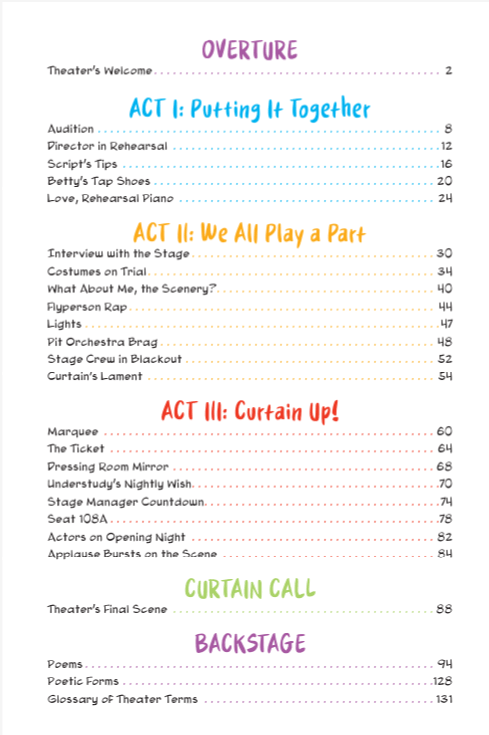
“Master of poetry” may be a stretch, but thank you for that vote of confidence. Haha. Very often in these cases, it is the poem that tells you what it wants to be. For example, I use several repetitive forms because the subjects themselves are repetitive: the curtain goes up and down forever and ever, always the same, so a melancholy pantoum was the obvious choice; instruments in a pit orchestra repeat musical themes, and the triolets allowed me to do just that; a desperate understudy may quietly obsess over her desires, so the subtler repetition of the roundel worked well to create a bit of humor. For “Applause,” I tried several forms, both rhyming and non-rhyming, before realizing that applause should not be constrained and free verse was the only way to go.
Lightning round:
Which poem was the most fun to write?
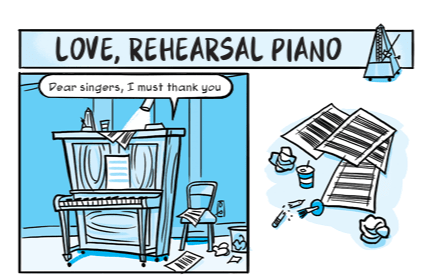
“Love, Rehearsal Piano” — This is the most “monologue-y” poem, and I loved acting it out in the piano’s Brooklyn accent as I wrote it. He’s such a character!
Were there any that kept you up at night?
“Applause” — ostensibly the “simplest” poem, but I just couldn’t figure it out! “Pit Orchestra Brag” was also a brain twister.
Which poem is your favorite?
I love all my children equally! (But I might love “Rehearsal Piano” a smidge more.)
What do you get for a theater snack?
Steak au poivre avec pommes frites. Just kidding! I don’t get anything because you don’t eat during live theater! Ha!
Thank you so much for giving us a behind the scenes peak into the making of Limelight. This brilliant book deserves a standing ovation.
Grazie mille! I hope it finds its audience. 🙂
Renée M. LaTulippe is a poet, writer, and lifelong theater person. She is the author of the poem picture book The Crab Ballet and has poems published in many anthologies. Renée lives in Italy with her husband and three children. www.reneelatulippe.com
 WRITERS' RUMPUS
Okay, okay, I know the Lin Manuel Miranda at the end was for fun but like seriously…. he might read your book Renee! Best of luck with your launch. Can’t wait to see you inspiring theater kids everywhere!
LikeLiked by 1 person
Haha — we have Monica to thank for the GIFs! Thank you so much, Lauri!
LikeLike
Such a fabulous book!!!
LikeLiked by 1 person
Thank you, my friend!
LikeLiked by 1 person
Bravissima, Renée!! And thank you both for this awesome interview 🙂
LikeLiked by 1 person
Thank you for stopping by, Hilary!
LikeLike
My copy is arriving soon…can’t wait!!
LikeLiked by 1 person
Whoo-hoo!!! Thank you, dear Teresa!
LikeLiked by 1 person
Amazing to hear how this all came together. It looks amazing! Great interview and can’t wait to read the book!
LikeLiked by 1 person
Thank you, Robynn! I hope you enjoy it!
LikeLike
I can’t wait to read your book, Renee! Thanks, Monica, for the great interview.
LikeLiked by 1 person
I hope you like it, Claire! Thank you! 🙂
LikeLike
Renee’s poems are always amazing so I can’t wait to read this book!
LikeLiked by 1 person
You’ve always been so supportive, Linda. THANK YOU!
LikeLike
Absolutely amazing – a culmination of many dreams!
LikeLiked by 1 person
Indeed! Took a while, but … I guess dreams do that. 😀 Thank you, Robin!
LikeLike
Looks like a fun book, congratulations to all involved! So glad Renee and Yolanda stuck with it all those years. 🙂
LikeLiked by 1 person
Thank you, Marcia! It sure helps to have a supportive and creative editor!
LikeLike
The book is a must have! What a great discussion, Monica and a fun and funny interviewee, the talented Renee.
LikeLiked by 1 person
Aw, thank you so much!! I hope you enjoy the book! 🙂
LikeLike