
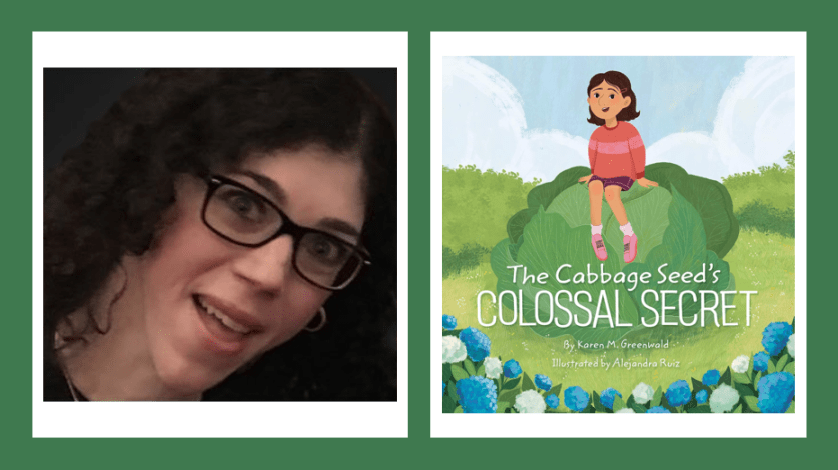
Some books arrive right when you need them.
The Cabbage Seed’s Colossal Secret is one of those books.
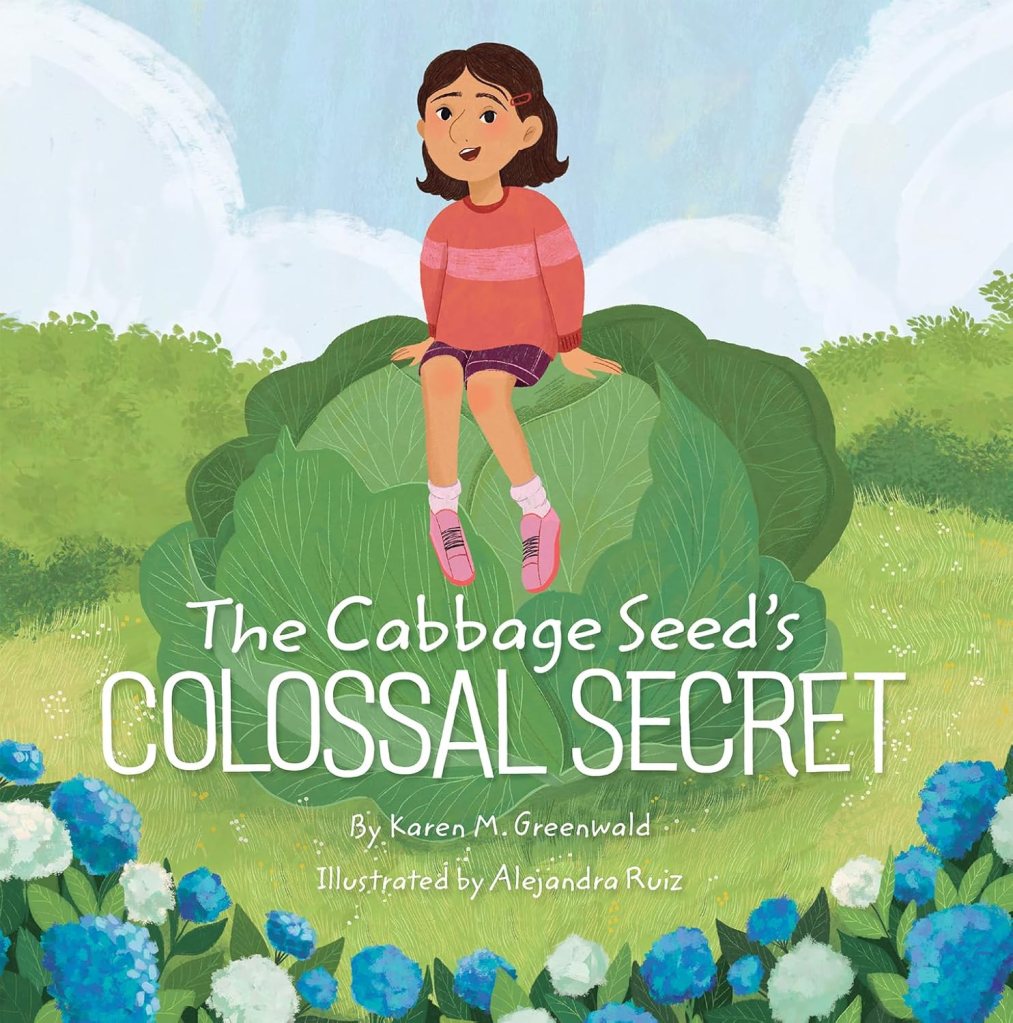
Inspired by the true story of a child, a cabbage seed, and an act of generosity that grew far beyond anyone’s expectations, the book—written by Karen M. Greenwald and illustrated by Alejandra Ruiz—invites young readers to think about food, hunger, patience, and what can happen when someone decides to help. It releases just days (!) after this post runs, with the exceptional Tilbury House Publishers (recently acquired by Penguin Random House), and it feels especially timely.
Community involvement is something Karen has cared deeply about for a long time. It shows up again and again in her work—not in heavy-handed ways, but through stories that trust kids with big ideas and remind them that small actions matter. The Cabbage Seed’s Colossal Secret does exactly that, beginning with a tiny seed and growing outward into community, care, and possibility.
It also happens to reflect who Karen is beyond the page.
Karen and I first connected two years ago when I interviewed her for Writers’ Rumpus about her picture book The Mud Angels. That conversation (if you missed it, you can read it here)—about service, history, and young people stepping up—was the beginning of something that has grown steadily ever since.
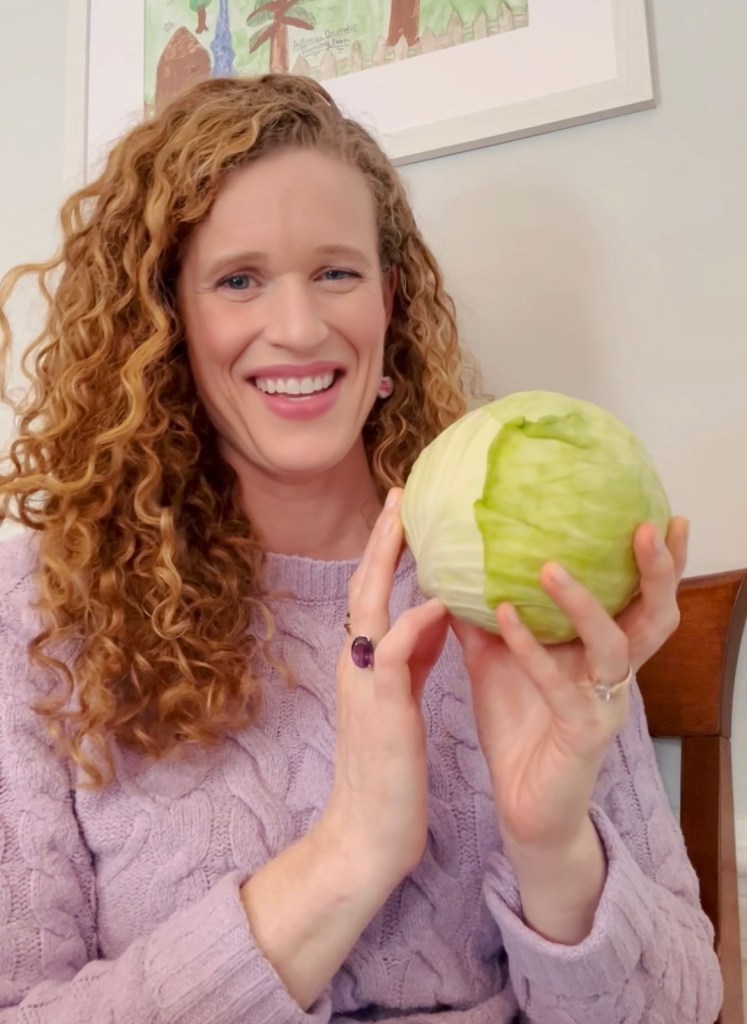
We laugh a lot when we talk. Our conversations bounce from books to kids to family life, from writing deadlines to shared hopes for the kind of world we want young readers to inherit. Threaded through all of it is a deep belief in kids—and in their ability to make a difference when they’re given the tools, the trust, and the chance.
Karen is also the author of A Vote for Susanna: The First Woman Mayor, and across all her books, she returns to the same quiet question: What happens when someone notices a need—and decides to act?
I am thrilled to talk with Karen again, this time about seeds and stories, food insecurity, writing nonfiction for kids, and the joy that comes from helping young readers see just how much they can grow.
Hilary Elizabeth Margitich: Well, hello, Karen. How are you, friend? Welcome back to Writers’ Rumpus!
Karen M. Greenwald: Thank you so much for having me, Hilary! It is always a good time when we get together.
HEM: This book feels very much like a continuation of the themes you’ve always cared about—community, generousity, and helping others. So, tell me…when did Katie’s story first start tugging at you?
KMG: Honestly, the moment I first read a little blurb about it! That seems to be what happens to me—there’s this inner voice that says, this is a story I have to tell! I think I subconsicously begin planning my initial concept before I’ve even begun researching. Katie’s story had all the elements that I care about—a kid found a way to do something that could, and has, changed the world…one seed at a time.
In many ways, I saw a little bit of myself in her. I’ve always cared about others and have tried to make a difference everywhere I can, ever since childhood. I did a book drive for my favorite literacy charity, Reader to Reader, last September and recently found out all the books that got donated became Christmas gifts for kids whose families were impoverished. I teared up when I learned where those books went. Likewise, Katie wasn’t asked to do what she did—it was an instinct born out of living a life of gratitude, even at nine years old. But even more impressive was what she did next, and continues to do. I’m still in awe!
HEM: One thing I noticed is how much time the book spends on waiting, tending, and wondering. Was that intentional?
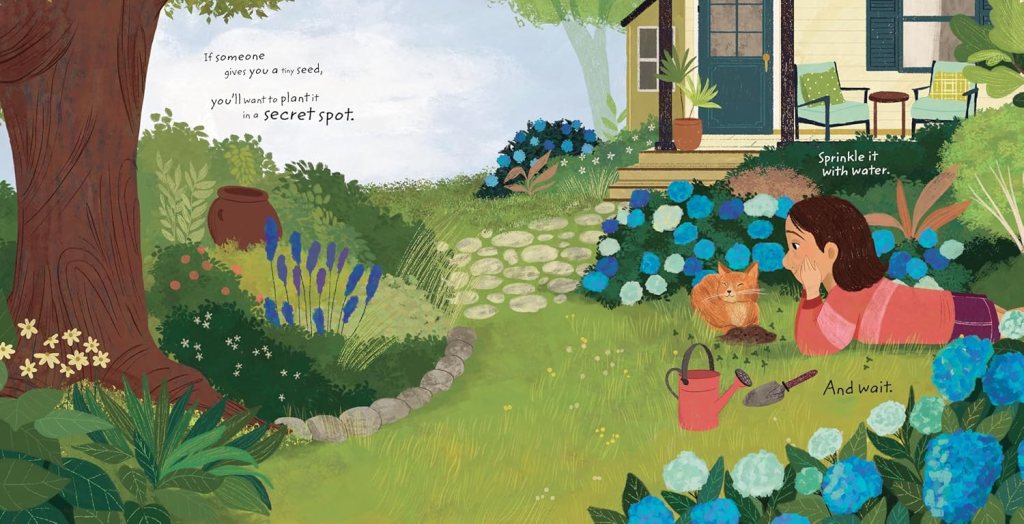
KMG: I’m so glad you noticed! For me, there were two fascinating aspects to Katie’s story. The first centers on the relationship between the child and the seed. She plants it and then feels a responsibility to encourage and protect it. There’s no fast forward button to press with nature. So instead of being glued to a screen, she’s out in the yard, embracing life as it grows before her. The second “act” deals with her relationship with the cabbage and what that means for those living in their own food deserts. Again, nature works on her own time. Katie learns about the values of respect and patience, and encourages others to do the same. So yes, it was my way of mirroring both the natural process of growth and the metaphoric “planting” of a seed—but one meant to acquire what’s needed to achieve a greater purpose.
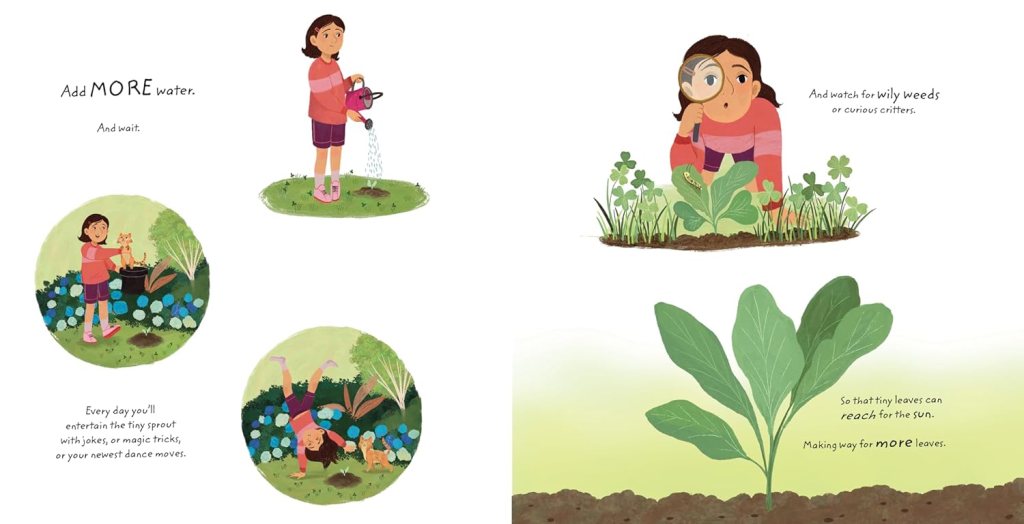
Also, by showing Katie’s patience and strengthening relationship with the seed, I hope readers of all ages see that ideas, inspiration, solutions, and other riches can sprout from simply being present in the moment.
HEM: What a great message to infuse throughout. Now, did you work directly with Katie, founder of the nonprofit Katie’s Krops, while writing this book? Can you tell me about that experience?
KMG: One of the things that excites me most when writing is the ability to do primary research. I’ve been so fortunate to have had access to amazing resources and people connected to what I’m passionate about writing. My agent, Liza Fleissig, always laughs and tells me to, “make a new friend” for each story. In one case, I even found a direct descendant when researching a story, when even books claimed there were no living relatives. We formed a special bond, and I might have solved a centuries-old mystery in her family!
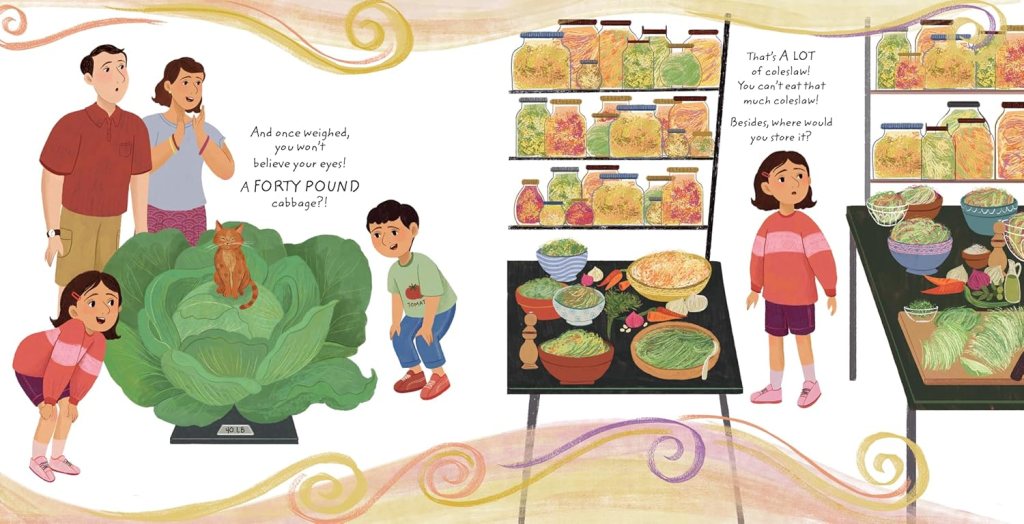
It was amazing to be able to connect with Katie, in real time, to interview her and ask all the questions I needed to make sure this story was a good fit for me. Both she and her mom were very warm, supportive, and helpful over the course of about a year and a half—and I made sure to check in during the “germinating” period of publishing (wink). In fact, there is an incredible picture of nine-year-old Katie and her forty-pound cabbage that her mom took, and gave me permission to include in the book. Were you shocked when you saw it in the backmatter? Even after all this time, I still am a little wowed when I look at the size of it!
HEM: Yes, that was a fabulous picture! I love those real-life elements you added. Now, as you know, we love to talk about craft here on Writers’ Rumpus. Can you walk us through your process for writing nonfiction picture books?
KMG: I have a lot of shorthand codes for myself when I handwrite things. I never thought that I would be someone who typed drafts because I was so entrenched in my process. However, after we were required in high school to use an in-class computer, I changed my opinion dramatically. I should win the award for the most moving of lines of text! I thought I was the only person who wrote this way—without doing a mock-up or charts, etc., but I have found that I approach writing much the way my dad does for his work, so apparently, I’m not alone!
In the beginning of a project, I draft and write in my head over a period of weeks or longer depending on the research (amount and speed). By the time I get to my laptop and start writing, I’ve already got my concept and a framework ready to go.
For research, I am obsessed with OneNote software (pro tip: if you use it, make sure to download the version that allows you to pin your notepaper on the desktop) and make tons of tabs for each element I want to incorporate. I also take notes on my pdfs in the pdfs. This is something that is leftover from law school, I think.

Another big thing for me is reading it out loud. I constantly read sections to get a feel for them, their rhythm, the assonance of word choice, et al, because these books are made to be shared aloud. The words and phrases sould be enjoyable to roll off your tongue.
Finally, when I edit, I erase and rewrite. When I help clients in my “day job” revise, my approach often makes them nervous. But for me, it is how I think I get the freshest, crispest, most powerful end results.
HEM: How do you know when a nonfiction story idea is worth the long haul? (And fellow nonfiction writers know what I mean by that!)
KMG: When I read a blurb or hear about something and my marketing side goes into motion with too many ideas. Also, when I get truly excited to dig in and learn more…then, I know. I feel like if you are going to go through the enormous amount of work to research, write, and sub nonfiction, it should be a topic that you are going to be happy to discuss for years to come. If it doesn’t intrigue you now, it never will and that is an unfulfilling prospect. I try to only write stories I am enthusiastic about and thankfully, so far, I’ve been lucky to have found them.
HEM: That enthusiasm comes through, definitely. And this book naturally invites conversations about hunger and helping others, which can feel like big topics. What do you hope families talk about after reading it together?
KMG: You ask the best questions, friend! Yes, food insecurity is an enormous problem faced by more people than is obvious on the surface. However, it is one all ages can participate in reducing, wherever possible. I learned about the value of doing acts of kindness as a child from my parents. My mom also used to take my niece (age 4 and up) grocery shopping for four imaginary kids each year. They would create backstories, and my niece would pick healthy food she thought the kids would enjoy. Once a grocery bag for each had a few items, they would donate them to a local food pantry. The act of helping inspired both my niece and all who heard about this annual tradition!
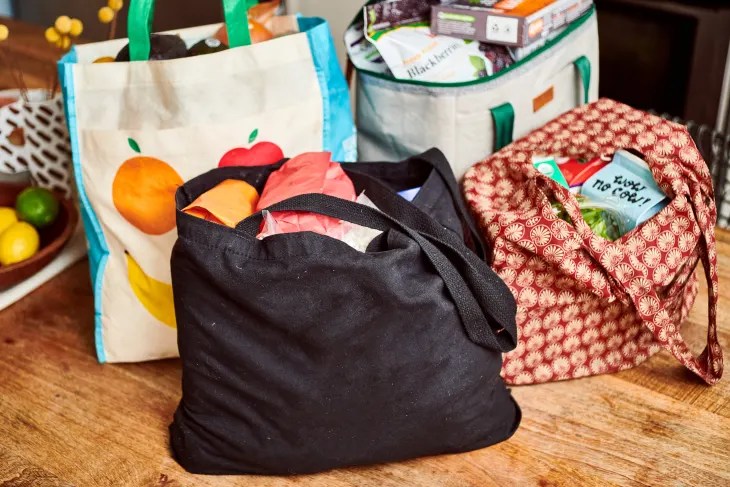
Katie’s Krops encourages children “growers” nationwide. If that commitment is too great, I hope kids and adults who read with them talk about what it must be like to live with food uncertainty. I’d love them to strategize their own ways in which they could help, even if only via small acts.
Finally, we can always say that books are windows and mirrors. Food insecurity can happen to anyone. Giving those facing hardships a sense of dignity and hope is another thing Katie does when she and her family serve her cabbage. I hope families discuss these elements and ways in which they can offer kindness to others in all types of need.
HEM. That’s beautifully put, Karen. And you’re deeply involved in the kidlit community—mentoring, organizing, and connecting people. What’s been energizing you lately?
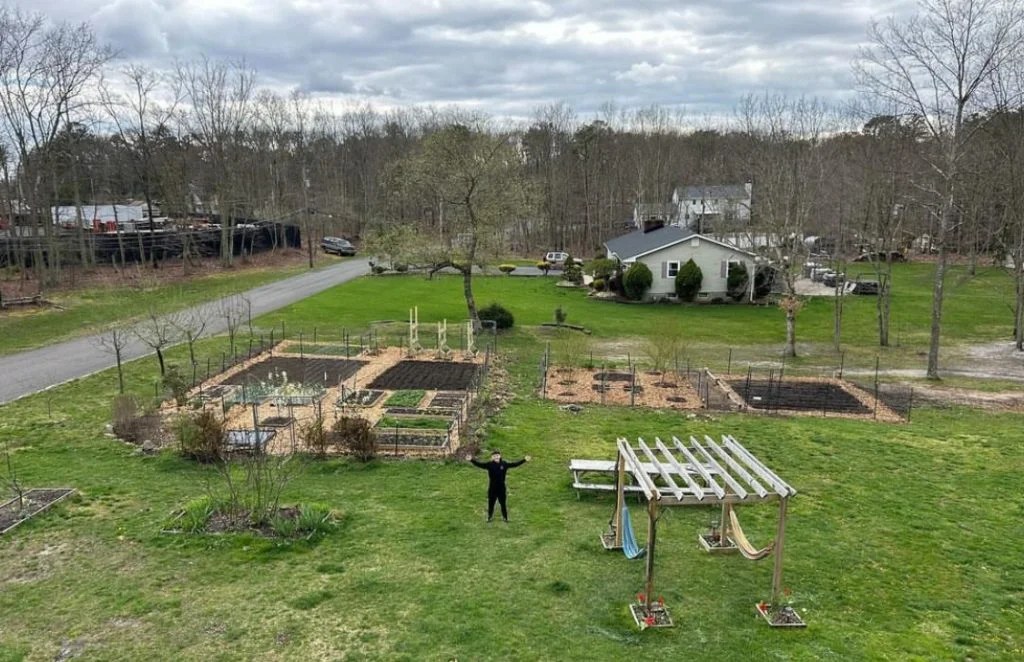
KMG: I am currently powered by Cabbage! Lol! (Couldn’t help myself!) Honestly, I am so moved by the generosity of the kidlit community, every time I do a book drive for under-resourced schools and rural libraries. The idea that I am a small part of enabling students with the opportunity to experience reading newly printed pages motivates me and inspires me. It’s a lot of work but all of it feels like a gift I’m giving myself.
I’m also excited for kids and adults to meet Katie and her cabbage, and to try and determine what the cabbage seed’s colossal secret is… I should have mentioned this before, but that is another thing I hope gets discussed. What exactly is the secret? Spoiler alert, there might not be only one right answer.
HEM: And I’m getting very excited for the #BookHero book drive we’re running next month with Reader to Reader! For those who may not know about it yet, can you share a bit?
KMG: You know, it’s so funny, I had to look on my Instagram to see when this started because it feels like I’ve been doing it forever (in a good way)! Months after my debut of A Vote for Susanna launched in 2021, I participated in my first Read Across America (RAA). Afterwards, I kept thinking about the fact that authors read their books for half an hour to classes around the globe—something I would’ve been thrilled to experience as a kid—but what resources got left behind? One reading on one day, once a year wasn’t enough, especially for schools lacking sufficient resources.
Add this to the fact that RAA was held on March 2nd (Susanna Salter’s birthday—the incredible ceiling-breaking woman at the enter of my first book) in Women’s History Month. To commemorate both and to achieve the goal of RAA, I decided to host a book drive the following year. That way, not only would I read to a class, but I could ensure that some classrooms in need got new books, too. I invited my dear friend, kidlit author Nancy Churnin to join me, and together we made something special happen by getting these books to the nonprofit charity, Reader to Reader. The results moved me so much that I knew I wanted to keep doing it. I think you joined us in the second year, right? And like the Hotel California, we’ll never let you leave! #BookHero became the official name three years ago.
When I started doing book drives for #SunWriteFun (a nonfiction/info fiction summer writing contest helmed by Jenny Buchet and me), I felt that the act of donating should have its own reward aside from the good karma it yields. The kidlit community responded in kind, and I was flooded with generous prizes for the raffle. The same thing happened for the March book drive and year after year, we have been able to open doors for agent, editor, and author opportunities. Thus, everyone wins whether it’s a raffle prize or just knowing that they may have changed the world for a student(s) they likely will never meet.
Finally, I love working with this charity because they give new books we donate where they are needed most, without charging the schools or libraries a penny. For the last few years, I have been given the name of a specific school, and I’ve had the opportunity to work with their principal or librarian on the donation process. This has been incredibly meaningful! Last year, you even took some of the books to the school we were championing, and broke our record of books collected—what incredible gifts!
HEM: I can honestly say that taking those books over to the elementary school was one of the brightest moments of my entire 2025. Finally, Karen—can you tell us what’s next for you?
KMG: I have some exciting events planned for Cabbage (that sounds so odd!), starting with a live IG interview on National Cabbage Day—yes, that is actually a thing! Lol! There will be information on my IG grid, website, et al. The National Women’s History Museum is going to host my official event on March 13th, and (of course) #BookHero later in the month.
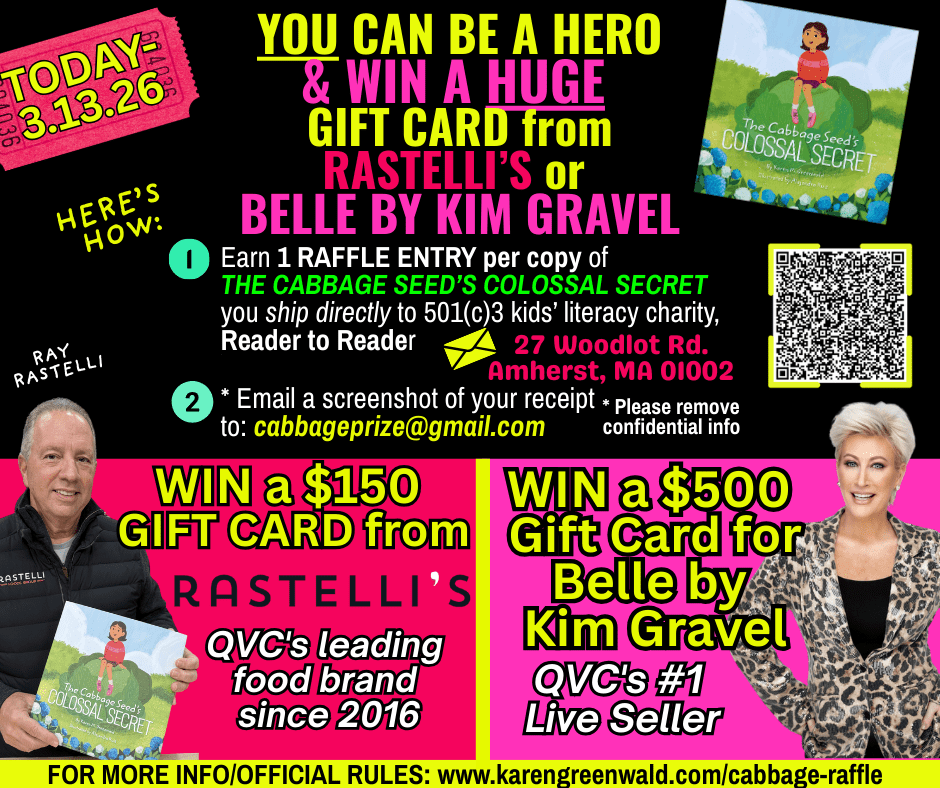
However, until the end of March 13th, I’m running a Cabbage book drive and raffle. For this, when someone donates a copy of The Cabbage Seed’s Colossal Secret to nonprofit Reader to Reader (and emails cabbageprize@gmail.com, or DM’s me a copy of their receipt), they’ll be entered into a raffle for one of two extraordinary prizes: a $500 gift card for Belle by Kim Gravel clothing line (thank you, Kim Gravel!) or a $150 gift card prize from famed food group, Rastelli’s (since 2016, they’ve been the top selling food provider on QVC—think filet mignon and freshly-caught Maine lobstah’! Thank you, Ray Rastelli!). I’m so honored these highly successful leaders in their own fields felt inspired by my efforts and wanted to support them. No limit to the number of entries.
Karen and her book remind me that generosity often starts with noticing. A seed. A need. A question. And then one small step, followed by another. The Cabbage Seed’s Colossal Secret captures that truth beautifully. And knowing Karen, I can say this with confidence: she’s been planting those seeds for a long time.
Karen is generously offering a 20-minute Zoom Ask-Me-Anything session to one lucky reader! To enter, comment on this post! If you share this interview on social media, mention that in your comment and you’ll get another entry. Giveaway closes in one week. US and Canada only.
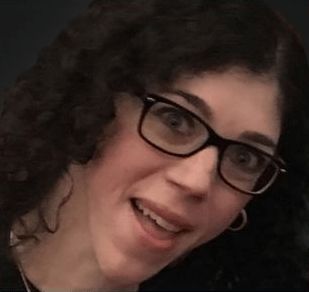
Karen M. Greenwald is the author of A Vote for Susanna (AW, 2021), which was a Kansas 2022 Notable Book and represented Kansas at both the Library of Congress’ National Book Festival and in their Great Reads from Great Places initiative, and The Mud Angels: How Students Saved the City of Florence (AW. 2024). This month, her next picture book–The Cabbage Seed’s Colossal Secret (Tilbury House, 2026)–will be released, with the official launch at a virtual event held by the National Women’s History Museum. She cofounded the #SunWriteFunwriting contest, and runs several book drives annually (including #BookHero) for kidlit charity, Reader to Reader. Her strategic branding efforts have earned nineteen international awards. Most recently, Karen’s educational marketing efforts won “Best in Category” from the 2024 Summit Marketing Effectiveness Award competition. She is a Phi Beta Kappa and holds both her undergraduate and law degrees from Georgetown University.
 WRITERS' RUMPUS
Great interview and congrats, Karen!!
LikeLiked by 1 person
Thanks, Danna!
LikeLike
The Cabbage Seed’s Colossal Secret looks like such a fun and special book! Congratulations, Karen and thanks for your part in making this a better world. I checked out Katie’s website, wow, she’s amazing! 🥬
LikeLiked by 1 person
This sounds brilliant! Growing a huge vegetable can feel like magic — something every kid (or grown-up kid) can appreciate, and the food insecurity theme is so important.
LikeLiked by 1 person
I agree, Ilona! We grow giant zucchinis at my house 🙂
LikeLiked by 1 person
I love this book! Congrats, my friend! And Hilary, please make something tasty with that cabbage.🥬
LikeLiked by 1 person
I will, Jilanne! I really like cabbage :0)
LikeLike
Wonderful interview! Congrats, Karen. You are an inspiration. I can’t wait to learn the colossal secret!!
LikeLiked by 1 person
Thank you so much, Lisa. Thankful for readers like you.
LikeLike
Congratulations, Karen! I look forward to reading your book! I shared this on X and BlueSky.
LikeLiked by 1 person
Thank you for sharing, Kim!
LikeLiked by 1 person
what gracious and generous people we have in the kid lit world!
LikeLiked by 1 person
It really is the best community out there.
LikeLike