
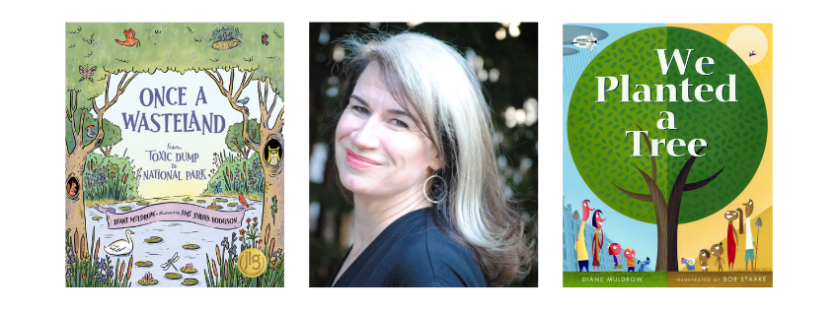
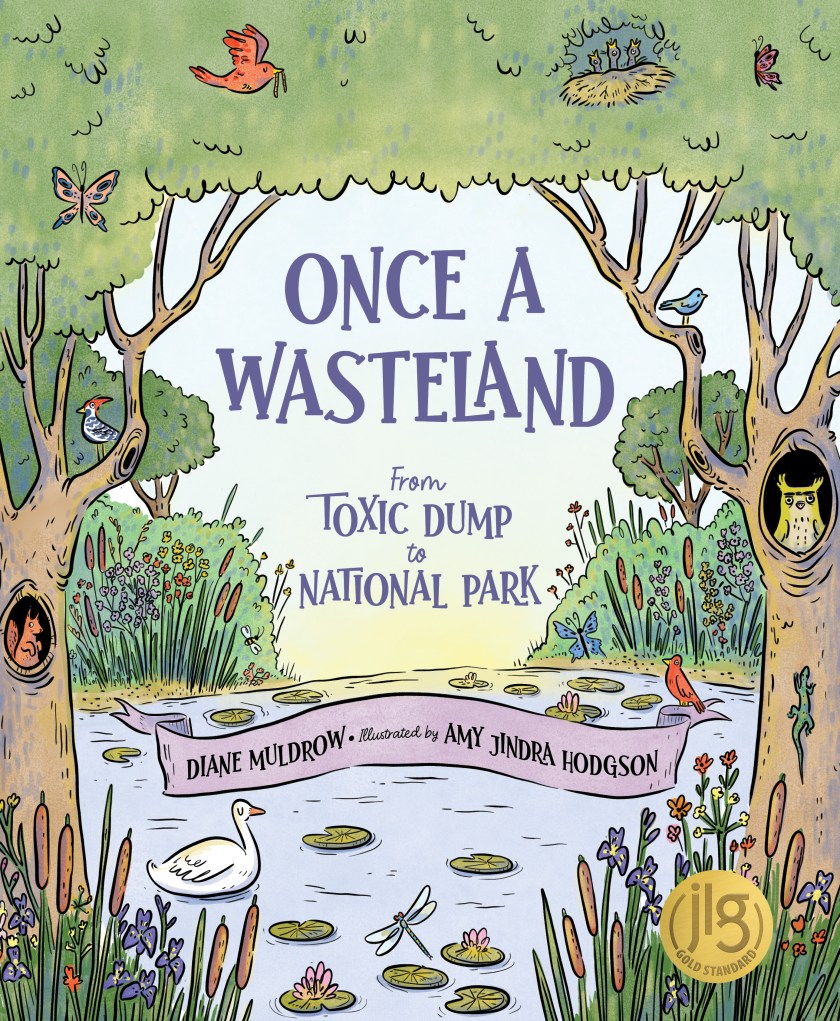
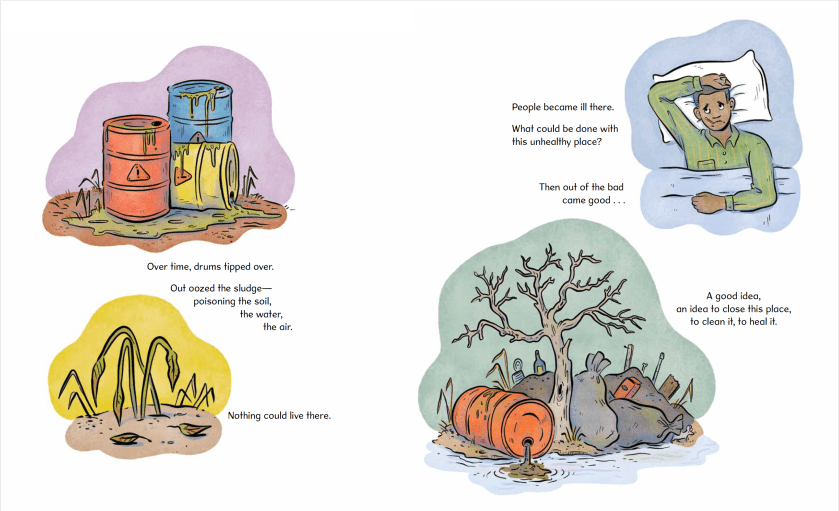
René Bartos: I’m so excited for the opportunity to chat with author Diane Muldrow today. Welcome to Writers’ Rumpus, Diane! You’re an award-winning and New York Times-bestselling author. You also worked for over thirty years as an editor in the children’s book industry, notably as the longtime Editorial Director of the famous Little Golden Books. Your latest book Once a Wasteland: From Toxic Dump to National Park, illustrated by Amy Jindra Hodgson and published by Sleeping Bear Press, is a Junior Library Guild Gold Standard selection. Congrats and Happy Book Birthday! I’m so grateful you’re willing to share your expertise and talk to us about your latest picture book in celebration of Earth Day 2026.
Can you tell us a little about your journey into the kidlit world?
Diane Muldrow: Growing up, I loved reading more than anything. When I learned how to write, I started writing letters to relatives, and then poems and stories through elementary school. In college (Ohio University), when I’d wander into the college bookstore, I’d head to the children’s section first. One day, as I realized that I always did this, I wondered if perhaps my future should be in children’s books.
In the summer of 1987, a month after college graduation, I moved to NYC with aspirations of working in children’s publishing as well as performing in the downtown/East Village avant-garde scene. Happily, I ended up doing both pretty quickly! I started working at Western Publishing/Golden Books that fall as Assistant to the Editor-in-Chief and worked my way up to Editor of Little Golden Books. During those seven years, I took every opportunity that was given me to write licensed books (Disney, etc.) or nonlicensed board books on staff. We junior staffers didn’t get paid to write those books–it was considered just part of the job–but it was fun, I got my name on a book, and it was my “picture book boot camp.” I learned much invaluable information about creating quality content for children.
One of the greatest challenges we editors had was to adapt Disney movie storylines into not only Little Golden Books–which are not large in size, and are just 23 pages of text and art–but also even smaller formats with fewer pages, such as board books. Such great training for me – there was simply no room to overwrite, and you had to get a solid movie storyline in, with dialogue, suspense, and of course lots of room for the artwork! From there, I went to Scholastic’s Cartwheel Books for four years. Now my former Golden Books colleagues began to constantly hire me to write freelance for them–everything from Barbie, to Lassie, to Disney books etc. So that’s what I did on a lot of weekends. . . more good writing experience, plus much-needed extra income. It all added up to a great education in writing picture books, and of course honed my editing skills.
After 4 years at Scholastic, where I wrote my first real original title, a novelty book titled The Happy Book, I freelanced for a year . . . I was hired as the offsite project manager of Golden Books’ Pokemon publishing program. I wrote all those books too. A full-time position was then created for me at Golden Books, so I went back to the corporate world. In 2013, my book Everything I Need to Know I Learned From a Little Golden Book was published by Penguin Random House, who’d acquired Golden Books in 2001. It was an amazing experience–it became a #1 Indie Bestseller and a #2 New York Times Bestseller, with something like 32 weeks on the NY Times chart. In 2018–after seeing the Little Golden Books through their 75th anniversary the year before–I stepped down from the job, got married for the first time at age 55, and moved West, ready for new adventures.
RB: What a fascinating kidlit journey! Such a wide range of experiences. I have many Little Golden Books in my collection, including Everything I Need to Know I Learned From a Little Golden Book. This interview with you sent me to my bookshelves to find and read these treasured stories again. I also love stories about the natural world and ecosystem restoration, and Earth Day 2026 is just around the corner. Please tell us more about Once A Wasteland. The setting for the book is in the Cuyahoga Valley in Ohio. I see from your bio that you are a proud Ohio University graduate. Did that play a role in your decision to write this book?
DM: In 1970, my mom had just taken over the responsibilities for our neighborhood Blue Bird troupe and was wondering what to do with all of us when she read about the upcoming Earth Day–the first one! Our neighborhood bordered a large wood with a creek, and we free-range neighborhood kids spent so much time down there. But the creek had lots of trash in parts of it, so my mom organized an Earth Day cleanup with the Blue Birds and the neighborhood Cub Scouts troupe. It was a huge success, we got written up in the local paper, and we had an early lesson in how communities can help themselves.
My husband grew up in Cleveland. I’ve known him since college. He took me to Cleveland’s Cuyahoga Valley National Park about 10 years ago, and I was knocked out by its beauty. I was especially intrigued by the Beaver Marsh, a former junkyard that had been rehabilitated by the local community, and then taken over by beavers. As I left the park, I thought, “There’s a picture book in this.” I’d mull it over from time to time over the years.
Then one day in 2022, an article popped up in my news feed about a toxic waste dump that had been rehabilitated, and–after 25 years of work and oversight–had just opened to the public as part of Cuyahoga Valley National Park. Here was a new and even more dramatic success story at Cuyahoga Valley National Park! I thought, “Now THIS is what my book will be about!” I started researching and writing it the next day.
RB: Sounds like your mom was a great role model and helped you all get involved in caring for the Earth at an early age. Free-range kids. Love it!
DM: I recently told my mom, “You turned me into an environmentalist!”
RB: Once a Wasteland has excellent backmatter filled with fascinating facts! I love that you included historical photos and a section with ways we can help keep waterways clean. This gives youth a sense of agency. Even though I grew up in nearby Michigan, I learned so much reading it. As you did research while writing the book, what were you most surprised to learn?
DM: I grew up in Pittsburgh, PA. Of course I knew that the Cuyahoga River, in nearby Cleveland, had caught on fire. As I researched this book, I was surprised to learn that the river had actually caught on fire many times!
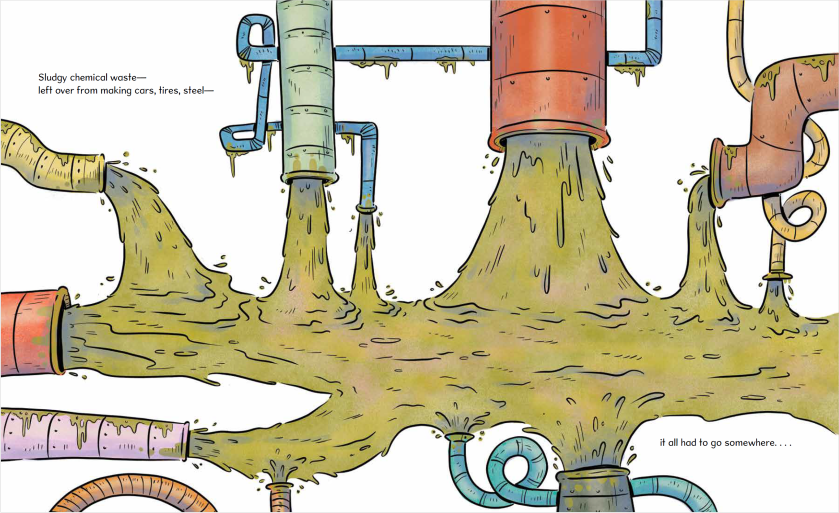
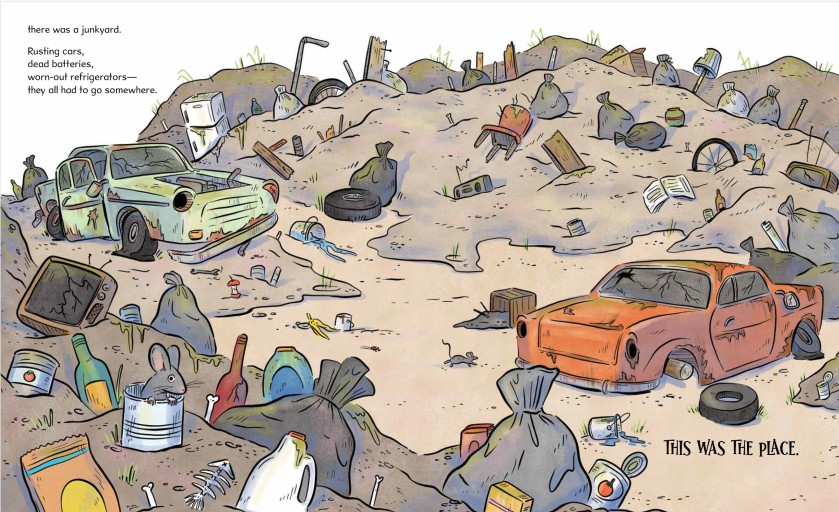
RB: Another aspect of the story I love is the sense of place. You point out that during the manufacturing boom, toxic waste had to go somewhere. And some folks decided that this was the place–apparently without much planning in regards to the land, the wildlife, or human health. NPS workers got sick when they tried to go in to clean it up. And after 25 years, now healed and restored, this is a place of beauty for all of us. A place for wildlife and clean water. We have the power to decide what to do with a place. To think before we act. It makes me think of a quote attributed to Benjamin Franklin: “An ounce of prevention is worth a pound of cure.” As you wrote the book, can you talk a little about techniques you used to give us that sense of place and to empower readers to take action to protect the Earth?
DM: It’s important to mention –and for our young readers to understand, as they will when they read the back matter–that decades ago, we as a society were not as enlightened as we are now about the unhealthy effects of dumping chemicals into waterways or the ground. There was no regulation, no EPA, no Clean Water Act yet. We know better today–and we cannot go backward. And yet, de-regulation is happening now. This book should serve as a cautionary tale of what can happen next. There’s a real danger now under current leadership that we can go back to those bad old days. But this true story’s happy ending should give our young readers hope, courage, and know-how.
As for my technique to present a sense of place in this book, I’m not sure I consciously thought much about it. . . obviously the illustrator deserves great praise for delivering on that! I think I focused more on mood– in choosing simple wording, in choosing to write this in free verse. I wanted the truth to present itself to our young readers; I knew it wouldn’t need a lot of “ornamentation” from me. And I didn’t want it to sound like a text book! I knew the illustrations would be essential in establishing the gravitas as well as the hope and beauty of this true story.
RB: Yes, such important points. We know better today. And this book is such a timely reminder for Earth Day. Going backward with environment protections would be a tragic mistake.
I agree wholeheartedly that the beautiful illustrations by Amy Jindra Hodgson (including endpapers filled with plants and wildlife) are powerful. I love seeing how the creativity of authors and illustrators combine to create magic in picture books. I have started making folders with information and photos for some of my nonfiction works in progress that might be helpful for an illustrator. I know that typically authors and illustrators work separately so that each can bring their own creative vision to the book, although I have heard that some folks collaborate. Did you connect with Amy during the book creation?
DM: It was challenging to write –and for Sleeping Bear to publish–a picture book on this sobering topic, even with its happy ending. The editor and creative director wanted to choose an artist who could bring a great sense of color, an upbeat feeling, to the project–and Amy Jindra Hodgson was the perfect choice! She brings lyricism, lushness, urgency, and a sense of action, of positive action. Her little mouse that lives in the dump brings a sense of fun and whimsy–a great touch for this age group. I was asked not to communicate with Amy during/about the making of the book. I wouldn’t have done so anyway–because I was an editor for 31 years, and I know that a request of this type is necessary. I like to say that it takes a village to make a picture book. Editors and art directors have their own vision of the book-to-be. Once the manuscript is with them, the author needs to let go so that the collaboration with the editor, art director, illustrator, book designer, and copy editors can happen. I saw the book in sketches, and there were several rounds of them before the color art stage. It was good work on all our parts to create what you see on each page. Once again I just want to say how lucky we were to get Amy Jindra Hodgson!
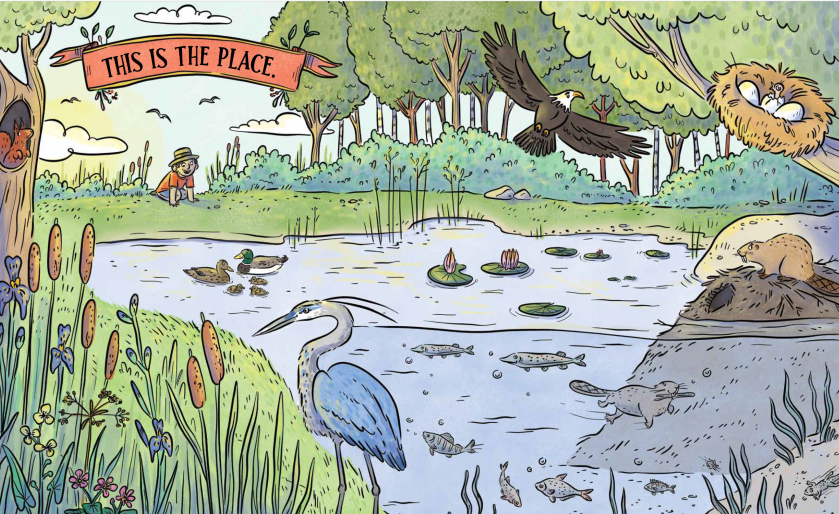
RB: Definitely a lot of great work from all involved! The details are wonderful, and kids will love pointing out the little mouse in the dump as well as the diverse wildlife featured after the area was restored. I adore national parks and have been on a quest to visit as many as I can with my family. How many have you visited in the U.S.? Around the World? Do you have any favorites?
DM: It’s not a national park but the Okavango Delta in Botswana, which is a UNESCO World Heritage Site, is a place I’ll never forget…so is Namib-Naukluft Park in Namibia, where I had the amazing luck to see a very rare pygmy desert elephant sleeping on its side, then waking and eating a piece of fruit from a tree. Closer to home, Sequoia National Park was a dream come true to experience. Carlsbad Caverns in southeastern New Mexico is a must-see!
RB: I’ve been to Sequoia. The other spots are on my bucket list now. Thanks for sharing!
In reading Once a Wasteland, I was reminded that sometimes we can start to take things we care about for granted, and national parks are no exception. There is a growing body of evidence supporting the importance of spending time in nature for our health and wellness. But these natural spaces remain only when we continue to protect them for all to enjoy. Were there things you found out in writing this story that surprised you? Ideas you hope readers will take away?
DM: As I embarked upon this project, I realized that I hadn’t known much about the Clean Water Act of 1972. I hope our readers will learn from this book how the “bad old days” were, and yet also understand that they will always need to be vigilant about caring for our natural world! Today’s EPA is reversing climate policies, weakening emissions standards, and prioritizing deregulation. WASTELAND is a success story that has come along at a good time to give today’s kids an education on the past and present, as well as hope… and know-how.
RB: A success story to educate and provide hope–I love that! Advocacy on a national level is only a part of the story. I often hear folks voice concern about national policy and actions. And I get it. But I also see a lot of great things happening at the state and local levels. And I know of amazing youth making a difference to preserve natural spaces and help people connect to nature. Every voice is needed and there is much to be done in our communities. And often, grassroots efforts are critical to build momentum and make a difference on a larger scale. Do you agree?
DM: Yes! Change usually starts on a local level.
RB: There is a growing concern about climate anxiety and ecoanxiety in youth, and a need for books with hopeful messages that give kids agency. Once a Wasteland is a good example of a book that provides facts but also shows how environments can change and heal when we take action. The back cover proclaims “Out Of The Bad Came Something Good” and shows images of the transition from a polluted space to a restored, thriving place of beauty. What advice do you have for authors tackling stories about the environment?
DM: My advice is to keep your message positive, or you will have trouble selling your story.
RB: True, both in terms of selling the story to a publisher and engaging and empowering young readers!
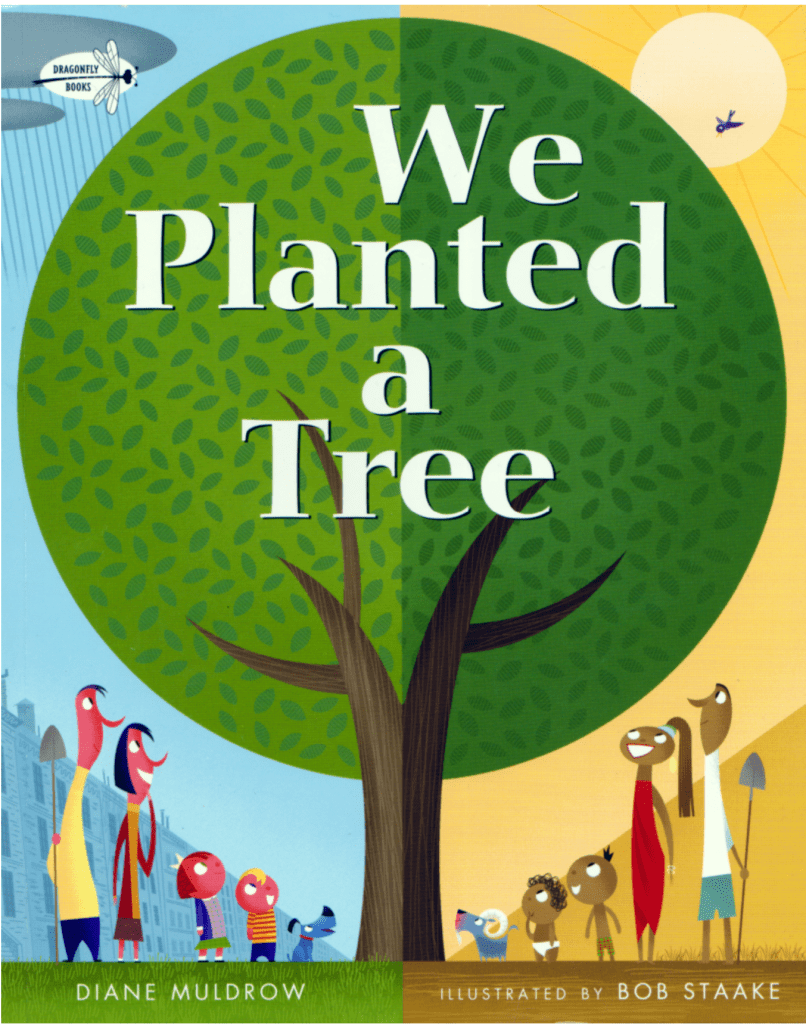
It is clear that protecting the natural world is important to you. Your book We Planted a Tree , illustrated by Bob Staake, was a 2010 Chicago Public Library Best of the Best selection, and a Bank Street Best Children’s Book of the Year. It has been distributed by NGOs and nonprofit organizations worldwide for the purpose of educating young people about sustainability. School Library Journal wrote “With a synergistic mesh of lyrical language and bright, expansive illustrations, this picture book . . . is a winner. Muldrow’s poetic text shapes beauty from simple observations. . .” Another great example of a book that gives kids agency and celebrates the natural world. Please tell us more about this book. What inspired this story?
DM: This book was years in the making, and the book I am the most proud of. For several years, I had the title “We Planted a Tree” rattling around in my head. It seemed so powerful with the word “We” in it– but I didn’t know what to write! As years went by, I’d mull over one idea and then the other. Then, one night I saw an interview of the Kenyan activist Professor Wangari Maathai on PBS. She’d recently won the Nobel Peace Prize (2004) for her Green Belt Movement, focused on planting trees in Kenya. She galvanized the people of her country to plant seedlings. This was not just an environmental movement– it became a civil rights movement. It’s an amazing true story of hope–look it up! Anyway, a good while after watching this interview, I finally started to see the book in my head…I knew it would show people all over the world planting trees, and then having better lives thanks to the trees. I knew a simple message like that would resonate with kids, and I knew it would be written in spare free verse with “We planted a tree” as a refrain–the kids of the world are the narrator. I then finally wrote it–really expelled it, it felt like giving birth–in a few hours. I had no idea that the book would go on to be used by NGOs, and environmental, and charitable orgs all over the world. It even was the subject of a symphony performed in Spain!
RB: I love that watching an interview of Wangari Maathai was an inspiration! And you raise another great point about the importance of her work galvanizing both an environmental movement and a civil rights movement. Environmental justice and access to nature as a child right– nature for ALL children–are central themes in my volunteer work. And as a pre-published author, knowing this book was years in the making brings me a sense of comfort. The creative process takes time. We need to continue learning, keep an open mind, and be patient for that spark of inspiration to show us how the story needs to be told. The kidlit industry can be tough.
As a previous children’s book editor, what changes in children’s literature have you witnessed over time that you see as most consequential? What gives you hope when it comes to kidlit?
DM: There’s a lot more nonfiction out there now, and most of it is so well-done…so much more artful than it was a few decades ago. But I hope we don’t lose sweet, fun, quirky stories. Story is still so important for our young readers! As the editor Little Golden Books, I reissued a lot of the quirky and fun Little Goldens that were published in the 1940s and ‘50s…with of course stunning artwork by the greats. Kids need to experience wonder, the wonder that comes from nonfiction, but they also just need to laugh!
…Kidlit is, as Leonard Marcus wrote so beautifully, “a child’s introduction to the twin realms of literature and art.” I believe that it’s as important for society as clean water, healthy food, love, and justice.
RB: Lovely. This is so true! Do you have any other words of inspiration or helpful tips for kidlit writers? For those who are just starting out in writing children’s books, what is something you wish you had known when you first started out in your kidlit journey?
DM: When you think you’re finished writing your manuscript, put it in a drawer and forget about it for a while. When you take it back out and read it, the flaws will jump right out and show themselves to you. Time is a great editor.
RB: Great advice. How about a fun fact about yourself you would like to share?
DM: I went on QVC two times to sell Little Golden Book sets. First, I had to go to QVC for rigorous training. It was fun, and kind of cool to be behind the scenes there. As you speak to the camera, there’s a screen that you can look over at, which shows how the merch is selling in real time. QVC is a world and really even a culture unto itself!
Another fun fact: A few months after I got my first job at Golden Books, my boss showed me my resume with the word “Maybe” written on it by the company’s HR person. “Look,” he said with a chuckle, pointing at the paper. “You were a ‘maybe’!”
RB: Well, the “maybe” has turned into quite a successful career and many delightful and inspiring books for children! Diane, thank you so much for sharing your work and your kidlit journey with us. I enjoyed getting to know you better and for the opportunity to learn more about your books, including Once a Wasteland. What is next for you? We can’t wait to see more of your work!
DM: Rene, thank you! I appreciate your thoughtful questions. I have another new book out right now: My Little Golden Book About Route 66. This year marks the Route 66 centennial! And in 2027, Sleeping Bear will publish my book Ssstanley, the Christmas Snake!
RB: Wonderful. Thank you again. We look forward to reading about Ssstanley!
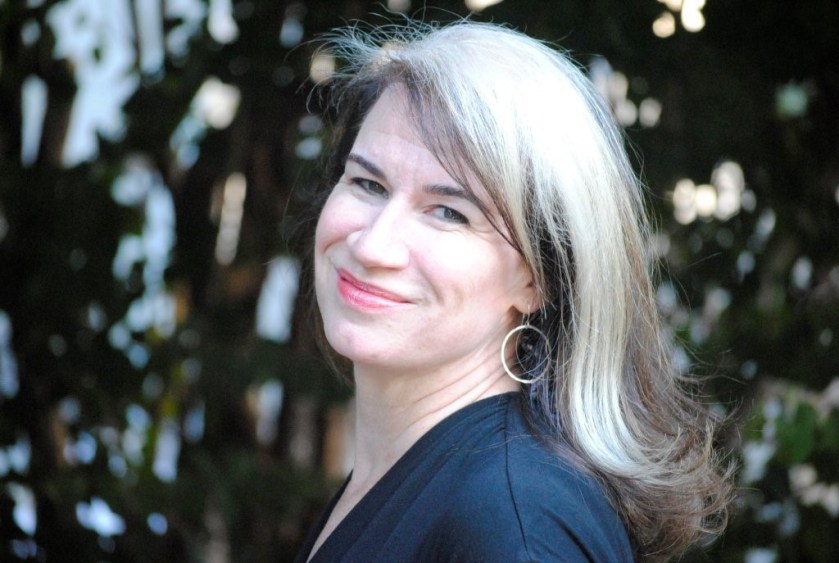
Diane Muldrow is the author of the New York Times bestselling book Everything I Need to Know I Learned From a Little Golden Book and its spinoff titles, and a prolific author of children’s books. Her picture book We Planted a Tree was a 2010 Chicago Public Library Best of the Best selection, and a Bank Street Best Children’s Book of the Year. It has been distributed by NGOs and nonprofit organizations worldwide for the purpose of educating young people about sustainability.
Diane worked for over thirty years as an editor in the children’s book industry, notably as the longtime Editorial Director of the famous Little Golden Books. She edited Golden Legacy: How Golden Books Won Children’s Hearts, Changed Publishing Forever, and Became an American Icon Along the Way (Random House, 2007), by Leonard S. Marcus. She and Marcus then co-curated a touring exhibition of original Golden Books illustrations. In October 2007, Diane was a keynote speaker at a 65th anniversary celebration of Little Golden Books in Amsterdam. Diane stepped down from Golden Books (Penguin Random House) in 2018 to marry, move West, and write full-time.
Diane appeared as a prolific dancer, actor, and writer-performer in New York City’s avant-garde downtown scene in the late 1980s/early 1990s. Raised in Pittsburgh, PA, she holds Bachelor’s degrees in Fine Arts (Dance), and in Magazine Journalism, from Ohio University in Athens, Ohio.
Diane is available for speaking engagements, storytime readings, book signings, and interviews. You can contact her HERE.
Website: https://dianemuldrow.com/ Social media: @dianemuldrow
 WRITERS' RUMPUS