
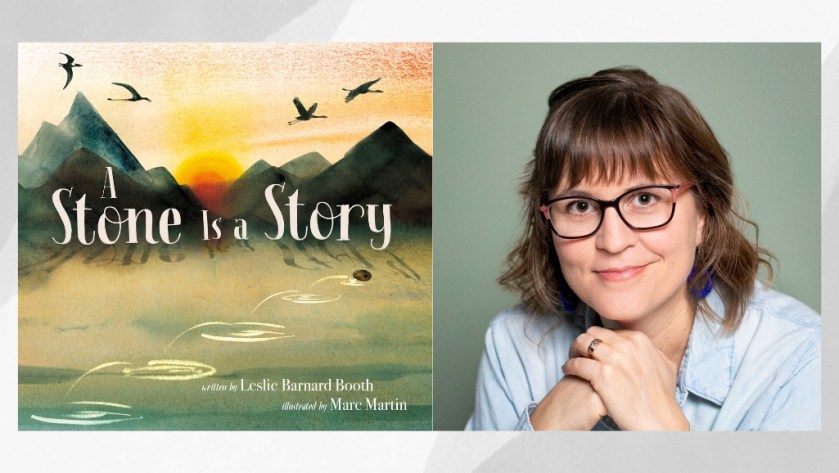
Guest Post by Leslie Barnard Booth
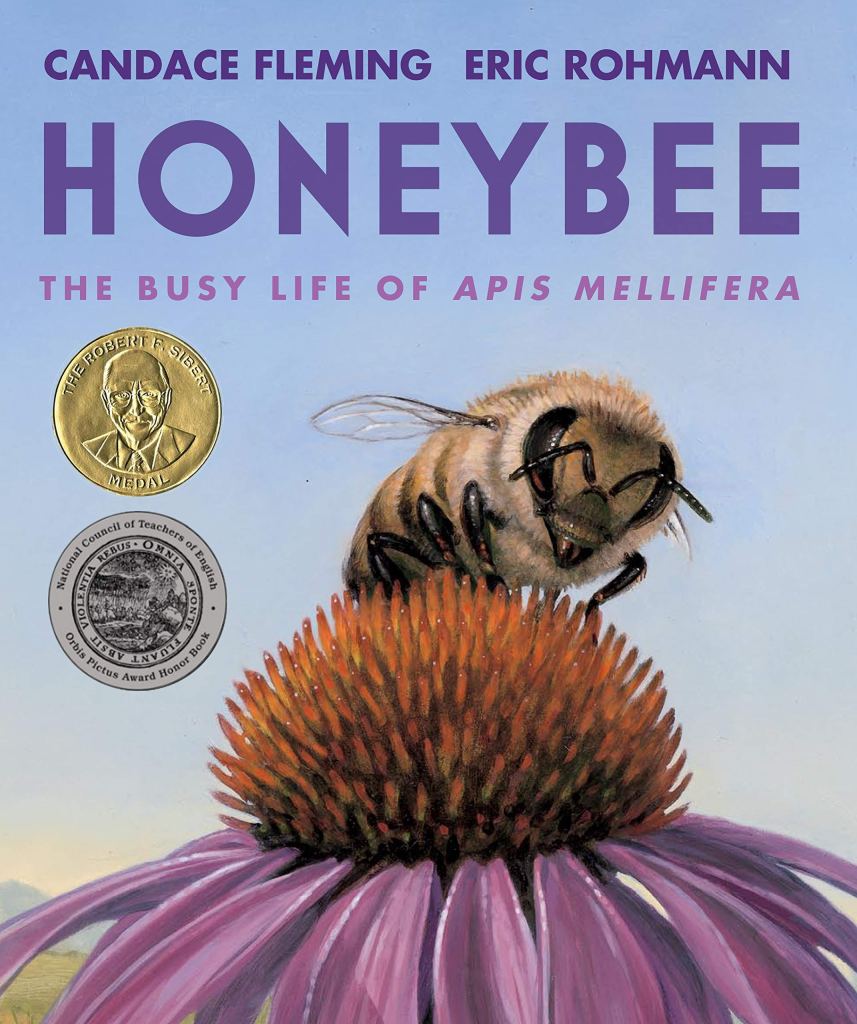
Poetry and science often go hand in hand in children’s literature. Candace Fleming’s Honeybee, winner of the 2021 Robert F. Sibert Informational Book Medal, is a perfect example of how lyrical language can bring science to life in a fresh and compelling way. But why do science and poetry pair so well?
As disciplines, science and poetry share some fundamental characteristics. Both fields require curiosity and careful observation. Both involve thinking outside the box, trying on new perspectives, and looking at the familiar in new and sometimes unexpected ways. This shared appetite for seeing the world anew could explain why poetry and science complement one another so well in the context of picture books. But perhaps it’s also the gap between the two fields that makes lyrical picture books about science and nature so appealing.
Children are curious people. They have endless questions—about where rocks come from, how life on Earth began, where outer-space ends, what it feels like to be a hummingbird, and on and on and on. Scientists and poets share this child-like curiosity, and both fields tackle big questions. But the two fields approach their subjects in very different ways.
Researchers use the scientific method to design experiments, make observations, take measurements, and analyze results. Poets also observe the world closely. But they observe it on both a physical and an emotional plane. Like children, they pause long enough to let awe in. They gaze into the face of nature and find fascinating facts, yes, but also sensory pleasures (the scent of a flower, the crunch of snow underfoot) and emotional significance, too.
In A Poetry Handbook, Mary Oliver writes that if a poem isn’t working, “. . . it is likely so not because the poet does not know enough words, but because he or she has not stood long enough among the flowers—has not seen them in any fresh, exciting, and valid way.”
Children can stare at a beetle or a mushroom or a flower for what seems like an eternity (especially for a parent trying to get from point A to point B). If we, as writers, are going to uncover the emotional significance of our subject matter, this is what we must do, too. When done well, poetry animates science—adding layers of emotional meaning, sensory richness, and immersive sound design to texts that might otherwise be merely informative.
Children want it all. They want to know how a bee lives and what it eats. They also want to care about the bee, and they want to hear the hum of the hive, and feel, in a visceral way, the explosive freedom of the bee’s first flight into the big world beyond. The most engaging lyrical picture books about science use poetic techniques—repetition, alliteration, onomatopoeia—to weave facts and information into an immersive emotional journey.

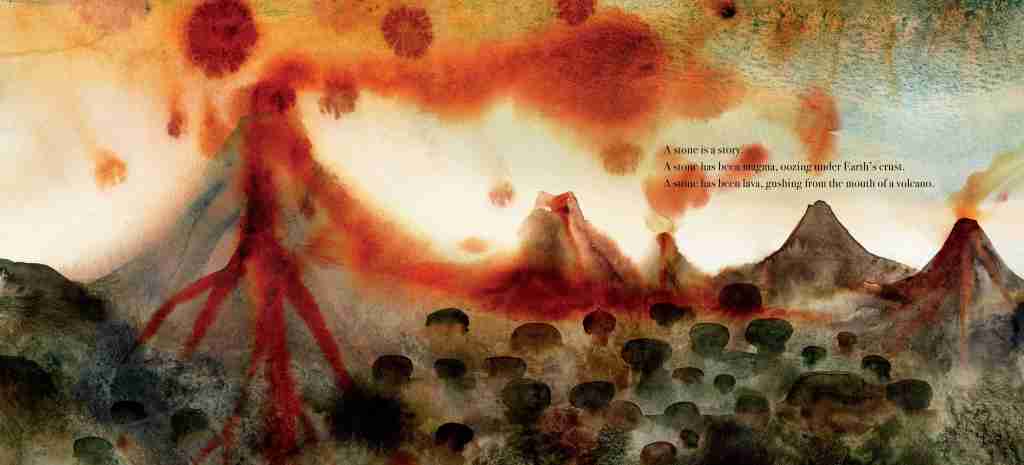
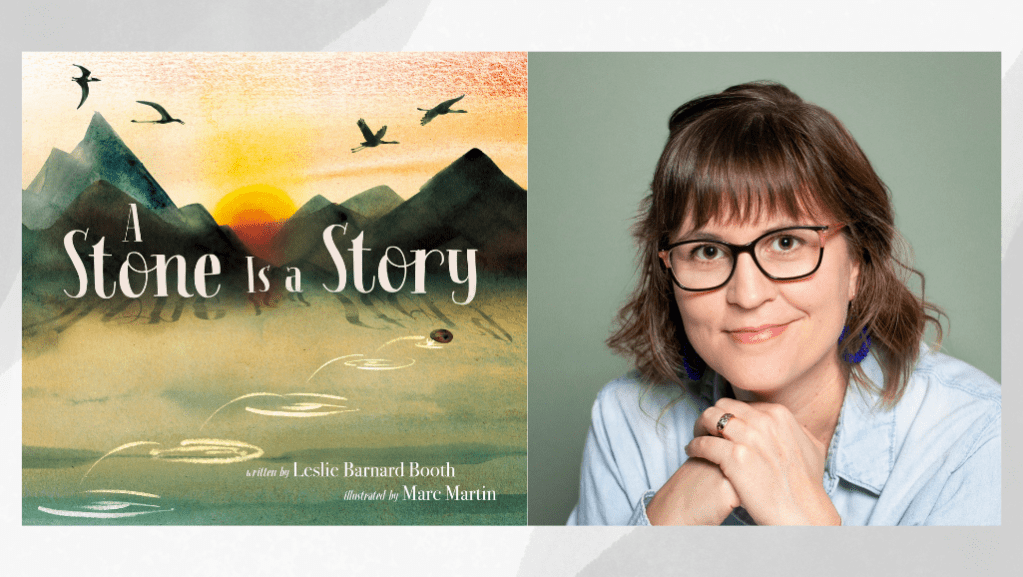
My debut picture book, A Stone Is a Story, is about the rock cycle—the process through which rocks form and transform over time. The rock cycle is fascinating on an intellectual level: how cool is it that natural forces continually shape Earth’s rocks, sculpting them into a tangible record of Earth’s deep past? But rocks also spark an emotional response in me. For me, the rock cycle is not only, or even primarily, about the labels igneous, sedimentary, and metamorphic. It’s also about feeling small but not insignificant; it’s about transformation, impermanence, and the astonishing immensity of time. It’s about finding a rock, holding it in your hand, and for a moment being connected to everything that’s come before you, and everything that will come after you. Poetry is a perfect vehicle for conveying these emotions, for letting awe in, and for tapping into children’s innate, deeply felt connection to the natural world.
Here is my bio: Leslie Barnard Booth writes picture books about nature and science. Her nonfiction picture book debut, A Stone Is a Story, releases in October 2023 with Simon & Schuster/Margaret K. McElderry Books, to be followed by One Day This Tree Will Fall in 2024 and I Am We: A Story of Survival in 2025. She has taught at preschool, elementary, and college levels, and holds an MFA in creative writing and an MS in education from the University of Oregon. Leslie lives in Portland, Oregon, with her family. You can visit her at lesliebarnardbooth.com and on Instagram @lesliebarnardbooth.books.
 WRITERS' RUMPUS
Interesting! Love this line—“It’s about finding a rock, holding it in your hand, and for a moment being connected to everything that’s come before you, and everything that will come after you.” This is how I’ve always felt when standing at the ocean’s edge.
LikeLike
Thank you, Marcia! Yes, me too. I love that feeling of transcendence that nature can bring when we let it in.
LikeLike
Yes! You’ve beautifully conveyed so much of what I’ve been feeling about science and poetry. This is a wonderful post and I can’t wait to read A STONE IS A STORY. Requesting from my library!
LikeLike
Aww thanks so much Gabi!
LikeLiked by 1 person
Congratulations! This looks wonderful!
LikeLike
Thank you Jennifer! 🙂
LikeLike
Fantastic analysis, Leslie!! I agree. And I think those who enter the various fields of science love the subjects they study deeply (as do most who write about it). That love is brought about by, as you say, awe, the sublime. And to me, poetry creates sublime moments. It is, itself, an extension of the sublime.
I can’t wait to see A Stone is a Story out and about in the world!
LikeLike
Yes, yes, and yes, Jilanne! Poetry connects us to the sublime! Thanks so much for reading and responding.
LikeLiked by 1 person
Sounds like a lovely book, Leslie! Thank you for sharing these insights.
LikeLike
Thanks for reading, Hilary!
LikeLike
This picture book is gorgeous! Congrats!
LikeLike
Thank you so much, Lori!
LikeLike
“Poetry animates science.” I love that. Congratulations on A Stone Is a Story. I can’t wait to read it.
LikeLike
Thank you so much, Claire!
LikeLike
Looks like such a perfect book for me! Can’t wait to check this story out to use as a mentor text and share with my students.
LikeLike
Thank you! I’m so glad to hear it! 🙂
LikeLike
How lucky am I to have been the beneficiary of you gifted poet/science heart as INKED VOICES mentor/mentee !😊. Can’t wait to hold your book!
LikeLike
Aww thank you so much Patricia! It was truly my pleasure. Your work is right at this magical intersection of science and poetry! Such a joy to read your beautiful manuscript and be part of your process.
LikeLike
YES! love how you connect the mystery and wonder of science with the emotional immersiveness (is that a word?) of poetry! The two connect so beautifully. Your book sounds wonderful Leslie, it would be a perfect read in my Kindergarten classroom !
LikeLike
Thank you so much, Jyoti! Yes! I love what happens when a book reaches both the mind and the heart, and helps us see the connection between the two. Wishing you and your class a great start to the school year!
LikeLike