
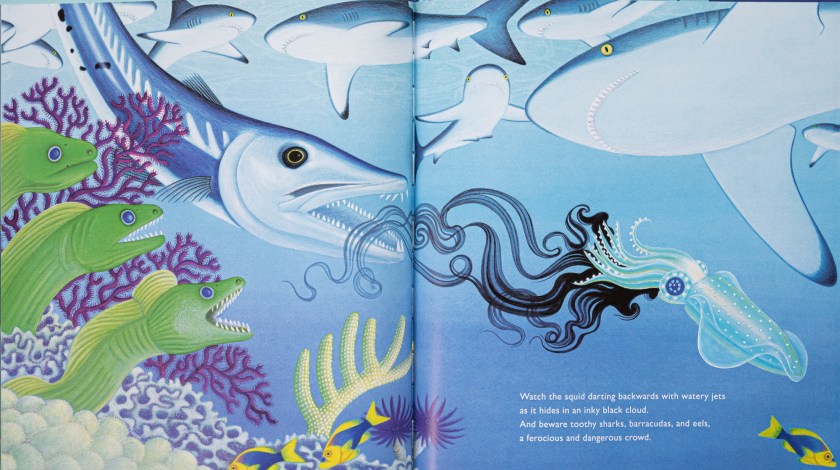

Picture book author Jennifer Berne adventured on a sailboat for two years while deepening her understanding of the ever-evolving sea. Two of her eloquent, award-winning books explore a man who discovered a way to soar fish-like deep beneath its vast surface, and a history of how the sea began and evolved to be what it is now.
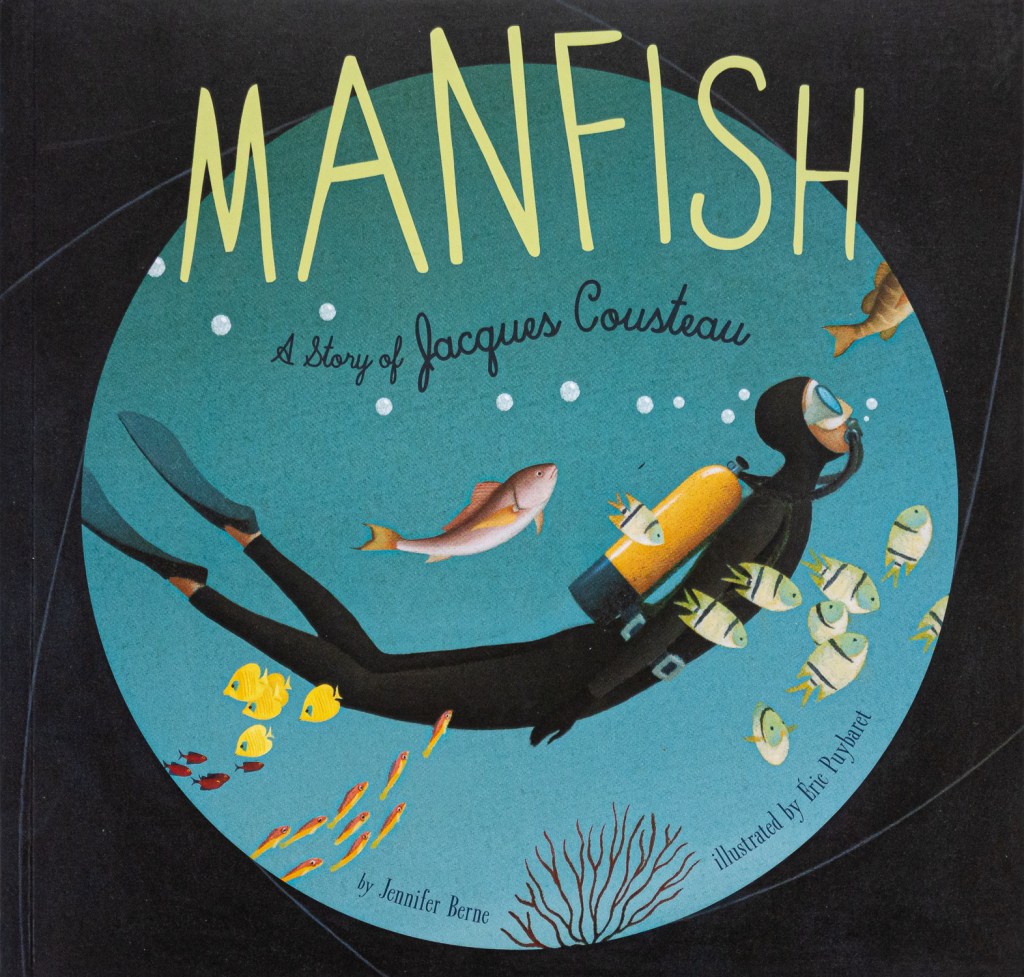
The cover of Manfish: A Story of Jacques Cousteau is designed as a camera lens in which the noteworthy Cousteau is pictured as one of the finned marine organisms. As a boy, Jacques saved to buy a movie camera, then immediately took it apart to understand it, reassembled it, and began making films. When a friend gave him a pair of underwater goggles, he discovered that “Beneath the water, he was surrounded by silvery green forests of sea plants and fish he had never seen before. Everything was silent and shimmering. It was a whole new world.”
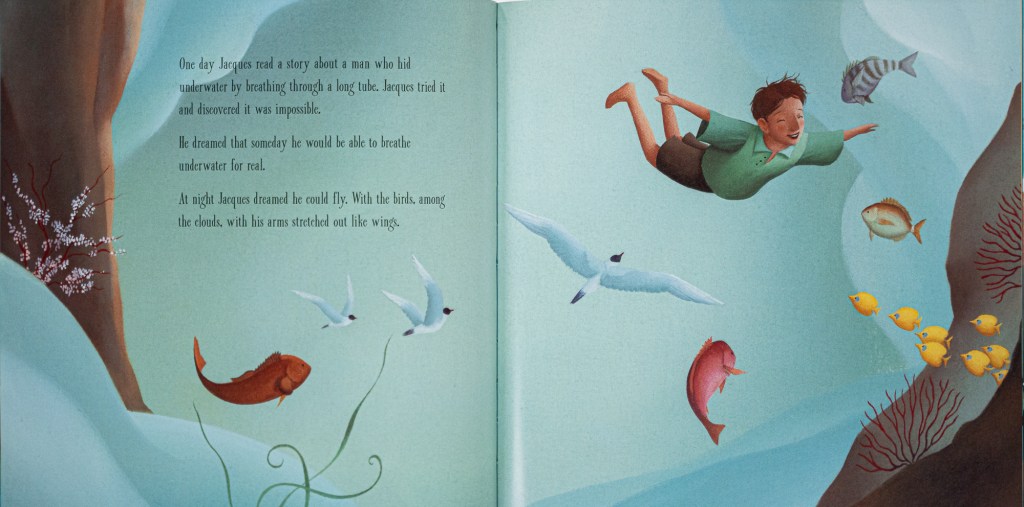
Transfixed, Jacques built a waterproof case for his camera so he could film this new universe. While diving with friends Philippe and Didi they designed rubber suits to keep them warmer and flippers so they could move more efficiently. But Jacques dreamed of swimming deep and long, far further than possible with one breath of air. “He wanted to become a manfish.” That led to his collaboration on the design of something entirely new, a device that allowed him to breathe underwater. He called it an aqualung, the first-ever SCUBA gear. In text redolent with Cousteau’s curiosity, determination, and poetic wonder, he is shown acquiring Calypso, an old wooden warship, and transforming it into a research vessel to explore the ocean wide and deep.
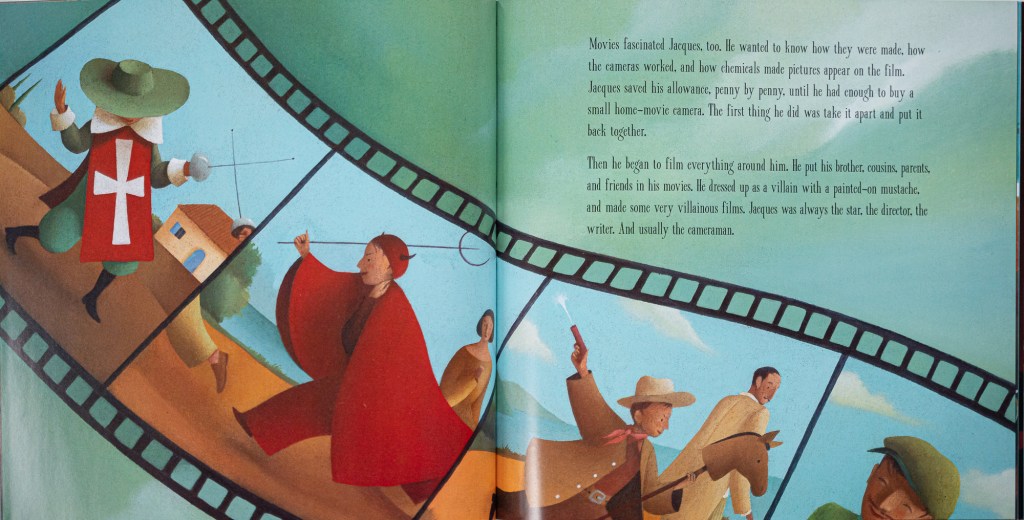
His films and underwater discoveries brought sea wonders into people’s living rooms and hearts. Lustrous illustrations painted in acrylic on linen by Eric Puybaret effectively convey the moody depths and rainbow-hued seaforms the graceful divers glide among. A gatefold dramatizes the vast, colorful depths the divers discover.
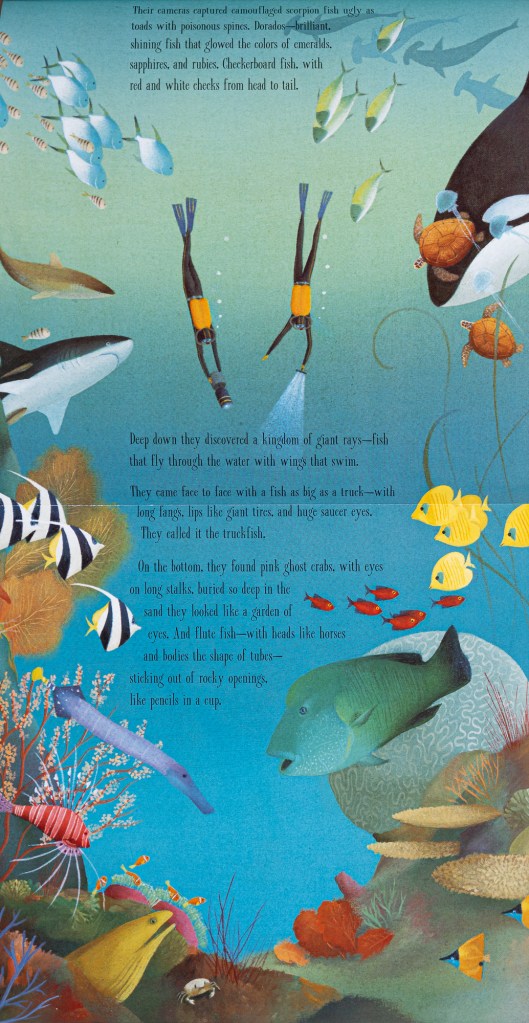
Inevitably, Cousteau is heartbroken over the pollution he also finds and he turns his camera to documenting this abuse. His pleas reach out to presidents, kings, queens, and people worldwide to help save the earth. And to children, he shares his hopes that they will love and cherish the oceans. An author’s note at the end suggests ways the reader can learn more about Cousteau’s life and work and the marine world.
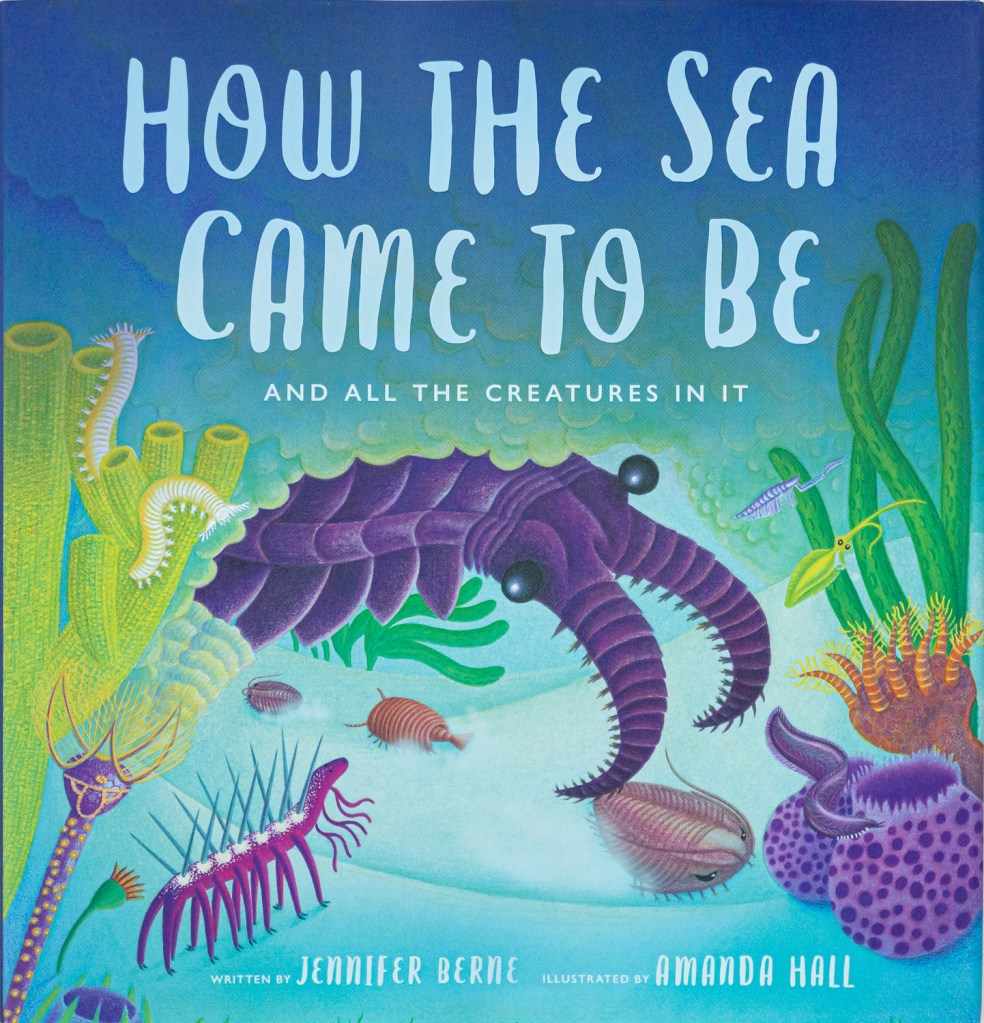
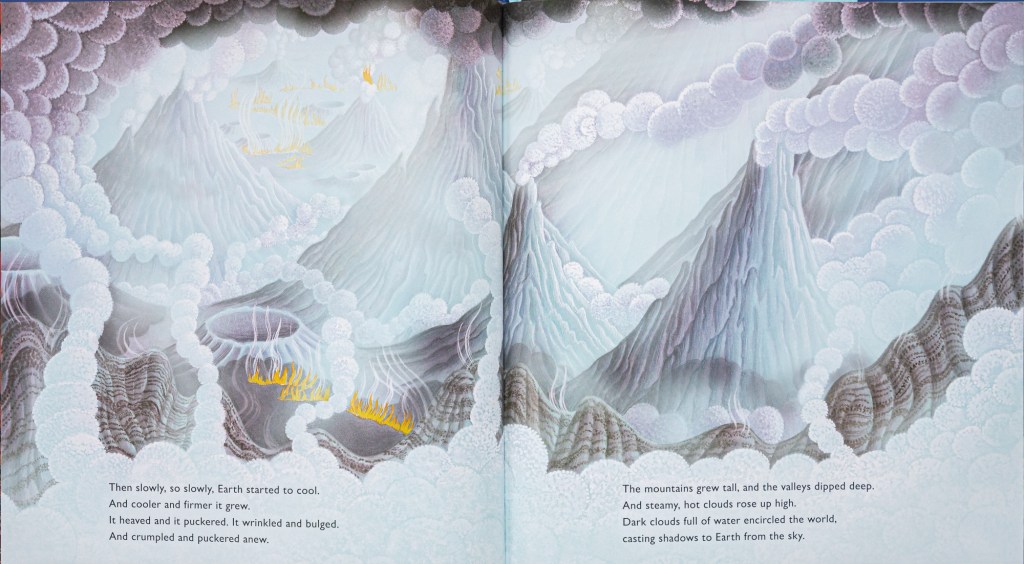
In captivating rhyme, How the Sea Came to Be: and All the Creatures in It dramatizes 4.5 billion years of the sea’s evolution, streamlined with clarity. Part One, The Birth of the Sea, begins with a lump of molten rock that was our planet and an origin story told in vibrant language. “Earth sizzled and simmered for millions of years. / It bubbled and burbled and hissed. /It raged and it rumbled, it thundered and boiled, / spewing lava and steamy hot mist.” Each spread explains a phase over eons in lyrical simplicity: earth’s cooling, mountains forming, the rising of vast clouds, and the first rains that eventually flooded the seas.
Part Two: The Birth of Life explains that tiny stirrings where one minute speck became two, then four, became more and more. After millions of years these first bits of life had assembled and rearranged to become organisms that wriggled and drifted – jellyfish, sponges, charnia, and many more, eating whatever they could. Finally, an organism developed the ability to choose where to go in search of food, or other worms like it.
By Part Three: All That the Sea Came to Be, multitudes of life forms grow and evolve on land and in the depths of the ocean: strange beings with fangs and lights and delicate appendages. Diverse fish, crabs, squid, and so much more show the rich abundance that fills the seas today.
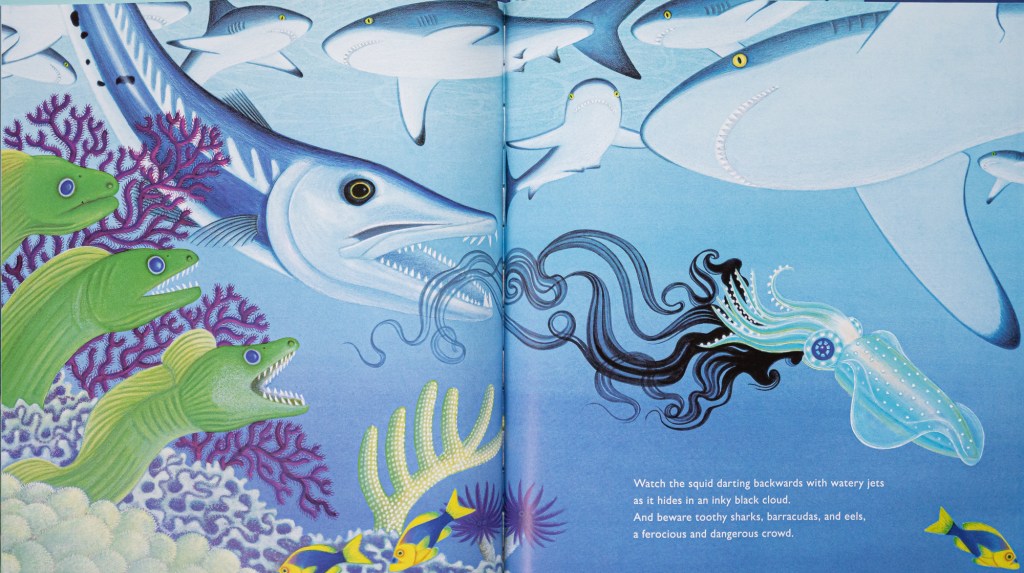
Illustrator Amanda Hall, who researched thoroughly as the author did, created luminous artwork in watercolor, gouache, pencil crayon, pastels, and digital materials that perfectly complement the text. Pages teem with weirdly wonderful organisms, large and small, in a delicate and powerful tribute to the diversity that is the sea. The Author’s and Illustrator’s notes at the end offer more detail and insights into the ways these two creative people approached this project during the COVID-19 pandemic. A double gatefold shows ocean creatures over time and within is a diagram revealing the various eras of the earth’s history attractively presented. This is followed by pages of key terms, concepts and sources for more information. How the Sea Came to Be is a tantalizing, concise, and expansive package bursting with intelligence.
A conversation with Jennifer Berne
Joyce: Jennifer, if you have a moment, could you share the origins of your wonderfully poetic books Manfish and How the Sea Came to Be?
Jennifer: I’ve always been fascinated by the sea and its creatures, from the time I was a little girl. So it’s no surprise that I wrote a couple of books about those passions and interests.
Joyce: What attracted you specifically to Jacques Cousteau’s story?
Jennifer: I grew up watching Jacques Cousteau’s adventures on TV, so when I started writing children’s picture book biographies, it was natural that he would be my first subject.
Joyce: Your How the Sea Came to Be, is a deep dive into a related complex subject.
Jennifer: One of my other great fascinations is the formation of our planet and especially the evolution of its creatures, so once again, writing what I’m passionate about, How the Sea Came to Be was a natural for me.
Joyce: Both books must have required extensive research. When you composed them, did you contact specialists in the fields you were writing about? Was there an expert to vet either story before publication? All nonfiction writing requires the challenge of presenting facts clearly and accurately.
Jennifer: Researching the two books couldn’t have been more different!
Jacques Cousteau gave me almost everything I needed. He wrote books and made films about himself and told us all about every adventure and discovery he made, even as a child. I was getting my input from the source himself, in words, in photos, and in movies. It was like Jacques was sitting on my shoulder and whispering to me every moment I was writing my book.
How the Sea Came to Be was a whole other story! That was one of the most research-intensive books I ever wrote. I had to research billions of years of geology, oceanography, marine biology, and evolution. You can imagine the piles and piles of books, the scores of websites, and the weeks and months of researching. Fortunately, Amanda Hall, the wonderful illustrator of the book, was also an obsessive researcher. With all the research she did for this book she could have gotten a PhD in marine biology. And additionally, Amanda and the Eerdmans team arranged for a prominent professor of marine biology to be our consultant, our outside very helpful expert.
Joyce: Your process and enthusiasm are inspiring!
Jennifer:
Thank you! And one more thought about the process. Although both books were about the sea and its creatures, the writing experiences were completely different. But isn’t that what we love about being writers — every project, every day, is completely different from the last, and from the next!
Joyce: Thank you, Jennifer, for these insights into your award-winning works. We look forward to your future projects as we savor these.
| MANFISH: A STORY OF JACQUES COUSTEAU By Jennifer Berne Illustrations by Eric Puybaret Published by Chronicle Books ISBN 0811860639 32 pages Also available in French, Korean, Portuguese, and Polish “Before Jacques Cousteau became an internationally known oceanographer and champion of the seas, he was a curious little boy. In this lovely biography, poetic text and gorgeous paintings combine to create a portrait of Jacques Cousteau that is as magical as it is inspiring.” — Chronicle Books |
How the Sea Came to Be: And All the Creatures in It
by Jennifer Berne Illustrations by Amanda Hall
Eerdmans Books for Young Readers ISBN 978-0-8028-5478-0 April 2023
Spanning 4.5 billion years of evolution, this book is a fascinating introduction to geology, oceanography, and marine biology. Lyrical rhyming verse and awe-inspiring art capture the mysterious beauty of the ocean and the incredible creatures who call it home.
 WRITERS' RUMPUS
I will be checking out both of these books! Thanks for letting us know about these beautiful picture books.
LikeLike
These sound like absolutely beautiful books. The text and illustrations shown are gorgeous!
LikeLike
I agree, Hillary. That is partly due to the two talented illustrators, and because the text content is so inspiring!
LikeLike
Laura, I appreciate your thoughts, and I too loved watching him on TV. Definitely an inspiring innovator.
LikeLike
Joyce, thank you for introducing us to Jennifer Berne and her wonderful books! Your post is so lyrically and realistically written, I could imagine myself swimming alongside Jacques Cousteau. FYI: I grew up mesmerized by The Undersea World of Jacques Cousteau, too!
LikeLike
Wow, these are great! Thanks for the post!!
LikeLike
Hi Angie. Thank you for reading! Jennifer certainly chooses fascinating topics to highlight!
LikeLiked by 1 person