
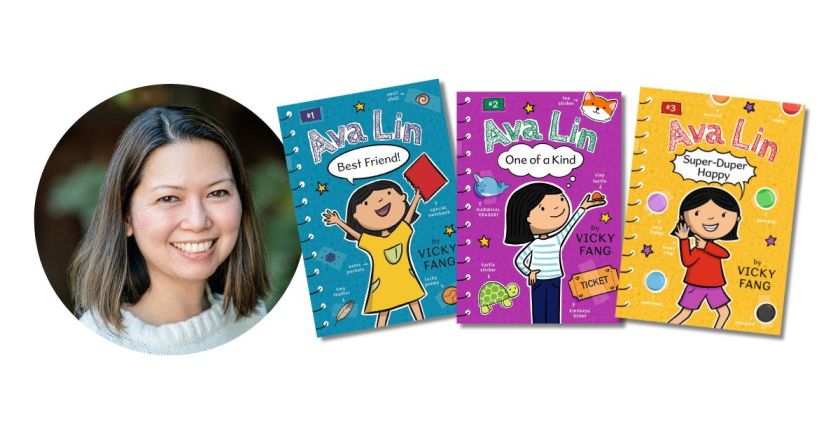
Guest Post by Vicky Fang
Hello! I’m excited to be talking about chapter books today. I’m the author of Layla and the Bots and the author-illustrator of the new Ava Lin series—with Book 3, Super-Duper Happy, releasing in just a couple of weeks! I love writing chapter books, and look forward to sharing some tips for kicking off your own chapter book idea.

First up, what is a chapter book?
Chapter books cover a wide range! They encourage young readers to transition to reading longer stories with more complexity. They are usually geared toward ages 6-10—which covers a wide range of reading ability, hence the wide range of chapter books. They’re typically a half-page trim size, they often have illustrations, and they are often series. Word count can range from ~1500-10k words.
Here are some examples of chapter books:

Mentor texts
I love studying mentor texts. It’s a huge part of my process for any book project. I recorded a video all about studying mentor texts for chapter books, if you want a deeper look at this topic.
For Ava Lin, I was inspired by the books that were captivating my kids and turning them into readers. They loved funny, relatable stories with lots of illustrations in them, like Dory Fantasmagory or Planet Omar. I set out to write a story like those, inspired by my kids and my own childhood.

AVA LIN, BEST FRIEND! (Credit: Candlewick, ©2024 Vicky Fang)
How do you know if your idea should be a chapter book?
As a picture book author who transitioned into chapter books, I’m all too familiar with this question! Once I started writing chapter books (and later board books and early readers), I started to develop a shorthand for how I think about the different book categories and how much story arc/complexity could fit into them.

In short—chapter book content is too complex for a picture book, yet too little content for a novel. There is usually one main plot arc that resolves (usually happily) in the end. You might have a B plot as well, but it should be a pretty straight shot that can be resolved in roughly 10 chapters. (This is a guideline for thinking about it, but there are obviously possible exceptions!)
For example, Ava Lin has twelve chapters at ~4000 words. There is one central goal (find a best friend, win the most kindness tickets, get a gold medal at the walkathon), but there are secondary story lines in each book that provide tension, character, or heart to the story. In Book One, Best Friend!, while Ava searches for a best friend, she also gets distracted by also wanting a special notebook and searching for treasure. These side stories highlight Ava’s character but also create a more fluid story of obstacles and hilarious mishaps along the way.

AVA LIN, BEST FRIEND! (Credit: Candlewick, ©2024 Vicky Fang)
Series Potential
Your idea should support multiple books. Chapter books are perfect for series, because they’re all about encouraging young readers. Once they find a character/story they love, they’ll want to read more about them! Plus, having a series helps a chapter book series stand out on the shelf.
- Does your main character (or characters) have appeal that will support many titles?
- Does the main premise of your idea support multiple, repeated story lines?
My original pitch for Ava Lin:
A 6-year-old Chinese girl navigates school, family, and friends—with a knack for getting herself into (and out of) sticky situations.
The publisher’s blurb for the final series:
In this funny and relatable illustrated chapter book series, first -grader Ava Lin wrangles her way out of comical mishaps at home and school with humor and aplomb. Drawing on her Chinese American family’s experiences, Vicky Fang introduces young readers to a heroine they will instantly love and frequently relate to.
Independent Reading Appeal
Because chapter books are written to encourage young readers to start reading longer texts, they are written to keep readers engaged. This means your chapter book should probably be upbeat and resolve happily, incorporate humor, and focus on appealing subject matter for the targeted age.
- Does your idea have engaging appeal for kids age 6-10?
- Will your idea compel a young reader to keep reading to the end?
A Great Hook
As with any category, you’ll want to have a great hook for your chapter book series. This probably means:
- Great Main Character
- Fun Setting/Premise
- Compelling Central Challenge
- Timely Themes
Tip: When I’m trying to find the hook for my books, I often try to combine two or more hooks for a compelling combination. Ava Lin is relatable humor/illustration plus an endearing Chinese American protagonist. There are lots of ways to develop a great hook, so find what works for you!

AVA LIN, ONE OF A KIND (Credit: Candlewick, ©2024 Vicky Fang)
Suggested Exercise
Find 4+ chapter book mentor texts. Target the same age range/reading level for your choices, and even better, from the same publisher. Break down why each book works:
- What is compelling about the main character?
- What is the premise and how does it drive the series?
- What themes does the book address?
Think about your own chapter book idea(s). How would you answer each of these questions for your idea(s)? How might you revise your idea to be even stronger and more compelling for young readers? What will make your idea stand out from the rest?
This post is adapted from a Substack post originally posted on Kidlit Survival Guide in collaboration with Christine Evans. Visit us for a deeper dive into writing/pitching chapter books, plus more kidlit craft and business posts.
About Vicky Fang
Vicky Fang is the author of the Layla and the Bots chapter books series, the Best Buddies early reader series, the I Can Code board book series, the picture books Invent-a-Pet and The Boo Crew Needs You!, and the forthcoming Lots and Lots of Ocelots. She is the author-illustrator of the Ava Lin series, the Friendbots series, AlphaBot, and the forthcoming One Mad Cat series. A former Google product designer, she now writes and illustrates children’s books full-time. Vicky Fang lives in California. You can learn more at vickyfang.com.

For signed copies of Vicky’s books, visit Linden Tree Books and leave a comment at checkout.


Thanks for sharing these useful tips!
LikeLike
Congratulations, Vicky! Great post, too!
LikeLike
Wonderful post, Vicky! It’s so well done with great suggestions and writing tips. Thanks for sharing.
LikeLike
Vicky, thank you so much for these terrific tips. I especially like the chart comparing books to audible publications. I also like the emphasis on fun.
LikeLike
Thanks for sharing these nice, clear tips about chapter books and best of luck with your latest Ava Lin story—she’s adorable!
LikeLike