
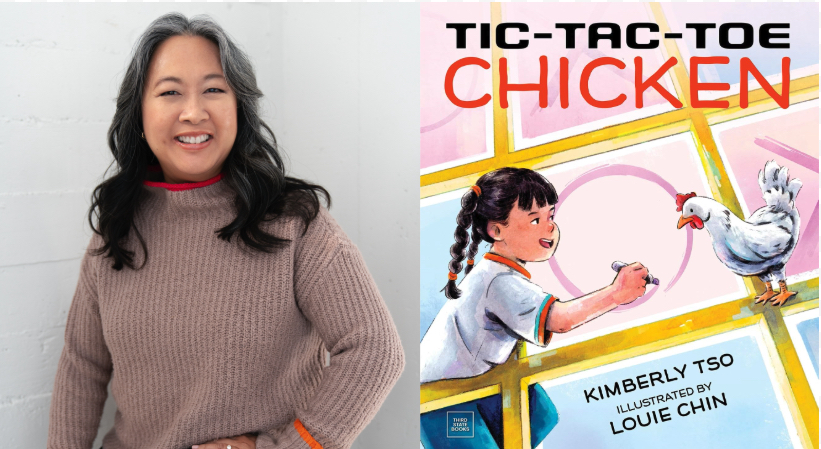
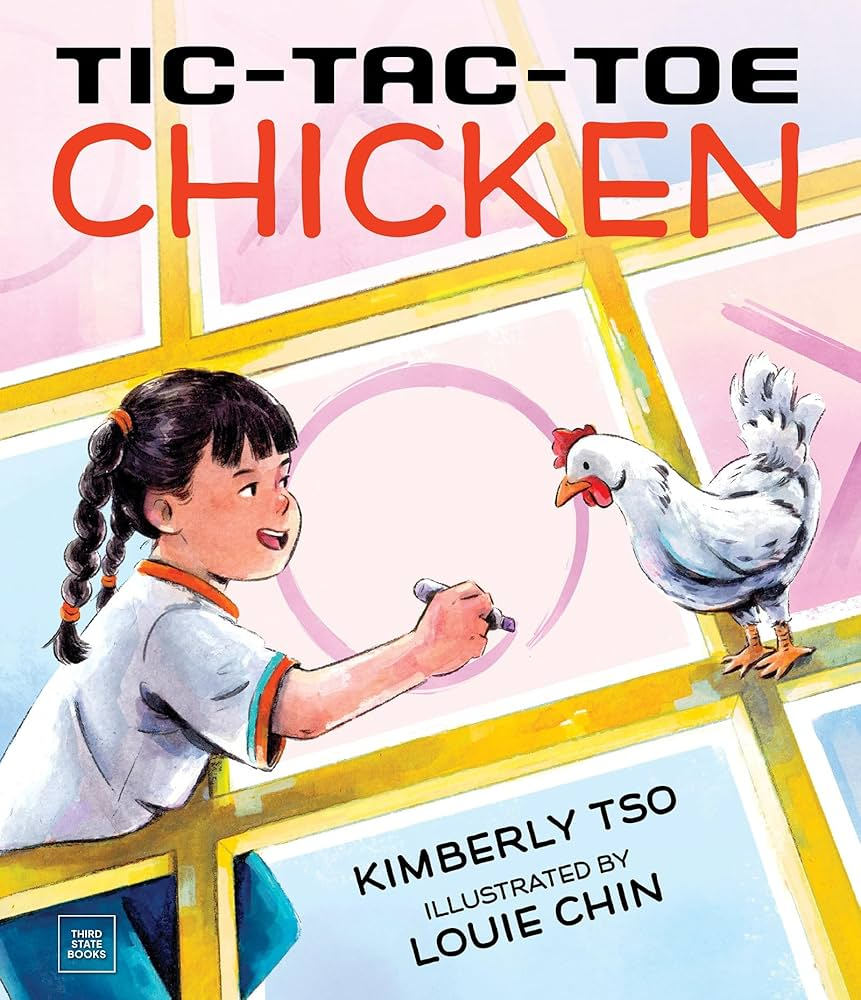
Kimberly, it’s my pleasure to welcome you to Writers’ Rumpus! Congratulations on your debut picture book, Tic-Tac-Toe Chicken, published August 19, 2025 by Third State Books. To quote award-winning author Grace Lin, “I loved reading this story inspired by the real Tic-Tac-Toe Chicken of Chinatown! Kids will be encouraged to seek clever solutions for the problems they see being ignored.”
Let’s dive straight into the questions!
Laura: I was intrigued to read in your bio that you played against a real Tic-Tac-Toe Chicken at the Chinatown Fair video game arcade on Mott Street in New York City several times. Please, tell us about that experience!
Kimberly: Both of my parents took me to the Chinatown Fair arcade over the years to play against the Tic-Tac-Toe Chicken, so I don’t have a specific childhood memory as much as a generalized memory of playing against it. When I moved back to NYC as an adult, I took my husband to Chinatown Fair arcade, and the Tic-Tac-Toe Chicken booth was still there. We played against it then, and of course, we lost. Clearly, my graduate degree is worthless. 😁
The booth had two main sides to the front. On the right side was a computerized tic-tac-toe board with buttons for you to make your selections. On the left side was a window so you could see where the chicken lived. Its floor was made of wire mesh, so that droppings could be cleaned up more easily. I distinctly remember how the wire floor bowed in the middle from the weight of the chicken. There was a metal box on the wall labeled “Thinking Box.” This was where the computer mechanism for Lillie (the chicken) to play was stored. You couldn’t really see it because the door blocked it, but we can reasonably speculate that there is where the chicken pecked at a button when a light came on and was rewarded with a bit of food when she did it correctly. The computer inside made the actual game selection. So you never really played against the chicken. You really played against a computer. So that helps my bruised ego a bit!
Laura: Wow, Operant Conditioning (a term from behavioral psychologist B.F. Skinner) at its finest! Now for my next question: When did you first develop the idea for Tic Tac Toe Chicken, and how many drafts did you write before you arrived at this charming version? From this Writers’ Digest interview (https://www.writersdigest.com/an-invitation-to-write-diverse-stories-that-break-the-rules), I learned that you threw out one and half years of manuscript drafts. Many writers experience frustration and doubt from the endless redrafting process, but you and your book show the value of perseverance and the importance of getting it just right!
Kimberly: I had the idea when I was brainstorming possible picture book stories that I could illustrate. Originally, I wanted to illustrate books and needed a story to practice, so I wrote this one. As is true for most authors, I wrote countless drafts. But there were three main versions that I wrote. The first one was more of an autobiography from the Tic-Tac-Toe Chicken’s point of view. That one was ridiculous, to be honest. The second major version was a grandchild who rescued the chicken from his grandfather who ran the arcade. It was too emotionally complicated and moralistic. This last version finally found the way to have the child rescue Lillie in a creative way.
I don’t regret any of those drafts, because I know now in retrospect that I was wrestling with the nostalgia that the Tic-Tac-Toe Chicken brings up and with the guilt I felt for being complicit in her captivity. I knew that the novelty of a chicken that played tic-tac-toe was a good hook with the kids, but so many children really love and feel deep empathy for animals. It took many drafts for me to finally get to one that could both honor this quirky piece of Chinatown history and acknowledge the moral dilemma that its real-life inspiration posed.
Laura: Main character Beatrice’s drive to free Lillie is admirable and inspiring. I also like how her dad explains how the chicken is trained to “peck at a light to make it look like she is playing,” as well as how the Big Boss readily frees Lillie after losing a public Tic-Tac-Toe match against Beatrice. Can you share insights into your creation of these characters and how they’re featured in the story?
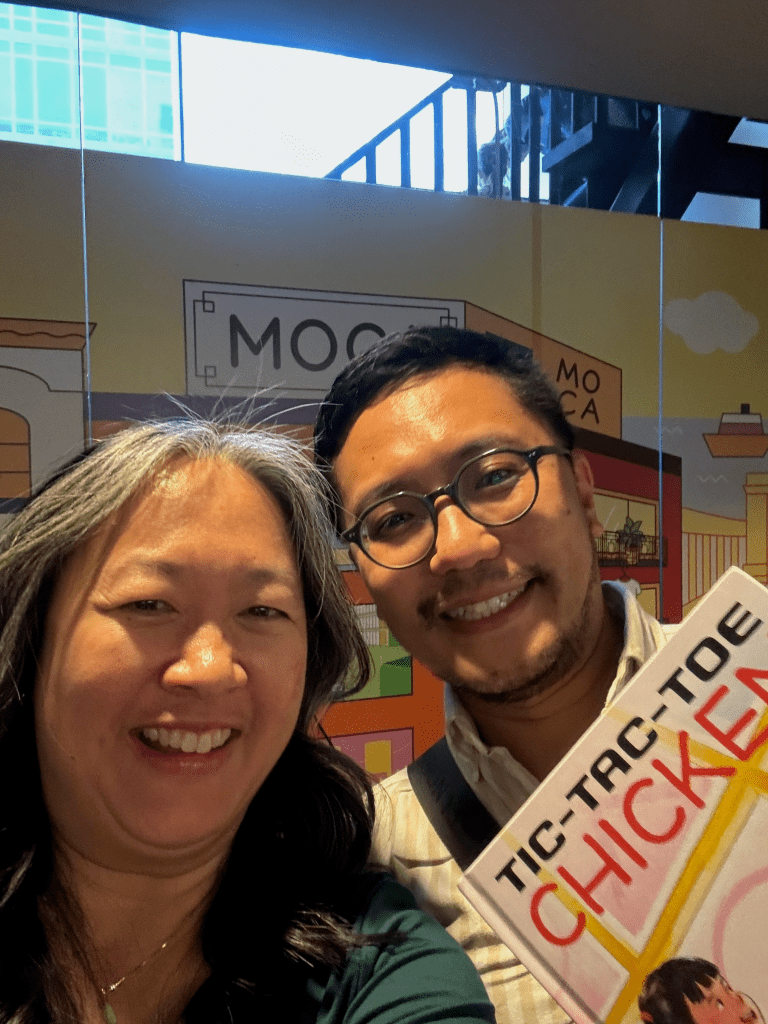
Kimberly with real-life rescuer Patrick Kwan: click here to learn about Patrick and fellow rescuer Toodie Whitmer, who brought Lillie to a Massachusetts sanctuary!
Kimberly: In real life, one of the rescuers was 17 years old at the time of the rescue, and he worked with another animal rights activist to secure Lillie’s freedom. I thought it was so admirable to be an activist that young. I also admired how the owner of the arcade made the compassionate choice for Lillie, so I definitely did not want to demonize him in any way. I firmly believe that these were all good people making the best decisions they could under the circumstances. I called him the Big Boss in reference to video game boss battles. The original title was “Bea and the Battle for the Tic-Tac-Toe Chicken” and my illustration vision included some video game references. I’m glad we didn’t go that way, but that’s how I got to calling him Big Boss.
Beatrice’s name came about because it started as Bea for the alliteration in the original title. But when people kept pronouncing it “Be-ah” instead of “Bee,” I knew it was going to be an issue, especially since it’s an unusual name for a non-native English speaker to have to read. So, my publisher and I considered different names for a couple of months, but naming a child by committee never really works, so we settled on the longer version of Bea’s name – Beatrice.
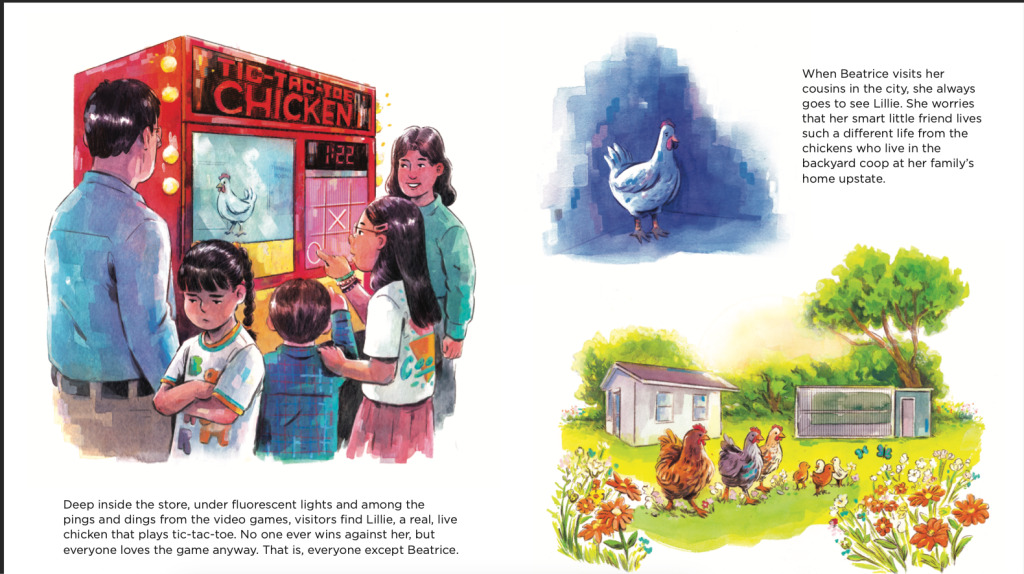
(Double-page spread from Tic-Tac-Toe Chicken, courtesy of Third State Books)
Laura: Please share your experience working with your publisher as well as with illustrator Louie Chin, who was born and raised in New York City.
Kimberly: I’ve enjoyed working with Third State Books and Louie Chin. It’s been a collaborative process, which is not often the case, so I’ve heard. The publisher always made final decisions, but I was included in many of the illustration discussions. I feel lucky to have gotten such an intimate look at how a book comes together behind the scenes and at all levels. I’ve learned so much through this process. And unlike the experience of many of my debut author colleagues, Third State has provided a lot of marketing support for my book. I never would have had a book tour or much publicity without their enthusiastic support of this project.
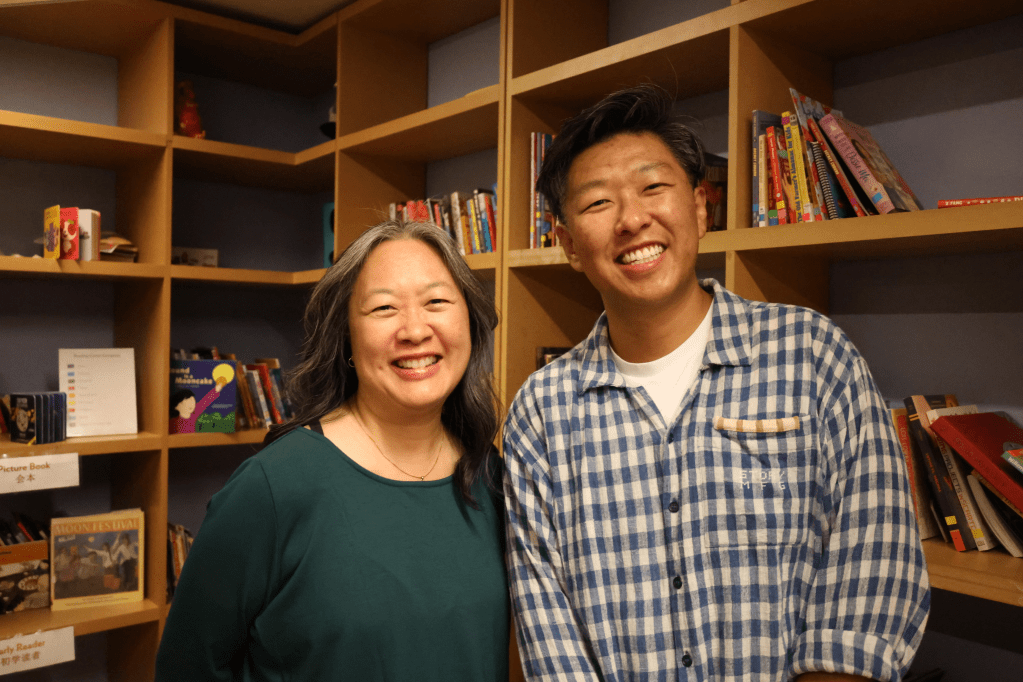
Kimberly with illustrator Louie Chin. Check out his amazing work at louiechin.com
Laura: In the same Writers’ Digest interview referenced earlier, I also loved your response to why you wrote this story. Can you share your reasons with our readership?
Kimberly: Well, first I’d encourage folks to read that Writers’ Digest piece. In it, I talk about the process, but also the crucial role that having the right publisher for an AAPI (Asian American and Pacific Islander) story makes. But to answer your question, I wrote the story because I wanted to capture something fun about living in Chinatown that was relatable to all children. It needed to be a story that celebrated the singularity of Chinatown without “other-ing” it. I also wanted to wrestle with and confront certain stereotypes about AAPIs – the false idea that we are cruel to animals and unwilling to “rock the boat” when it comes to controversial topics and politics. AAPIs are not a monolith; those negative characteristics can be found in any group of people, and there are many more positive examples to counter them. Lastly, I wanted to encourage children’s empathy, and their instinctive love of animals was a natural place to start.
Laura: Beatrice definitely comes across as an empathic, animal-loving character that many children will identify with (animal-loving adults like me, too). How can our readers connect with you?
Kimberly: The best way to connect is through Instagram (@kimberlytso), but folks can also subscribe to my Substack newsletter through my website (kimberlytso.com). I’ve got links to other socials, but I check Instagram the most regularly.
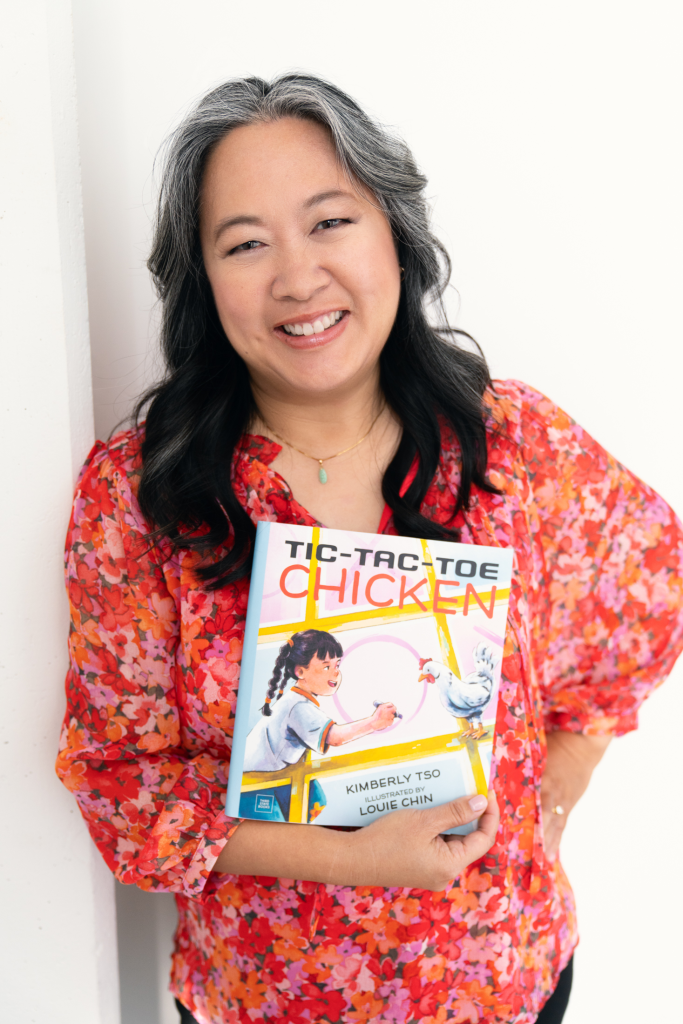
Kimberly Tso is the author of the picture book Tic-Tac-Toe Chicken, illustrated by Louie Chin, published by Third State Books in August 2025. Ms. Tso was born in New York City, and growing up she split her time between there and Arlington, Virginia. She now lives in Los Angeles with her partner and daughters. She has also been a grantwriter for nonprofits and taught grantwriting to graduate public policy students. When she is not writing books, she enjoys cooking, reading, playing video games, solving puzzles, and spending time with her family.
Thank you so much for visiting with us. Best wishes for your continued success!
GIVEAWAY RAFFLE:
Third State Books is generously offering a free hardcover copy of TIC-TAC-TOE CHICKEN to a lucky Writers’ Rumpus reader. To enter the raffle, leave a comment on this post. If you share this post, mention it in your comment, and you’ll earn another entry. The winner will be notified on November 17th, so check back to see if you won. Good luck!


I would love to win this book! My littles are devouring books and I want to help foster that appetite with diverse stories.
LikeLike