
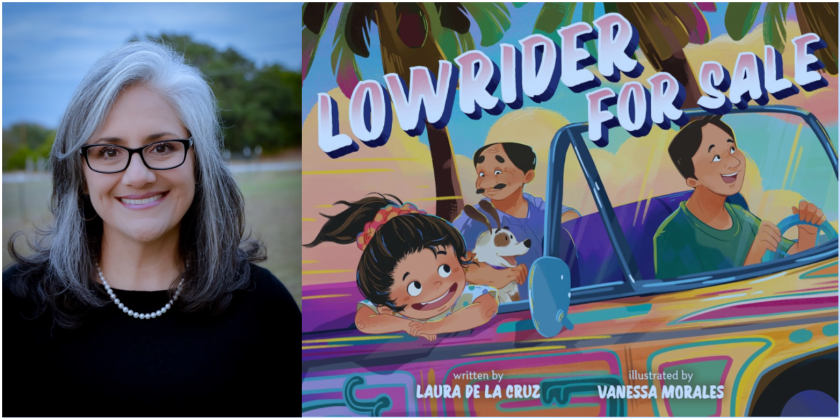
Happy Book Birthday to LOWRIDER FOR SALE, the heartwarming picture book debut by talented and gracious author Laura De La Cruz. Laura has impressed me with her positive and supportive comments on our blog, so when she inquired about an interview, it was my honor and pleasure to enthusiastically say yes! And not just because we share the same first name! In fact, to avoid any confusion in the Q and A, I’ll refer to us by our last names.
Cooper: Laura, I’m so excited to welcome you to our Writers’ Rumpus audience on the launch date of LOWRIDER FOR SALE! I have long enjoyed learning about cultures and traditions different from my own, and this heartwarming picture book was a relevation to me (as a white, Jewish, New England girl with Russian-German heritage). I absolutely love how your book introduces the “cruising” tradition, and especially how much care goes into decorating and maintaining Pico Nights, the family’s beloved car. Please share how your own experience inspired this story, as well as what LOWRIDER FOR SALE is about.
De La Cruz: Hi Laura! Or should I say,”¡Hola, tocaya!” Tocaya is a Spanish word we use when someone shares your first name. That makes us tocayas! Thank you so much for having me on Writers’ Rumpus, Laura! I’m so excited to be here and to share my debut picture book, LOWRIDER FOR SALE with you.
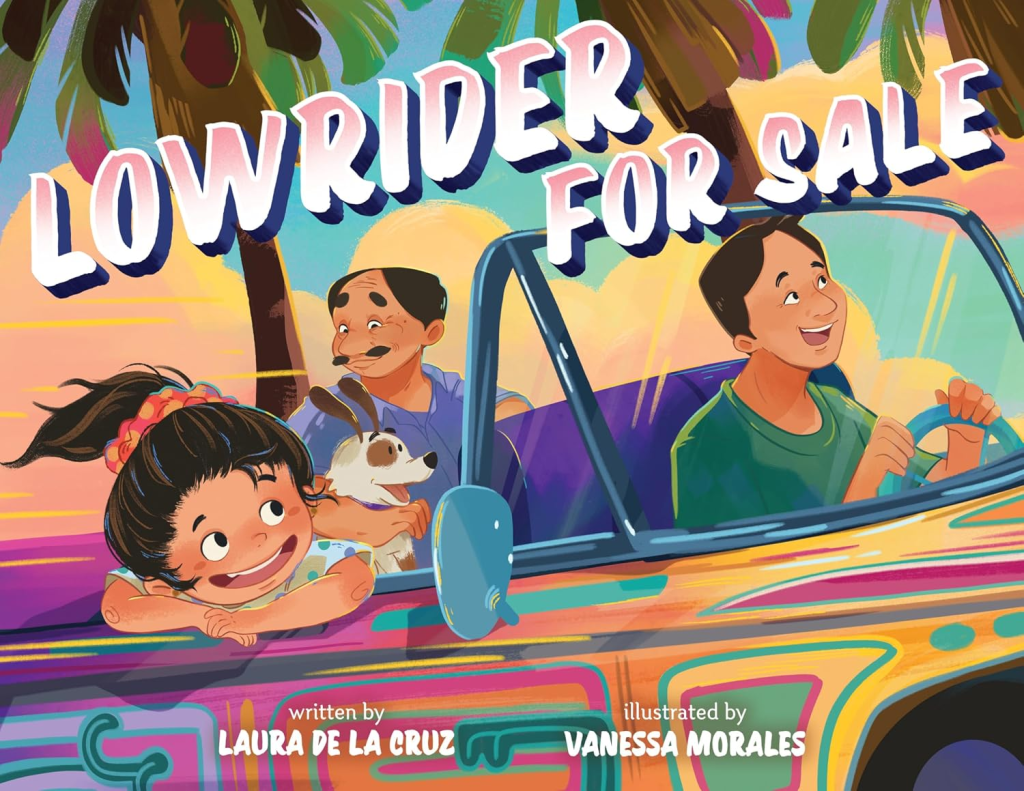
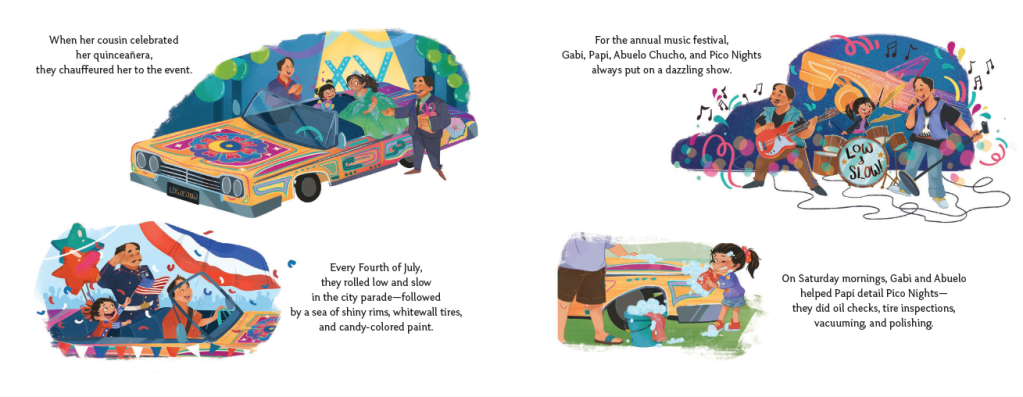
LOWRIDER FOR SALE is about a little girl named Gabi who knows that Papi’s lowrider, Pico Nights, is more than just a car. It’s a family scrapbook on wheels—a treasure trove of memories for Gabi, Papi, and Abuelo Chucho. It chauffeured Gabi’s cousin to her quinceañera, rolled through years of Fourth of July parades, and was detailed most Saturday mornings by Gabi, Papi, and Abuelo. So when Papi places a FOR SALE! sign on Pico Nights, Gabi tries everything she can to save their beloved car, and all the memories tied to it.
I found inspiration for this story in several places, but the initial spark came from my wanting to honor my dad. My dad was a great guy—funny, talented (he played the guitar), and incredibly generous. Sadly, in 1976, when I was only eight years old, he died of cancer. I miss him greatly. Although our time together was far too short, the years we had were enough for him to make a lasting impact on my life. I knew I wanted to honor him in a story, but I couldn’t just write a story about my dad. There had to be more to it. So, I kept thinking.
In 2019, I was working at an elementary school library as a Library Media Technician, and I read to every class that visited the library each week. One week, I read YARD SALE by Eve Bunting and Lauren Castillo. There was something heart-wrenching about that story. In the book, a family is moving to a small apartment and can’t take all of their possessions with them, so they hold a yard sale. The main character, Callie, struggles to understand what is happening as she watches strangers buy the things that have been part of her family’s life. As someone who has always collected things that hold memories—concert ticket stubs, posters, t-shirts, knickknacks, and other little treasures—I immediately connected with Callie. I started to wonder what I would have done at eight-years-old if someone had asked me to give up something that held so many precious memories.
Finally, the last piece of the puzzle came from where I grew up. Growing up in Pico Rivera, California, near Whittier Blvd., it wasn’t unusual to see lowriders cruising the boulevard. Saturday nights in the 80s were especially busy. These gorgeous classic cars with shiny chrome bumpers, stunning murals, and hydraulics that made them hop and dance, were a familiar sight. A lowrider was the missing piece of the story. It brought everything together—the memories, my childhood, my father, my community, and a part of my culture that I rarely saw represented in picture books. And that’s how I came up with the idea for LOWRIDER FOR SALE.
Cooper: I’m deeply touched with the way this story honors your dad’s memory. And tickled that we are tocayas! Now onto my next question. What was your writing and draft process for LOWRIDER FOR SALE? Writing solo, belonging to a critique group, attending conferences, etc? The phrase “low and slow” is one that readers will never forget!
De La Cruz: Yes! I love the phrase ‘low and slow’ or ‘bajito y suavecito!’ Laura, the next time you read LOWRIDER FOR SALE, check out Pico Nights’ vanity plates. You’ll notice we used that phrase there.
As for the actual writing process, I started researching for this book in 2019 when the idea first came to me. I have a friend who was a photographer for Lowrider Magazine, so I asked him all kinds of questions about lowriders: How do lowrider owners name their cars, and why is that important? I asked him about hydraulics, and we reminisced about cruising Whittier Blvd. back in the day. I also read everything I could about lowriders—online articles, magazines, books, and websites—anything that would help me learn more about the culture.
Then, in June of that same year, my family and I moved to the Austin, Texas, area. That’s when I discovered the Writing Barn, and in 2020, I took an online picture book workshop taught by Rob Sanders. By that time, I had a very rough draft of the story, and Rob, along with a few of my classmates, critiqued it. Their feedback helped me see what was working, what needed more development, and where I needed to dig deeper into the story.
From there, the manuscript went through many, many revisions. I shared it with critique partners, editors, agents, and a few authors who offer paid critiques. I even used LOWRIDER FOR SALE for a scholarship opportunity through Julie Hedlund’s 12×12 Picture Book Challenge, and I won! Eventually, the manuscript helped me find my agent, Leah Pierre, who made the last suggestions before we went out on submission.
Looking back, the book really grew through a combination of research, writing, feedback, and lots of revision. It definitely wasn’t the story I started with, but each step helped me get closer to the story I wanted to tell.
Cooper: The love and connection between the characters in your book literally leaps from each page, as does their pride in being an integral part of the community. I can’t imagine anyone, young or old, no matter their heritage or experience, not feeling this sense of belonging themselves with a smile on their face and warmth in their heart. How did you choose these characters and this East LA setting and imbue them with such heart?
De La Cruz: Thank you so much, Laura! That means so much to me because the love between these characters is really at the heart of the story. I wanted Gabi, Papi, and Abuelo Chucho to feel like a real family. Not a perfect family, but a family who is playful, loving, and connected through the memories they make together.
Gabi is the center of the story, and I wanted to tell this story from her perspective. She loves Pico Nights, but what she really loves are the memories connected to that car and the time she has spent with her family making these memories. Papi and Abuelo Chucho are the people who helped create those memories with her.
Abuelo Chucho is especially personal to me because I based his character on my father. My time with my dad was far too short, but I have very vivid memories of being beside him while he worked on our family’s car. I would hand him tools, hold the flashlight, or wipe the sweat from his brow simply because I wanted to be wherever he was. Those memories found their way into the relationship between Gabi and Abuelo Chucho.
I also wanted the setting to be as important as the characters in the story. I grew up in Pico Rivera, California, about twenty-five minutes from East Los Angeles, and the community I grew up in was full of life. Lowriders were part of the landscape, especially on weekend nights. You could see beautiful cars cruising the boulevard, hear music playing, and see families and car clubs gathering together. There was so much pride, creativity, and community surrounding cruising and lowriders.
I wanted readers to see that lowrider culture is about much more than beautiful cars. It’s about the people who build them, maintain them, admire them, and share them with their families and communities. That’s why I included details like cruising, car clubs, Fourth of July parades, quinceañeras, and the care Gabi, Papi, and Abuelo put into Pico Nights. I wanted those details to feel familiar to someone who grew up around lowriders, while also giving readers who didn’t the chance to experience a little piece of the world I knew.
Ultimately, I think the heart comes from the fact that I wasn’t trying to invent the love between these characters. I was drawing from the love and memories I experienced growing up. I wanted to capture that feeling of being surrounded by people who know you, love you, and share your history. And I hope readers, regardless of their background, recognize that feeling in their own families and communities.
Cooper: Much happens in this picture book – with emotional highs and lows: joyfully cruising the boulevard, needing to sell Pico Nights, trying and failing to save the car, and ultimately, the birth of a less showy tradition. This brings up my next question: how did you determine what to write, what notes to write for the illustrator, and what to leave out all together? This issue is one that many picture book writers can appreciate, myself included!
De La Cruz: This was something I had to learn as I worked on LOWRIDER FOR SALE. There was so much I wanted to say. I knew my characters and the world they lived in, but obviously, I couldn’t put everything into the book. There simply isn’t enough room for everything I want to say in a picture book—I had to keep the word count down. I needed to focus on the emotional heart of the story and ask myself, “Does this moment move Gabi’s story forward? Does it help the reader understand why Pico Nights means so much to her?”
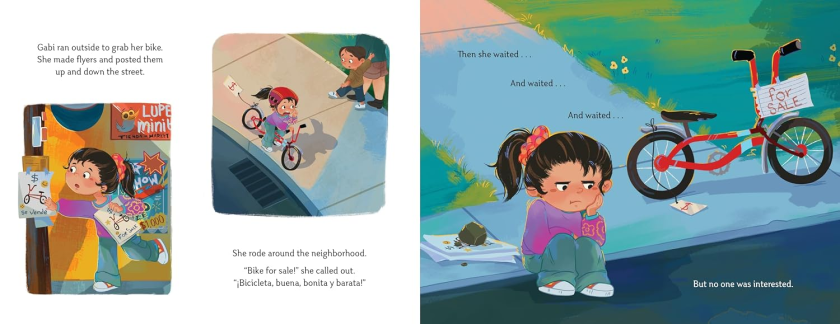
The memories of Gabi, Papi, and Abuelo working on Pico Nights, cruising together, attending Fourth of July parades, and celebrating family milestones were important because they showed the reader why Gabi was so attached to the car. Without those moments, her desperation to save Pico Nights wouldn’t have the same emotional weight.
But there were also plenty of things I left out. I had ideas for scenes and details that I loved, but if they didn’t add something to Gabi’s emotional journey, they had to go. One example was using the secret language of the Pachucos, known as Caló. Words like carucha (old car), órale (hey, right on, okay), símon (yes) were words old-school Pachucos would use, including my dad. I wanted to use these words because not only are many of them still used where I’m from, but they also remind me so much of my dad. Unfortunately, I ended up cutting most of them in earlier drafts because I realized that wasn’t something I wanted to focus on in this particular story. As much as I love those words, they weren’t serving Gabi’s story. I also learned to look for places where the illustrations could tell part of the story. I didn’t need to describe every detail I could see in my head. I wanted to leave room for Vanessa to interpret the story and add things I hadn’t imagined.
I didn’t include a lot of art notes in my manuscript for that same reason. In fact, my very first draft didn’t contain any art notes at all. Eventually, I did add a few, like when Abuelo is wearing his Marine Corps uniform in the parade. That was important because I mentioned in my author’s note that lowriders emerged when Mexican Americans men returning from WWII began fixing up old cars. Or when Abuelo is dressed in his Zoot Suit. That was important because he was once a Pachuco. So, not a lot of notes, because I wanted to give Vanessa room to bring her own vision to the story. There were certain cultural details that were important to me, especially details about lowriders, but I tried not to dictate how those things should look.
I think one of the hardest lessons for a picture book writer is learning that not everything you know about your story needs to be in the story. We have to be willing to leave things out, trust the illustrator to show what we don’t need to say, and trust our readers to fill in some of the blanks. Sometimes what you leave out is just as important as what you put on the page.
Cooper: Your author’s note is fabulously informative yet so much fun to read. Was including the author’s note your idea – did it appear in your original submission (in full or as a suggestion)- or did your agent or editor encourage it? However it came to be, please share some highlights here.
De La Cruz: Yes, Laura, the author’s note was my idea and was included in the original manuscript. I felt it was important to share a little more about lowriders and their history. Since lowriders are such an important part of my culture, I wanted readers to understand that they’re much more than customized cars. They represent creativity, craftsmanship, family, and community. I wanted to answer some of the questions I thought young readers might have after reading the story. How did lowriders come to be? What is cruising all about? Why do people say “low and slow” or “bajito y suavecito?” How do you make cars “hop and dance?” My hope is that after reading LOWRIDER FOR SALE, readers will be curious and want to learn more.
Cooper: How many submissions did you sent out before signing with your agent, Leah Pierre of Ladderbird Literary Agency, and did you originally set out to find an agent? It must feel like a dream to have your first picture book published by Disney Hyperion as well as your second picture book, BESOS FOR MAMI, which will launch in 2028. What can you share about these two sales, or what your experience has been on the publishing end – especially with choosing/working with your wonderfully gifted illustrator, Vanessa Morales?
Borrowed from Amazon:
Vanessa Morales is an illustrator + character designer/concept artist based in Mexico with a deep love for the nature, the whimsical and the fantasy.
Connect with her at www.phonemova.com
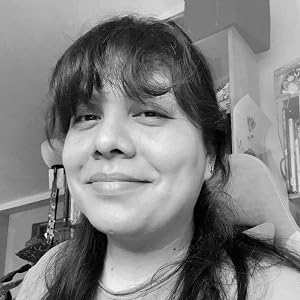
De La Cruz: Thank you, Laura! Let me tell you, Leah is absolutely awesome! She is encouraging, supportive, and best of all, she loves my work! Or at least that’s what she says. 😉 And to tell you the truth, Leah kind of fell into my lap. And yes, I was looking for an agent. But like most of us, I started querying too early. I found an agent I thought was my dream agent, and I sent her my query letter and a different manuscript. And of course, I received a rejection. That was a huge blow to my ego because I had convinced myself that she was going to love my story. But that didn’t happen. I continued to write, read, and critique, and a year later I queried the same agent again, this time with LOWRIDER FOR SALE. I thought—she’s going to love this one. Wrong! Another rejection. Then, in 2021, I queried her one more time, and guess what? Yup, you guessed it, another rejection! After that agent broke my heart, I submitted to a few other agents but only received more rejections.
Then I submitted the story to Natalie Lakosil, who said she loved it but didn’t have the bandwidth to take it on. But in the same response, she suggested I send my manuscript to her mentee, Leah Pierre. But now there was another problem: Leah was closed to submissions, and I didn’t have an email address for her. I was determined to get my manuscript to her, so I went to her website and sent her a message on Friday. By Monday morning, Leah responded and requested LOWRIDER FOR SALE. The next morning, I had an email in my inbox offering representation!!! At the same time, I had received another offer for representation from another agent, but went with Leah instead.
And yes, Laura, having Disney-Hyperion pick up LOWRIDER FOR SALE as well as offer me a two-book deal was a dream come true! My editor, Regan Winter, has been great to work with. She and I shared the same vision. And I couldn’t be happier! Regan fell in love with LOWRIDER FOR SALE and later on in the process, had me send her some of my other manuscripts. I believe I sent her two or three for her to choose from. Regan eventually selected BESOS FOR MAMI scheduled for release in March 2028.

The whole process has been interesting. There is a lot of hurry up and wait in this business. When it came time to find an illustrator, Regan asked me to put together a list of illustrators I could see working on this project. Regan’s team came up with a list as well. We looked at all the illustrators, and I gave Regan my choices. She then began contacting the illustrators’ agents. Some weren’t available, and the illustrator who was initially selected had to drop out due to illness. Eventually, Vanessa Morales’ agent was contacted, and we were told she was available and excited to work on the project!
At one point, Regan asked me to send her pictures of different items: lowrider cars, lowrider bikes, my dad, my husband’s uniform, etc. She was going to forward this to the illustrator. Throughout the project, Regan made me feel included. She consulted with me on a lot of the project. I received emails from Regan about even the smallest details, like, “Does Pico Nights, the lowrider, have a vanity plate? If so, what would it read?” These were the kinds of details that would make the book feel authentic. Regan really wanted this book to reflect lowrider art and culture and include as much detail as possible. I really appreciated that.
I did get to see sketches along the way, and Vanessa’s vision was very much in line with what I had imagined. In fact, she brought so much more to the story than I could have imagined on my own. Even though Vanessa didn’t grow up surrounded by lowrider culture, she did an incredible job of capturing the details, spirit, and feeling that were so important to me.
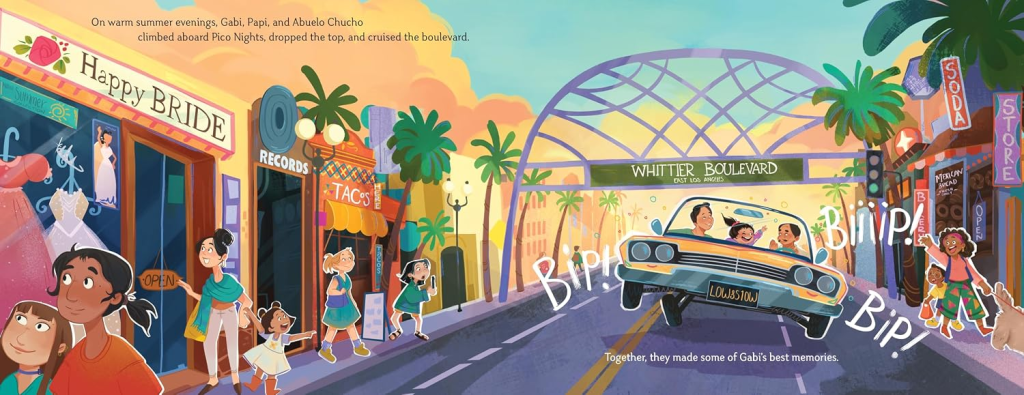
In the end, I was so happy and grateful to have been able to work with Vanessa. She did an amazing job. And now I have to share my favorite spread from the book: the sun setting in the beautiful Southern California sky, cruising down a palm tree-lined street with the top down. What could be better than that? Love it!
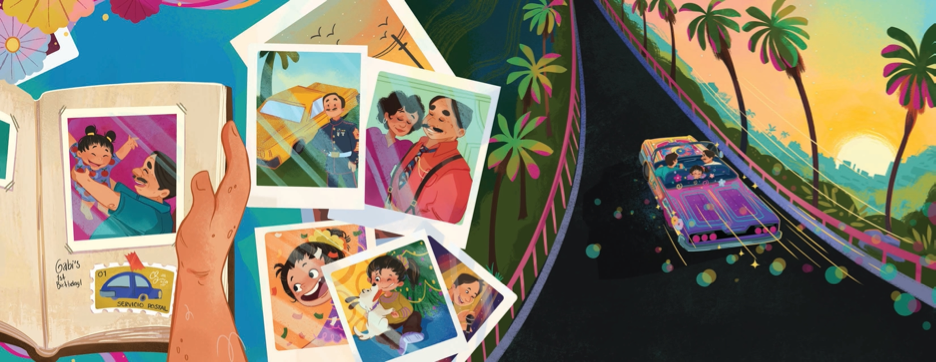
Cooper: This is my favorite spread, too! Thank you for sharing your road to finding the right agent and your lovely experience with Regan and Vanessa. What advice can you give to other writers hoping to make their first sale?
De La Cruz: My biggest piece of advice is to be persistent and patient. Don’t give up! Trying to get a book published is a long process, and rejection is simply part of the journey. LOWRIDER FOR SALE went through many, many revisions before it became the book it is today. When my agent and I first submitted LOWRIDER FOR SALE, I was excited. My agent, Leah, sent it out to about thirteen editors in our first round. As the rejections started coming in, I began to worry and doubt myself. I started thinking maybe the book just wasn’t going to sell.
Leah assured me that it was going to work out and reminded me that it was only the first round. l trusted Leah, and we went into the second round. Regan Winter at Disney-Hyperion received the manuscript on February 22. On March 13, she sent us an email letting me know she loved it, and by March 23, we had an offer!
My point is that this business is so subjective. You never know who will fall in love with your manuscript. You will most likely get rejections, and sometimes those rejections can be especially hard because an editor may have wonderful things to say about the manuscript and still pass on it.
I had editors tell me things like, “I love family stories and love seeing more Latinx rep in my inbox,” “As much as I love the themes and voice, this tugged at my heartstrings so much, and Laura nailed that young feeling of wanting to help without really knowing the next step,” and “I love seeing the family relationships in this story.” But the manuscript still wasn’t getting picked up. Some of the editors said it wasn’t a perfect fit for my list, they didn’t connect with the writing as much as they would have liked, they didn’t have a vision as to how to collaborate editorially, or they worried that lowrider culture was a little too niche.
Those comments were hard to hear, but they also taught me something important: a rejection doesn’t necessarily mean your manuscript isn’t good. Sometimes it simply means it wasn’t the right manuscript for that particular editor at that particular time.
So keep going. Keep revising, keep learning, and keep submitting. Remember, all you need is that one yes!
Cooper: A thousand times YES to everything you shared! The press release for BESOS FOR MAMI is darling and mouthwatering! Now I have to share your bio because it is extremely cool! As a fellow animal fanatic, I would love to see some dog and horse photos, too!
Laura De La Cruz is a Latina writer who specializes in picture books. She has worn many hats – author, mother, library media technician, Spanish preschool teacher, and teacher’s aide. Born in East LA and raised in the greater Los Angeles area, Laura now calls Austin, TX, home with her husband, three grown children, two dogs, and a horse. Laura writes heartfelt stories about family, home, food, and her own life experiences. She is passionate about creating stories where marginalized children can see themselves reflected on the page. She hopes readers enjoy her stories and connect with the characters she creates. Learn more and contact Laura at www.lauraadelacruz.com
De La Cruz: Ha! Well then, you’re going to get a kick out of this family Christmas Photo!
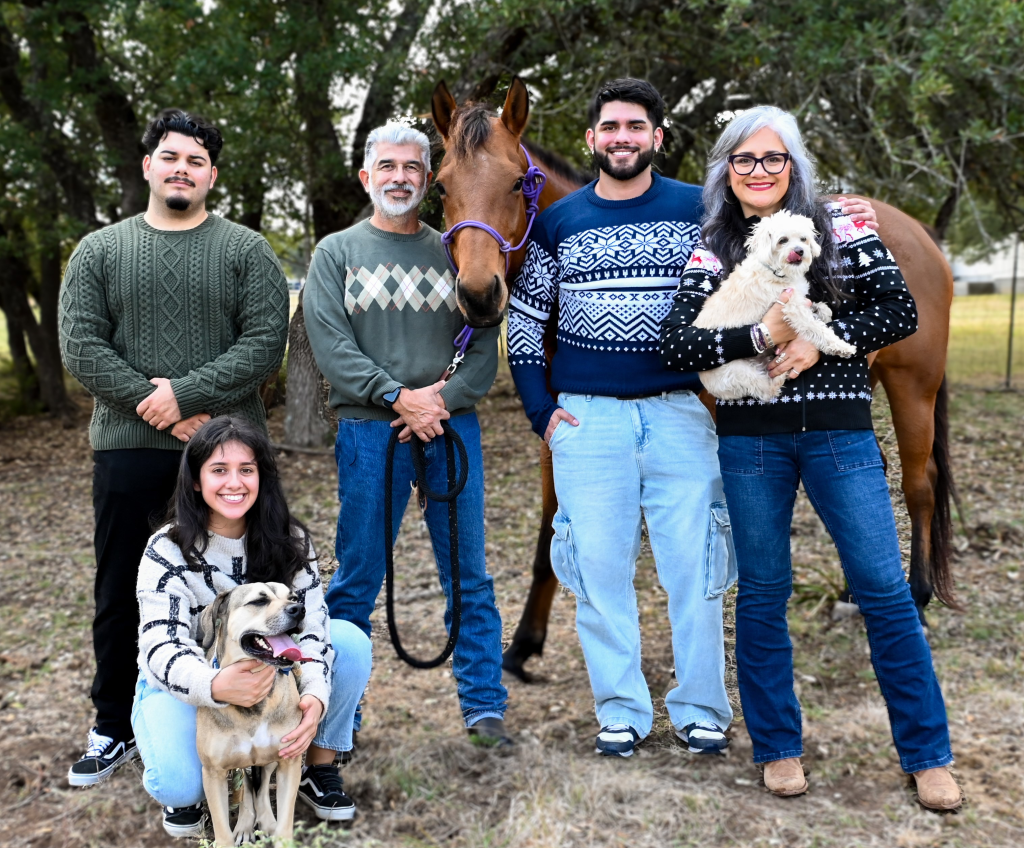
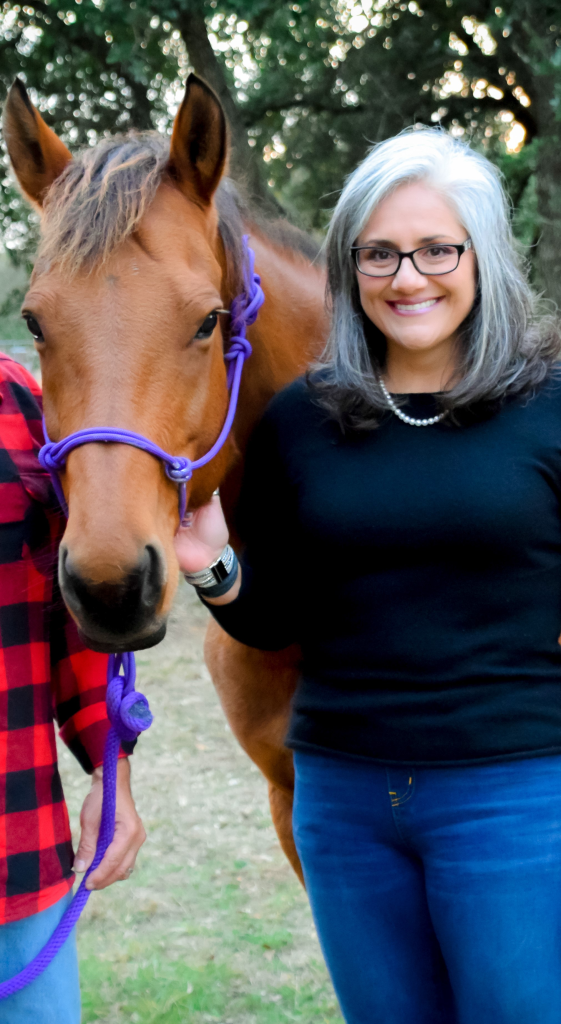
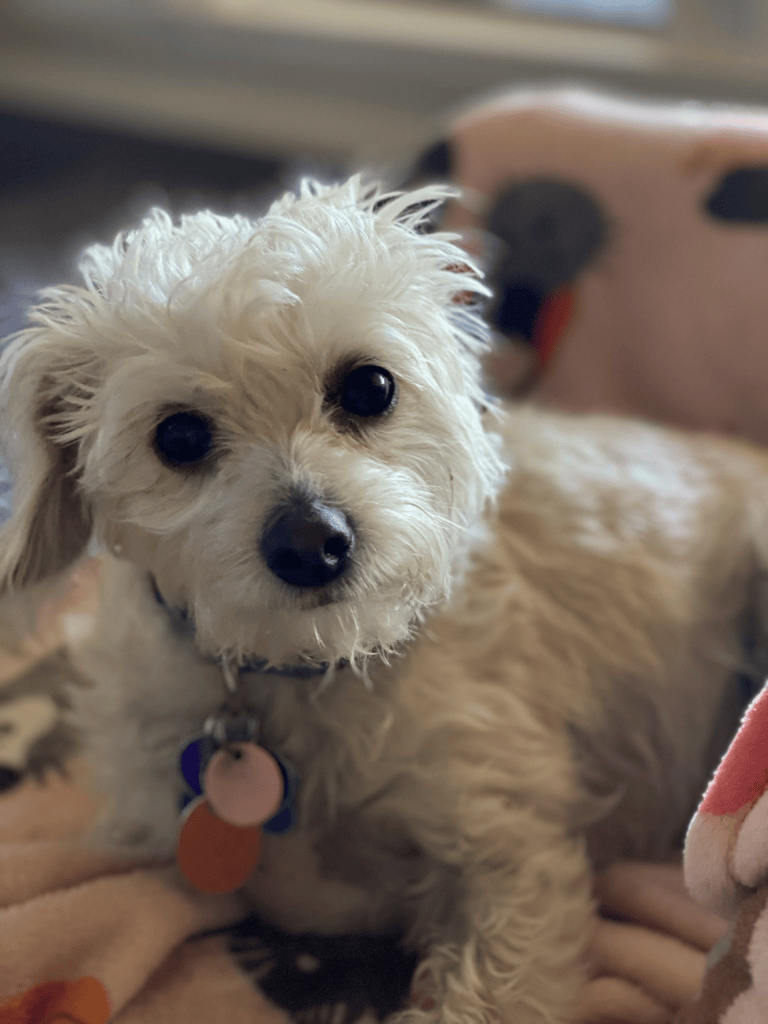
Cooper: What a beautiful family! I couldn’t resist adding two other photos you shared. A closeup of you with your horse Dolly and one of Eddie, your fluffy writing partner.
Thank you, Laura, for answering my questions with such depth and honesty. If you’re ever in the Boston area, I would love to connect in person!!
De La Cruz: That would be fantastic, Laura!!! Thank you so much for having me on your blog!
Cooper: Now for the moment you’ve all been waiting for: the raffle instructions! To earn a chance to win a gorgeous hardcover copy of LOWRIDER FOR SALE, please leave a comment below. The winner (U.S. addresses only) will be randomly chosen and notified on September 16th. Best wishes to you all!


What a wonderful interview! I loved hearing about your writing process. And it’s so comforting to hear that you got passed on a manuscript that is now out in the world! And with Disney Hyperion, no less! Congratulations, Laura, on this beautiful, heartwarming book that I absolutely adore!
LikeLiked by 1 person
*comforting to hear you got passes*
LikeLiked by 1 person
Thank you, friend!!!
LikeLike
I am so excited to receive e my copy! I just happen to come across this interview on social media and was immediately interested. I loved learning the background story to this book. Being a Mexican American myself I can relate to a lot that was mentioned. I cant wait to share this in my Elementary school libraries for Hispanic Heritage Month!
LikeLiked by 1 person
Thank yu so much, Delia, for reading this post!
LikeLike
Wonderful interview! Right from the start I was fascinated because I never knew there was a Spanish word for two people sharing the same first name–such fun.😃 All the information and pictures are very interesting, too. Lowrider for Sale looks like a great book! Congratulations and best wishes for your continued success!
LikeLiked by 1 person
Thank you so much, Macia! I glad you enjoyed the post!
LikeLike
Congratulations!! Loved learning about all the pieces that came together for the concept of your beautiful book, Laura!
LikeLiked by 1 person
Thank you so much, Armineh! I’m glad you enjoyed reading about how LOWRiDER FOR SALE came about.
LikeLike
I enjoyed the discussion about how this author decided what to include and what to leave out and up to the illustrator to show. This book looks vibrant and packed with emotion. Congratulations on a book I know readers will connect to.
LikeLiked by 1 person
Thank you so much, Danielle! I’m glad you enjoyed the post! And I hope you get a chance to read the book someday soon.
LikeLike
I’m super curious to read your fun new book after reading this interview. Thank you for sharing the backstory and your journey. Love the spark in Gabi’s eye!
LikeLiked by 1 person
Yay! I’m glad you found the post interesting, Claire! I hope you get a chance to read the book.
LikeLike
Thank you for sharing this wonderful post! Congratulations, Laura!
LikeLiked by 1 person
Thank you so much, Cathy! I was an amazing process!
LikeLike
Laura, what a wonderful sharing of culture and family story book. I also love that you centered the story around a lowrider! Love watching these cars bop and jiggle down the street – often with loud music accompaniment. Congratulations!
LikeLiked by 1 person
Thank you so much, Kate! I enjoyed writing this story so much!
LikeLike
Dear Kate,
Congratulations! You are the randomly chosen winner of the giveaway for this beautiful book!
Cheers!
Laura Cooper
LikeLike
Yay!!! Thanks again, Laura!!!
LikeLike
Wonderful! Thank you! And Laura De La Cruz – thank you for writing a fun book. Can’t wait to hold it and read all of it! Best, Kate
LikeLike
Yay!! Congratulations, Kate!!!
LikeLike
Congratulation, Laura! And thank you for sharing your story. What a lovely family you have!
LikeLiked by 1 person
Thank you so much, Rose! I’m glad you enjoyed the post.
LikeLike