
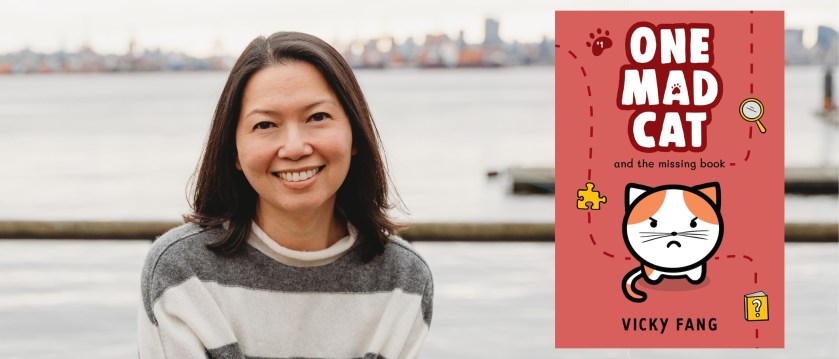
Guest Post by Vicki Fang
I recently launched my newest series, One Mad Cat. My publisher calls it a “graphic reader.” SLJ calls it an “early reader.” JLG calls it a “chapter book.” So what on earth is it? And does it even matter? I’m going to talk about the world of early readers, including the various formats, craft considerations, and pitching.

What is a transitional reader?
First up, let’s talk about the world of “transitional readers” which includes BOTH early readers and chapter books. It basically refers to the entire category of books that are designed to
- Transition new readers to reading independently
- Boost reading confidence
So what’s the difference between an early reader and a chapter book? Generally, early readers are designed to help kids learn to read, while chapter books help kids grow into reading longer text.
But it can get fuzzy! These categories can overlap, as they do with my One Mad Cat series. One Mad Cat is BOTH an early reader and a chapter book. As an early reader, the series encourages new readers with simple sentence structure, sight words, and repetition. With a slightly heftier chapter book format (at 64 pages instead of the standard 32), the series ALSO boosts reading confidence, by giving kids the sense of accomplishment of reading a longer book.
So how does one approach writing a book like this? How do you know what format to pursue? How do you ensure your writing will encourage and appeal to new readers? Can text-only authors succeed in this format? Let’s dive in.
Authors vs Author-illustrators
You do not need to be an author-illustrator to write in these categories. While there are many self-illustrated books in transitional readers, there are also plenty of collaborations. Some of my books are illustrated by other people, like Best Buddies (illustrated by Luisa Leal) and Layla and the Bots (illustrated by Christine Nishiyama).

As with any category, my advice to you is to get started by reading a lot of mentor texts.
Reading mentor texts
By reading lots of mentor texts, you’ll get a good idea of the vocabulary, story content, arc, characters, language, etc. It will also help you better understand the different publishers and their standards or guidelines. As you read, make note of particular publishers and if you find a format you like, dive into that one publisher’s format to gain familiarity with it. Often, I might have a specific publisher in mind while writing an early reader, and then my agent will sub more broadly depending who might also be a fit.
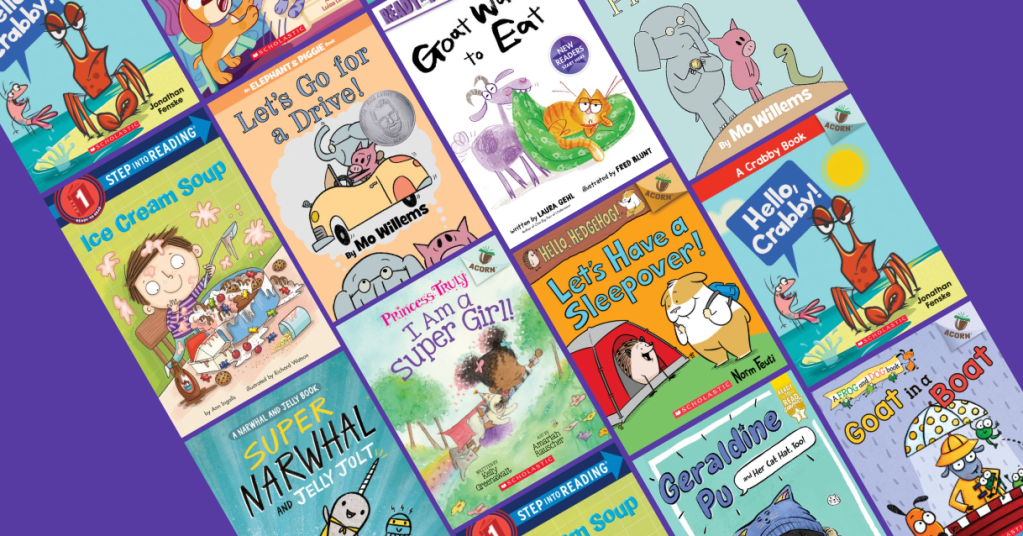
Suggested Exercise
Read 3+ mentor texts. Identify themes. What makes the character stand out? What’s the “hook” for the book? Make note of word count, use of repetition, sentence structure, vocabulary, and punctuation.
If you are looking for early reader mentor texts, here’s a list to get you started.
Some format examples
Let’s look at my existing early readers—they were all inspired by precedents that I could look at for format.
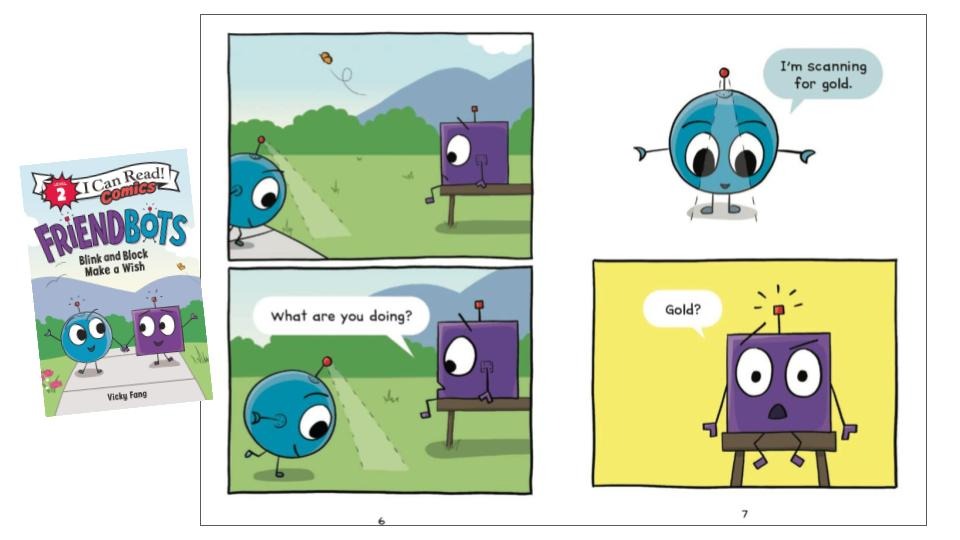
FRIENDBOTS: BLINK AND BLOCK MAKE A WISH | Credit: HarperAlley, ©2021 Vicky Fang
Friendbots was inspired by the Jelly and Narwhal comic panel format by Ben Canton. In fact, it was originally pitched as a 3-story compilation with robotics facts, just like Jelly and Narwhal, but HarperAlley bought them as standalone books, and I adjusted each to fit their format rules.
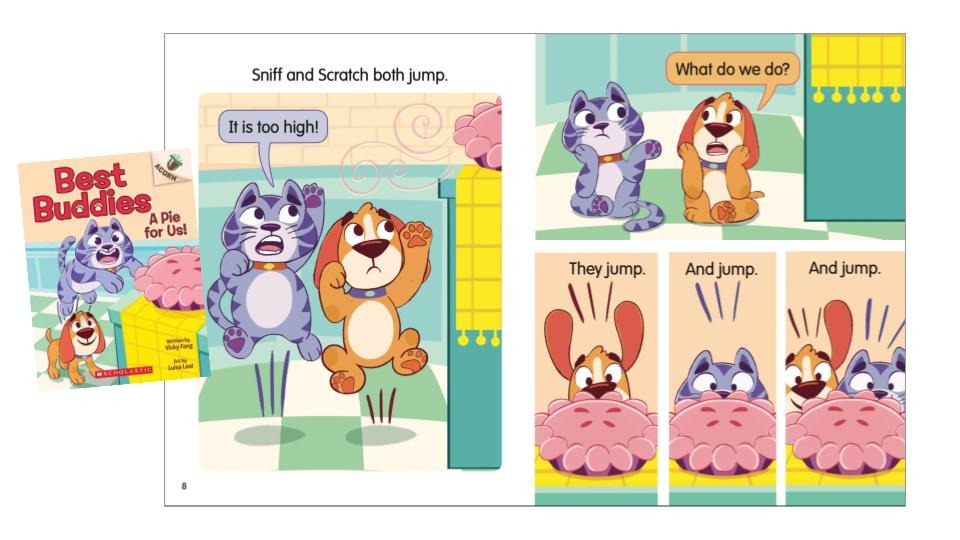
BEST BUDDIES: A PIE FOR US! (Credit: Scholastic, ©2023 Text by Vicky Fang, Illustrations by Luisa Leal)
Best Buddies and Layla and the Bots were specifically designed for the Scholastic Acorn/Branches lines in a fully illustrated format, mixing small bits of prose with lots of graphic novel elements. I submitted these exclusively, modeled after their books.

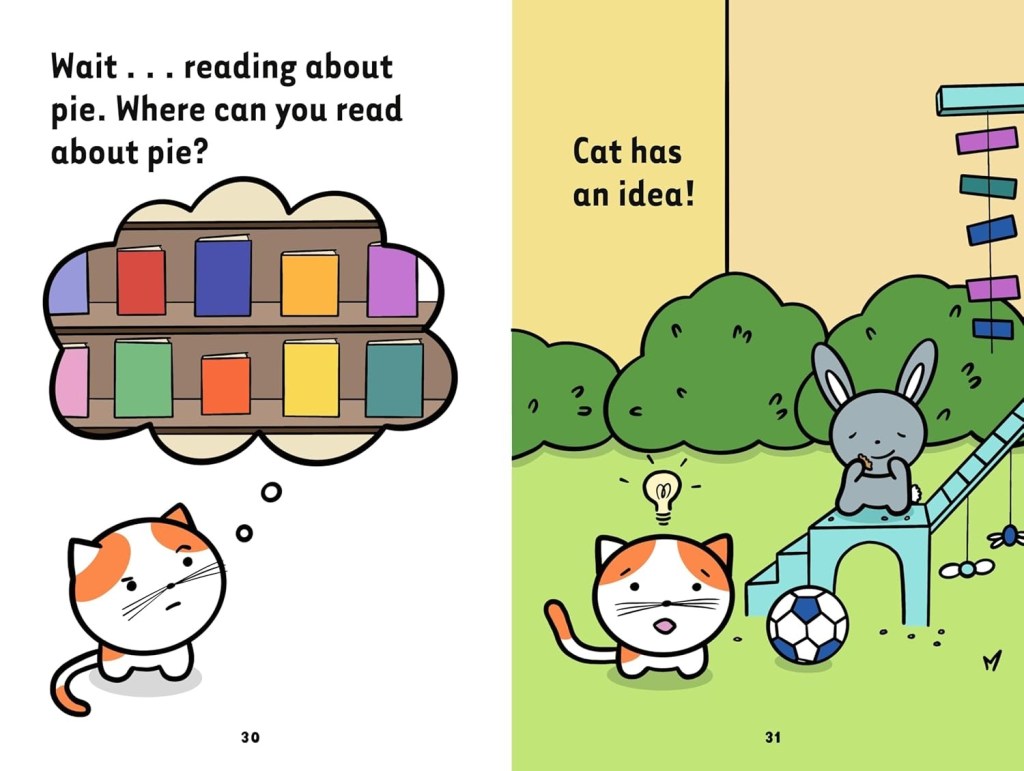
ONE MAD CAT AND THE MISSING BOOK | Credit: Candlewick Press, ©2026 Vicky Fang
One Mad Cat is both an early reader (designed to help kids learn to read) AND a chapter book (at sixty-four pages with six short chapters.) It is also a fully illustrated graphic reader (mixing prose and graphic novel elements together.) The format for these books was inspired by Scaredy Squirrel by Melanie Watts and the Jack books by Mac Barnett and Greg Pizzoli. I love the strong graphic quality of these series with accessible text for new readers and longer page counts.
As you can see, I found inspiration from mentor texts with every story and leaned into different formats within the early reader category. Much like choosing to write in first or third person, I choose the format based on the voice of the story that I’m writing. Maybe I want a dry narrator like in One Mad Cat. Maybe I want only character voices like in Friendbots. You’ll have to find the format that fits the tone of the story you want to tell.
Writing for new readers
When it comes to writing early readers, you will want to be meticulous with the language you use. At the most basic level, you want to keep things simple. You’ll want to be thinking about vocabulary and sentence structure. Digging deeper, especially for early readers, some publishers have stricter guidelines, with focus on repeated sounds and phonics. Some publishers will not allow certain punctuation or contractions (“I am” -> “I’m”.) When you sign on with a publisher, they will often have literacy experts and guidelines that they use to help ensure your text fits their requirements.
This sounds scary, but it’s not! Again, this is where the mentor texts come in handy. If you read a bunch of books at the level you have in mind, you’ll get a feel for what kind of language is appropriate. If you read a bunch of books from a particular publisher, you’ll get a sense of what their specific approach is.
Tell a great story
On top of the language considerations, you must tell a great story!
I often think of early readers as little word puzzles, because you’re so restricted in word count and vocabulary, yet you still need to tell a great story. Plus, you’re trying to establish rhythm and repetition and patterns with the words.
These are the elements I keep in mind when drafting an early reader:
- Early readers are like skits/vignettes. Short, simple, stories with punch.
- Think visually. Your narrative should support compelling illustrations to drive interest.
- If you include dialogue, use clear voices with short, simple sentences.
- Like any good story, your ending should be unexpected, but inevitable.
- Use humor! (Humor is a great way to encourage new readers to keep on reading.)
For One Mad Cat, the story idea was inspired by my love of puzzles and my kid’s struggle with anxiety (which I also recognized in myself as I started writing.) The humor and heart came naturally, from a super cute but irritated Cat navigating lots of annoying things to help solve mysteries for her friends.
ONE MAD CAT AND THE MISSING BOOK | Credit: Candlewick Press, ©2026 Vicky Fang
As you move into books for readers that are growing in confidence, you have more leeway to play with language and complexity. This is also why many early reader lines have different “levels” to their readers. You’ll work with your editor to figure out the right level for the language.
Pitching a transitional reader
For early reader manuscripts, even fully/heavily illustrated ones, I use the same format that I do for picture books. I do not specify pages or panels. For One Mad Cat and the Missing Book, I did not know what the final page count would be. Once the text was acquired, my editor provided the suggested page count.
I follow that manuscript formatting for books where I am author-only and when I am illustrating. If I am pitching to illustrate, I will also include a full color dummy of the first chapter.
As with any of my series pitches, I include the following:
- Pitch (developed with my agent):
- Synopsis for Book 1
- Synopses for two additional books
- Dummy of the first two chapters
- Bio
(For a full behind the scenes look at my process and a peek at a sample from my pitch for One Mad Cat, you can read my post on Kidlit Survival Guide.)
That’s it from me!
Go forth and write some transitional readers!
Some of the content in this post was pulled from my posts on Writing Early Readers and Writing Chapter Books on Kidlit Survival Guide.
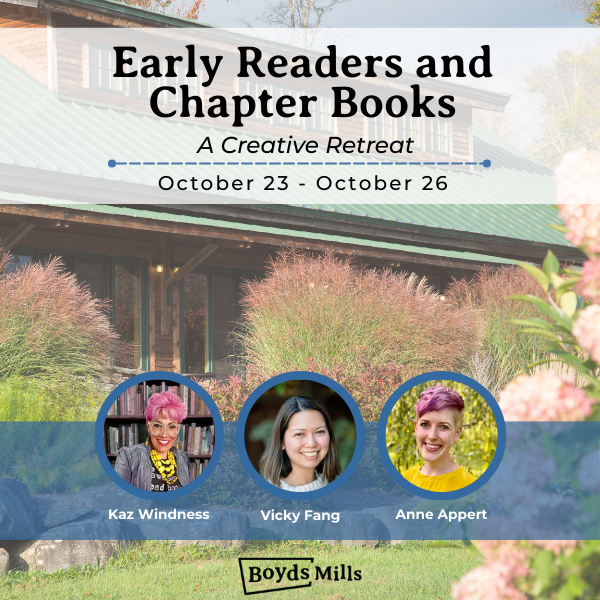
If you want an in-person deep dive into the topic, join Kaz Windness, Anne Appert, and me at an in-person workshop at Boyds Mills this fall.
And go get a copy of One Mad Cat and the Missing Book, anywhere books are sold!
https://vickyfang.com/books/one-mad-cat


Great post, Vicky! Thanks for sharing your expertise. Congratulations on One Mad Cat. It looks adorable!
LikeLike
What a helpful post! Thanks, Vicki! Wishing you continued success in all things #kidlit!
LikeLike
Great post, Vicky! Thank you!
LikeLike
Thank you for this very enlightening post and mentor text suggestions. Very helpful!
LikeLike
Vicky, Thank you for this thorough look at early readers and chapter books – a fine line indeed. I’ve always thought I’d be a natural for this genre because of my first career as a speech-language pathologist, guiding children to accurate speech and language use. But it’s not so easy as just knowing that ‘stuff.’ I love watching young children grasp the concept of reading. I’m not totally throwing in the towel yet! Thanks for creating books that bring children joy!
LikeLiked by 1 person